WordPress database error: [DELETE command denied to user 'sala-manca'@'localhost' for table `sala_manca_net`.`wp_options`]
DELETE FROM `wp_options` WHERE `option_name` = '_site_transient_wp_theme_files_patterns-3e81fb819c0831df69203ee558a709b9'

WordPress database error: [DELETE command denied to user 'sala-manca'@'localhost' for table `sala_manca_net`.`wp_options`]
DELETE FROM `wp_options` WHERE `option_name` = '_site_transient_timeout_wp_theme_files_patterns-3e81fb819c0831df69203ee558a709b9'

WordPress database error: [INSERT, UPDATE command denied to user 'sala-manca'@'localhost' for table `sala_manca_net`.`wp_options`]
INSERT INTO `wp_options` (`option_name`, `option_value`, `autoload`) VALUES ('_site_transient_timeout_wp_theme_files_patterns-3e81fb819c0831df69203ee558a709b9', '1792702757', 'off') ON DUPLICATE KEY UPDATE `option_name` = VALUES(`option_name`), `option_value` = VALUES(`option_value`), `autoload` = VALUES(`autoload`)

WordPress database error: [INSERT, UPDATE command denied to user 'sala-manca'@'localhost' for table `sala_manca_net`.`wp_options`]
INSERT INTO `wp_options` (`option_name`, `option_value`, `autoload`) VALUES ('_site_transient_wp_theme_files_patterns-3e81fb819c0831df69203ee558a709b9', 'a:2:{s:7:\"version\";s:3:\"4.0\";s:8:\"patterns\";a:0:{}}', 'off') ON DUPLICATE KEY UPDATE `option_name` = VALUES(`option_name`), `option_value` = VALUES(`option_value`), `autoload` = VALUES(`autoload`)

WordPress database error: [INSERT, UPDATE command denied to user 'sala-manca'@'localhost' for table `sala_manca_net`.`wp_options`]
INSERT INTO `wp_options` (`option_name`, `option_value`, `autoload`) VALUES ('_transient_doing_cron', '1792700957.7735650539398193359375', 'on') ON DUPLICATE KEY UPDATE `option_name` = VALUES(`option_name`), `option_value` = VALUES(`option_value`), `autoload` = VALUES(`autoload`)

salamanca – Sala-Manca

Yiddish Silence – A Puppet’s reconstruction of an Academic Lecture in the frame of Mame-Loshn show, Labyrinth Gallery, Lublin

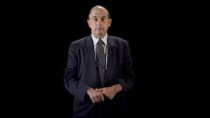
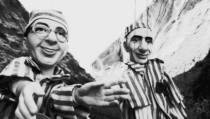
A reconstruction by the Sala-manca’s puppets group of one of Diego Rotman’s lecture on Dzigan and Shumacher. The film is beign exhibited as part of the Mame-Loshn exhibition at the Labyrinth Gallery, Lublin, Poland, curated by Drorit Gur Arie and Tal Schwartz.

A project by the Sala-manca Group (Lea Mauas and Diego Rotman) in collaboration with Ayelen Coccoz (puppets and painting of Sala-manca’s puppets).

Natalia Rozenthal (painting of Dzigan and Shumacher puppets), Yeshaiahu Rabinowitz (Clothes), Adi Kaplan and Shachar Carmel (paintings),  Dan Lahiani

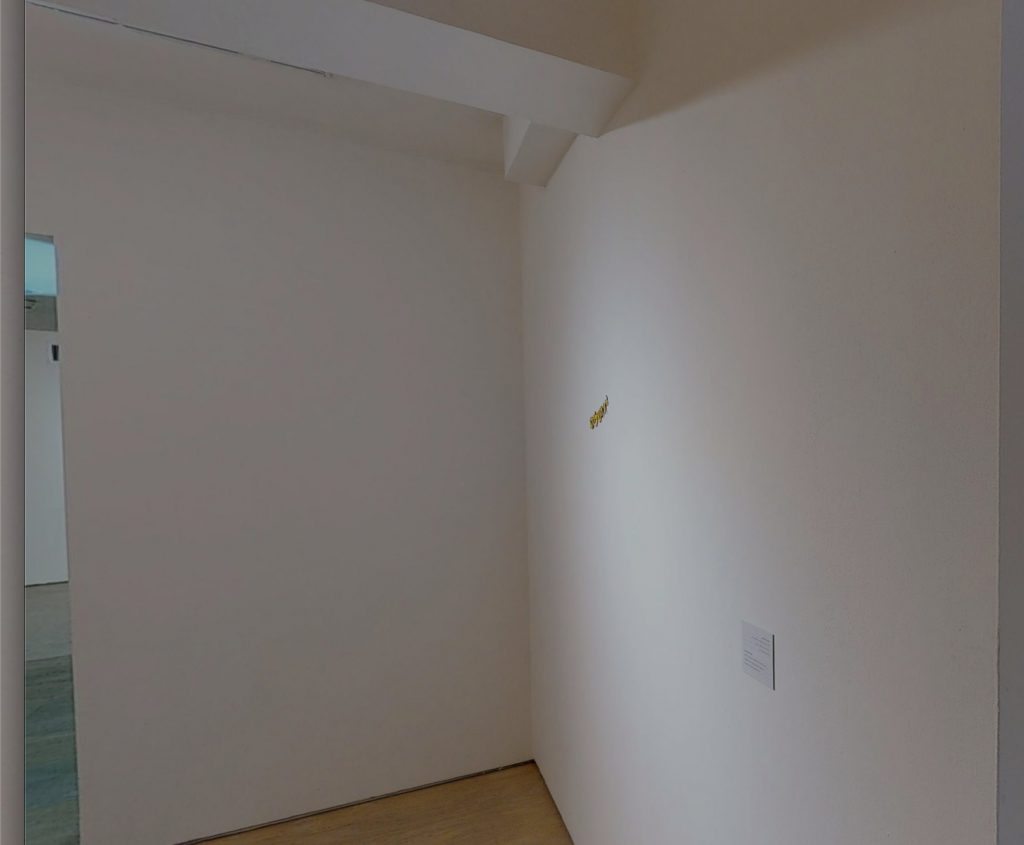
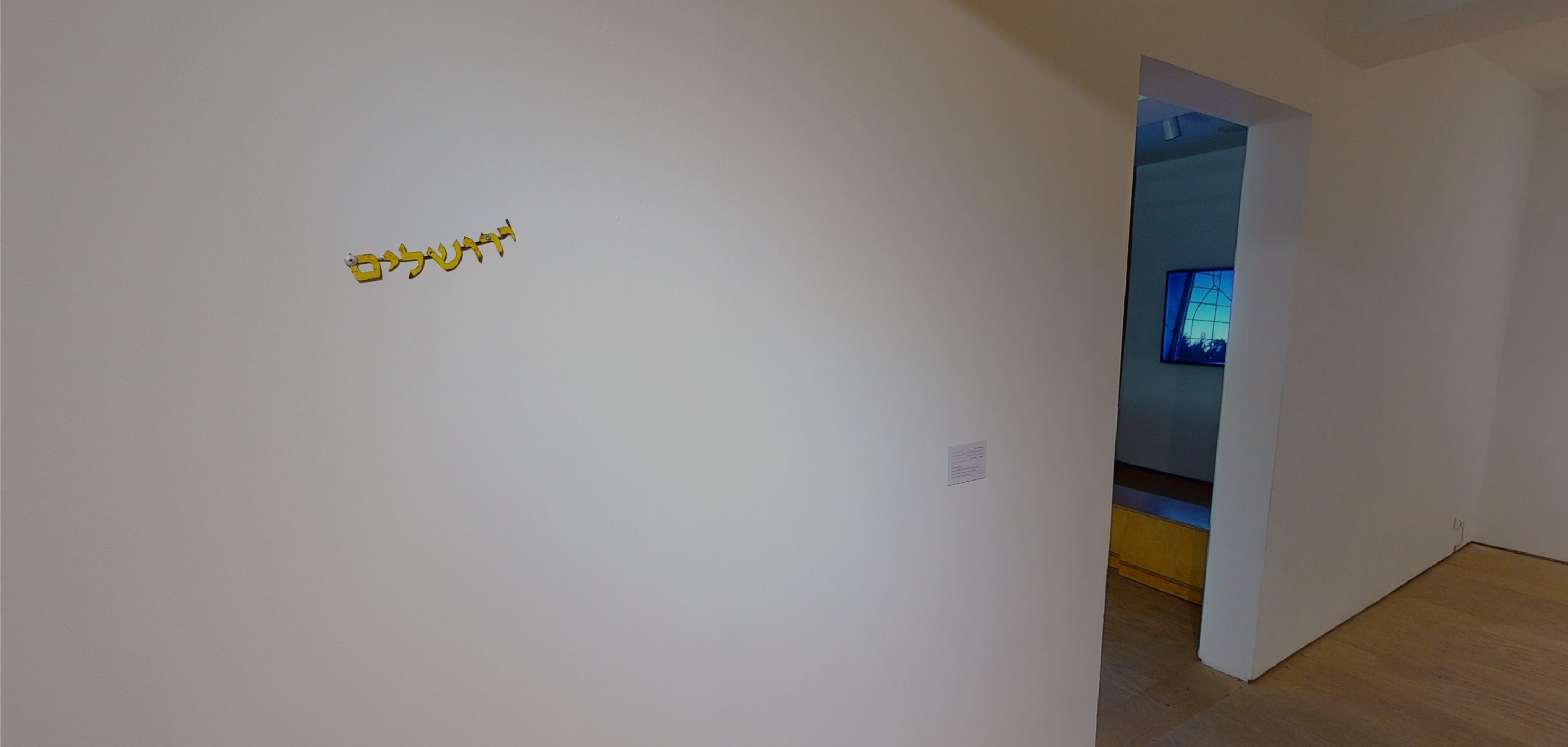
“Jerusalem” at the Tel Aviv Museum of Art

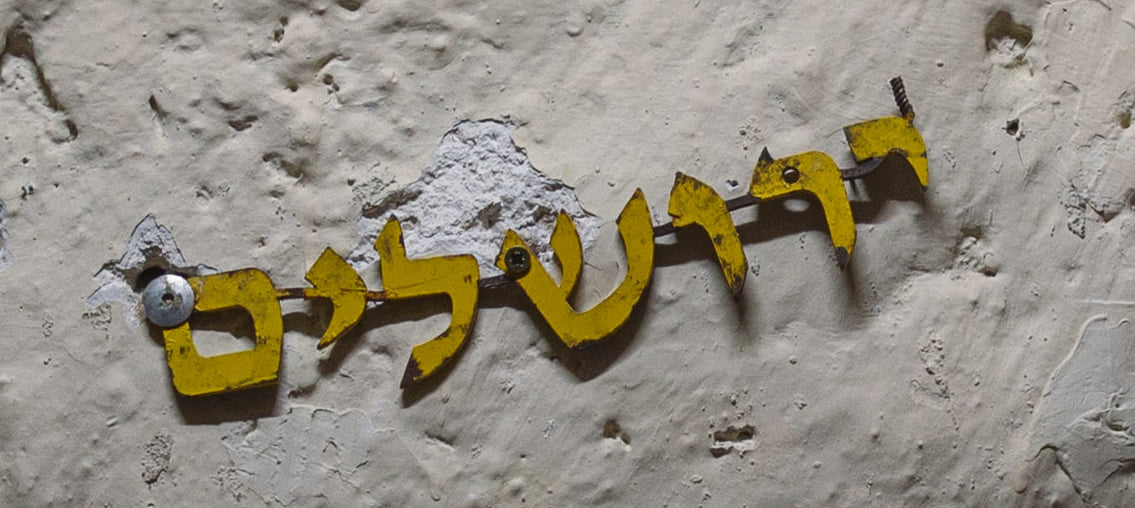
“Jerusalem” a work by Sala-manca (Lea Mauas and Diego Rotman) at “Skein: New Acquisitions for the Bruce and Ruth Rappaport Israeli Art Collection”

Curation: Dalit Matatyahu Assistant Curator: Amit Shemma, 13/8/21​-​31/12/21

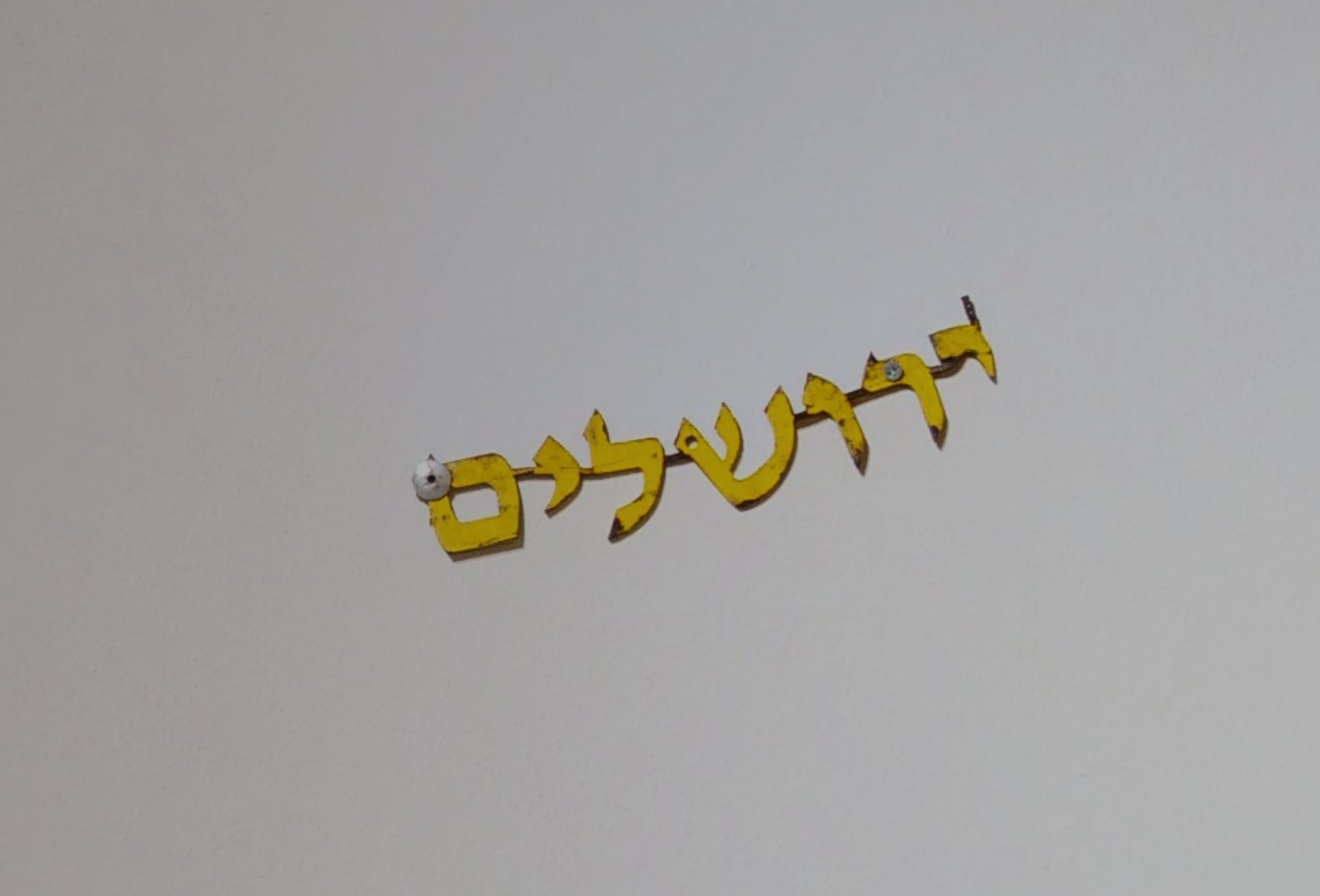
Jerusalem (2019) | Sala-manca

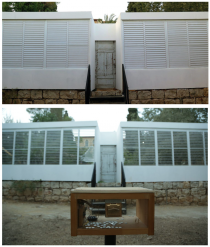
Iron sign from a garbage municipal container at Mishmarot st, Musrara, Jerusalem.

This exhibition marks a significant moment in an extensive acquisition of works by Israeli artists for the permanent collection of Tel Aviv Museum of Art. The Israeli art collection is an accumulation of works assembled from the moment the Museum was founded to the present, and their varying exhibition over the years reflects the different perceptions of them. The collection’s historical scope depicts a wide view of an archival and conservational project, both symbolical and real.

New Film: “Tearing Down Walls”by Solly Elfaks, about the Course “Art, Activism and Public Space”

Link to the film

The film documents, reviews, and describes the legendary course, “Art and Activism in the Public Space,” at the Bezalel Academy of Art and Design in Jerusalem. For a decade, Solly Elfaks follows art activism projects that are collaborations between art students and residents of the Gonnenim/Katamonim neighborhood in Jerusalem, in the struggle to save the Train Track Park. The projects include creating an alternative to the planned highway, interventions in the public space, bringing down walls, and the design and construction of street libraries which operate 24/7 and have become a Jerusalem neighborhood icon. The film comprises documentation of work processes and outcomes, interviews with lecturers and students at the art academy and with residents of the neighborhood directly affected and of the adjacent Arab neighborhood of Beit Safafa. It poses questions about the relationships between the academic world and the community, art and activism, and the right to public space as part of the struggle for equal rights and to help communities to make their voices heard.

Exposición de Sala-Manca celebrando 20 años, por Chiquita Levov

“Residencia permanente” es una nueva exposición en el Beit Hansen, que surgió tras el viaje de los miembros del grupo Sala-Manca a una larga estadía en la provincia de Ontario en Canadá y su posterior regreso a la realidad israelí aproximadamente un año después. La muestra marca los 20 años de actividad de este innovador grupo independiente de Jerusalén, cuyos miembros son una pareja de artistas nacidos en Buenos Aires.[…]

Link

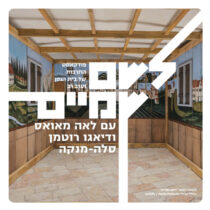
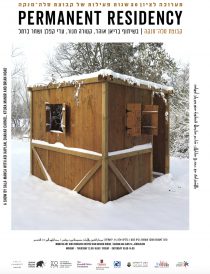
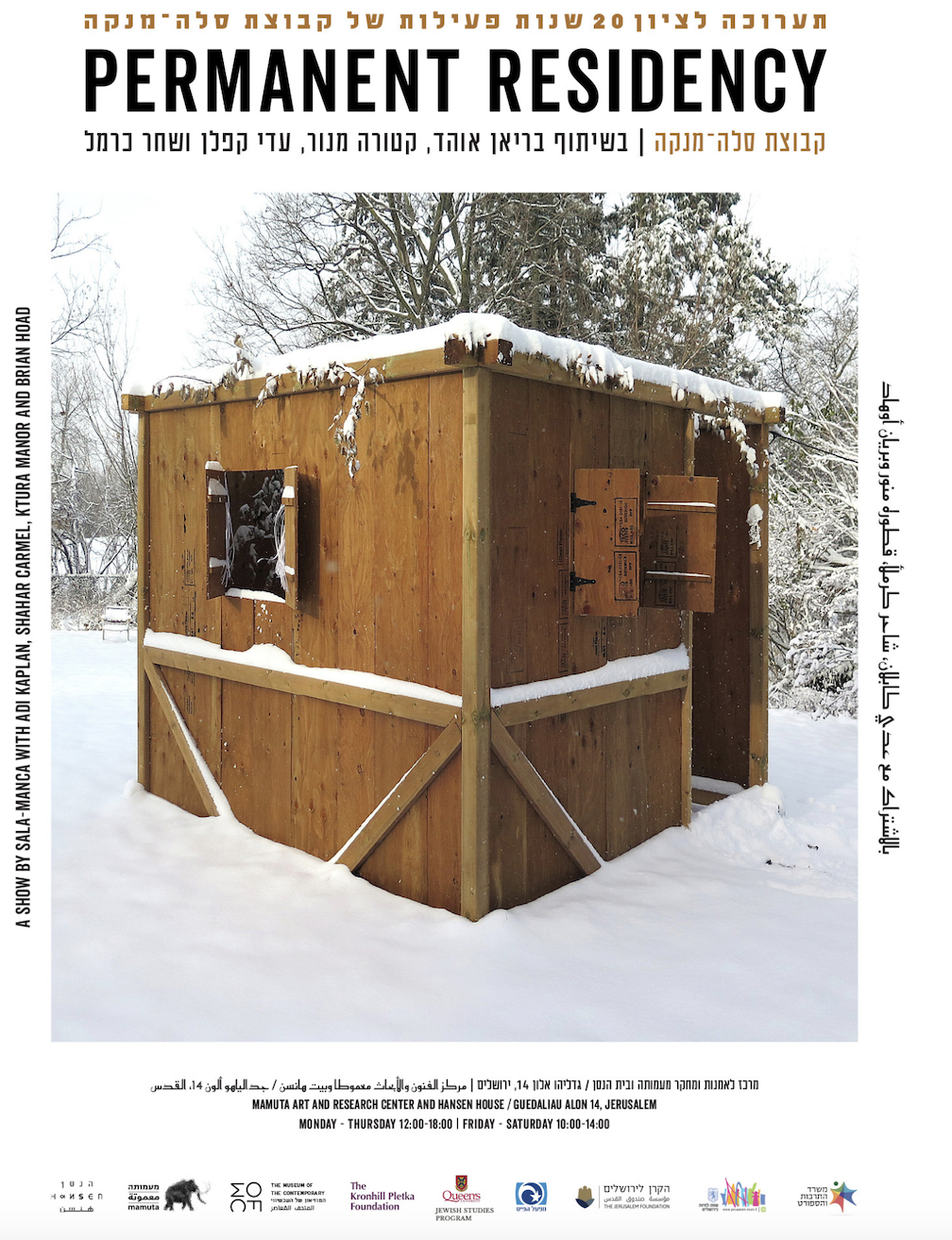
Permanent Residency | New show by Sala-manca in collaboration with Adi Kaplan, Shahar Carmel, Ktura Manor and Brian Hoad

Link to the website: https://museumofthecontemporary.com/

20 years of the Sala-Manca Group
Permanent Residency
An exhibit with footnotes and performative actions
with the collaboration of Adi Kaplan and Shahar Carmel, Ktura Manor and Brian Hoad
Hansen House and Mamuta Art & Research Center
Over the past six years we have acquired, dismantled, assembled, and transported various temporary structures, created unauthorized replicas, searched for doubles of ourselves, and relocated our home in our search for a temporary homeland. In August 2018 we moved to Canada for an indefinite period of time, to continue this search.We began the transition with a garage sale to sell off our personal objects, as our departure approached; the sale took the form of an exhibit at the Kfar Saba Urban Gallery and explored the connection between economy, art, and life (the video Garage Sale is a documentation of the opening of the exhibit).
In Kingston, Ontario, we rented the only furnished house we could find. The Sobermans, the owners of the house, had died at the beginning of the previous decade, and their children had put the home up for long-term rental “as-is” — a kind of “family museum,” with a 1960s decor, just as their parents had left it. We lived in the house for a year, inside the set of another family. A video work in the exhibition (Permanent Residency 1) documents fragments of day-to-day family life in Kingston: our children’s cultural acclimation, forays out into nature, and musings about migration and identity.
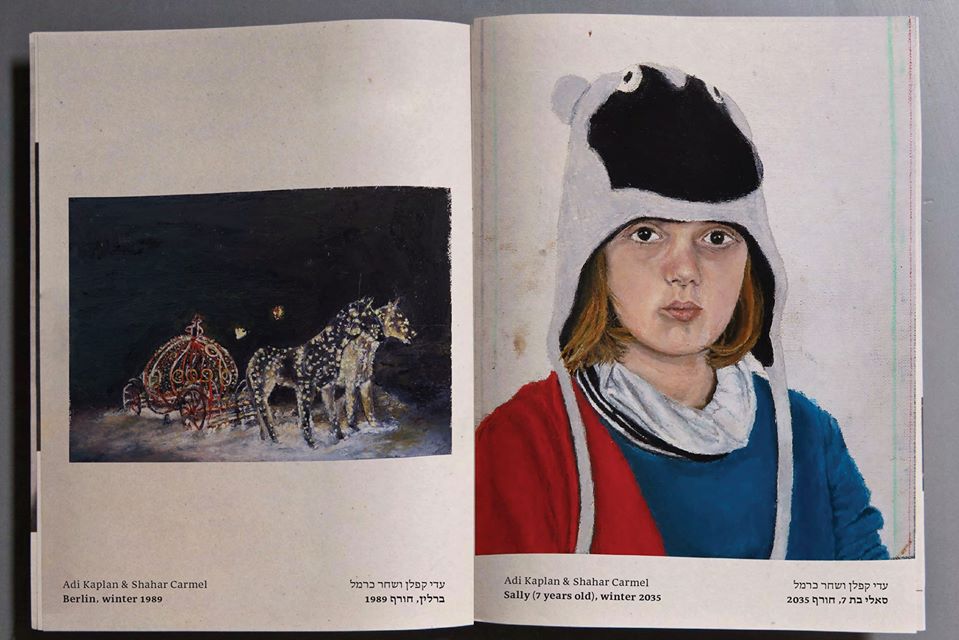
The Soberman’s art collection included more than 40 paintings — mostly reproductions of well-known artworks, and some originals by non-canonical artists. When we returned to Israel, we commissioned Adi Kaplan and Shahar Carmel to reproduce the paintings from the collection, down to their frames. The new collection (the Soberman Collection) will become one of the permanent exhibits of the Museum of the Contemporary, of which we are the curators. In the present exhibition the Soberman Collection is presented in the framework of an installation reproducing the Soberman family living room. The installation also includes a piano, which our daughter will practice on occasionally during the exhibition opening.
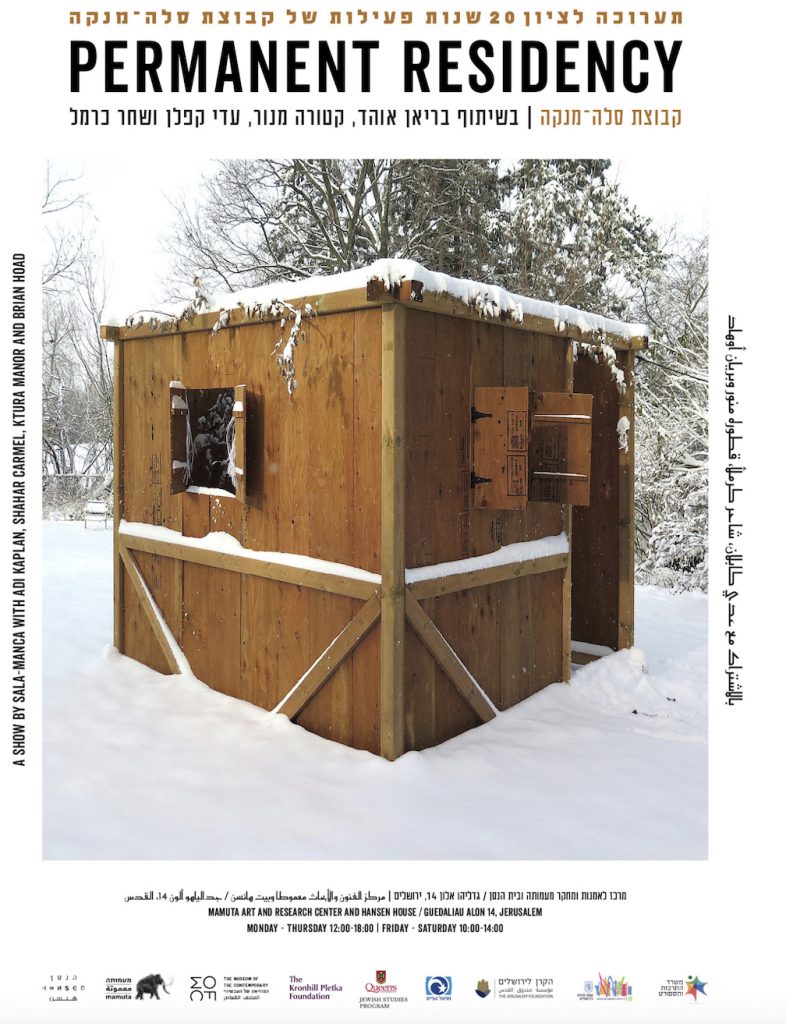
Approaching the Jewish holiday of Sukkot, near the beginning of our time in Kingston, we built a Sukkah in the yard. Contrary to the custom of dismantling the Sukkah after the end of the holiday, we left our Sukkah standing throughout the entire year, exposed to the extreme changes in weather. At the end of the winter we invited Canadian painter Brian Hoad to paint the snowy landscape on the walls of the Sukkah and thus to commemorate the frozen Lake Ontario on the wall traditionally designated for an image of Jerusalem. We shipped the Sukkah with the Canadian landscapes to Jerusalem as a Gazebo, in order to install it as an ethnographic object (The Kingston Sukkah) at Hansen House, alongside the source of its inspiration: a replica of the german Deller Sukkah (1840-2017). This time we commissioned Ktura Manor to build a smaller replica of the Kingston Sukkah for the collection of the Museum of the Contemporary.
Additional works from the Ethnographic Department of the Museum of the Contemporary are presented as a “footnote” to the new works: A Geography of Cracks (documentary film, Sala-manca, 2017); Deller Sukkah (replica, Sala-manca, Ktura Manor, and Nir Yahalom, 2017); Eternal Shabbes candlesticks (object, Samuel Rotman, 1998); Deller Sukkah model (Adi Kaplan and Shahar Carmel, 2017), Eternal Sukkah model  (Ktura Manor, 2017), Eternal Sukkah – documentation (short film, Sala-manca, 2018); Amulets from the Tawfiq Kna’an Collection (Yishayahu Rabinovitch, 2014); Heim (Short film, Adi Kaplan and Shahar Carmel, 2014); Curators (Wall painting, Itamar Mendes-Flohr, 2019); Jerusalem (Ready-made, Sala-manca, 2019).
Lea and Diego (Sala-manca Group)
The exhibit was made possible thanks to the generous support of the Pais Cultural Council, Hansen House, the Ministry of Culture, the Jerusalem Foundation, the Jewish Studies Program and Cultural Studies Program at Queen’s University in Ontario, The Regina Rosen Visiting Artist Fellowship – Queen’s University, the Jerusalem Municipality, Rose Ostrovsky and the Kronhill-Pletka Foundation.
Pulke’s Visit (2004/2020) (video work)

Pulke’s visit (a sculptor by Pesach Slabosky z”l) at the Sala-Manca’s house in Nachlaot in 2004,  his chance to encounter a rooster and  his first visit to the Israel Museum . The materials were filmed in 2004 and we edited them for the first time in honor of the exhibition “The Story of Pesach” in honor of Pesach Slabosky curated by  Naomi Tenhaus and Uri Holben, Barbur  Gallery and Koresh 14.
https://barbur.org/new-exhibition-opening-the-story-of-pesach/

Hearat Shulaym Art Journal – Issue 13 – April 2020

New Issue of Hearat Shulaym Independent Art Journal edited independently by Sala-manca.

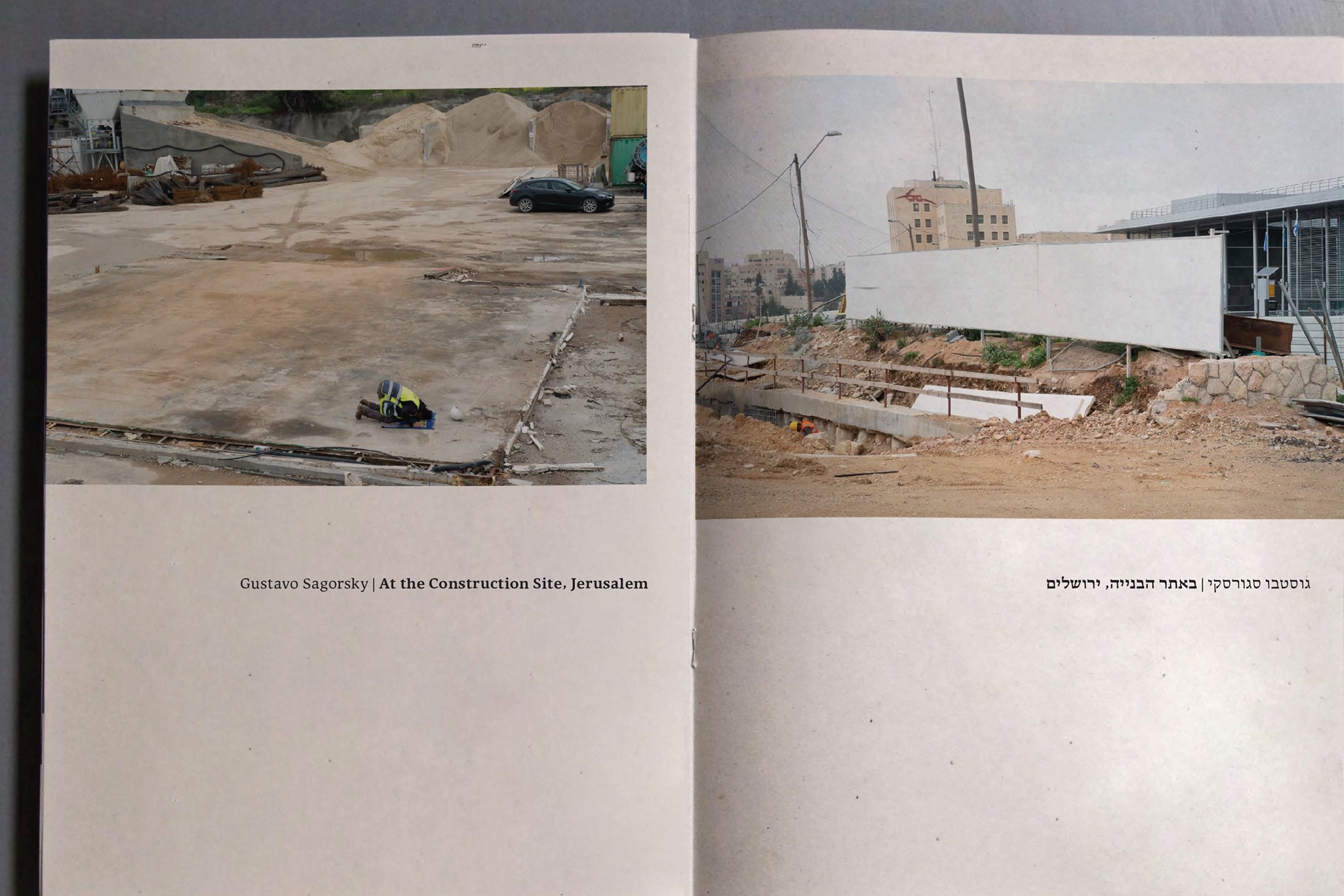
The issue was produce during the Covid-19 isolation time (April 2020) with contributions by (unfinished list) :Shoshke Engelmayer, Rotem Engelmayer, Tal Mor Sinai, Josef Sprinzak, Merav Shinn Ben-Alon, Ofri Cnaani, Gilad Meiri, Sagit Mezamer, Gustavo Sagorsky, Nino Biniashvilli, Adi Kaplan and Shahar Carmel, Ira Shalit and Galit Hasan-Rokem.

Link to read the journal on-line

Link to the PDF

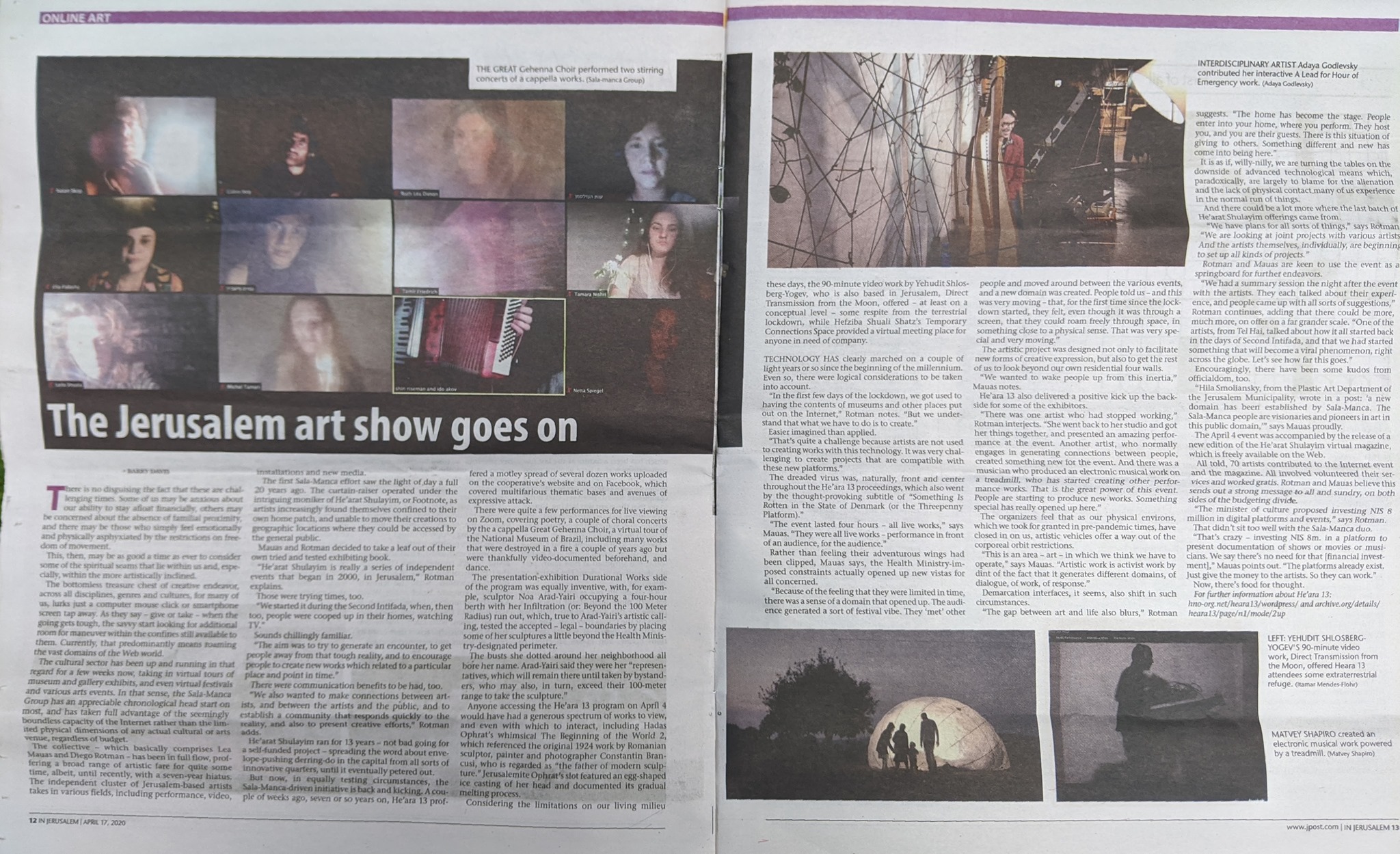
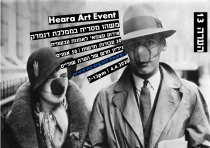
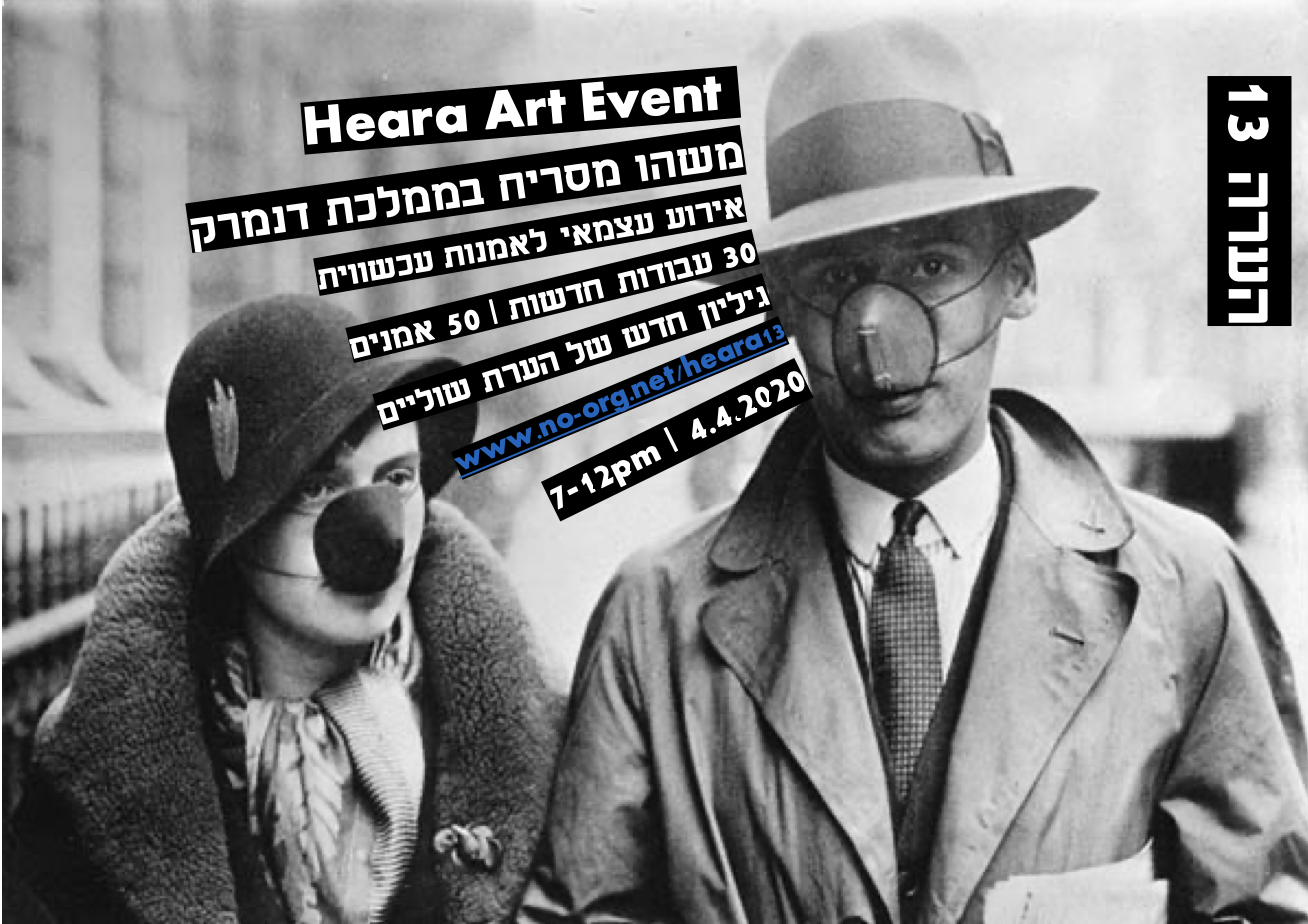
Heara 13: Something is Rotten in the State of Denmark (or the Threepenny Platform)

Heara 13: Something is Rotten in the State of Denmark (or a Threepenny Platform)

“From Zion will emerge the DictaTorah (Dzigan and Schumacher,1956)

Since the first event in 2001, the aim of Heara [Comment] events (multidisciplinary independent events for contemporary art) was to meet among new trends on art, artists and public, through the creation of alternative ways of art exhibition and creation from those that the artistic mainstream institutions propose. The Heara events were critical site and time specific events.

In these days, in which a virus is defined as terrorist and we all become rhetorical and practical potential terrorists, we seek to create a different discourse, a new platform and new and alternative hope through common action.
Heara 13 is also an independent response to the decision of the Minister of Culture from the 17th of March to invest 8 million NS in a digital platform, instead of to support artists.

Heara13 comes to offer a conversational space that forms, imagines and creates a rhetoric, visual and ideological alternative to that which the government offers us. This platform will enable meeting, discussion, support and creation of new content that responds to current reality. Heara13 will take place in a virtual space, both safe and sensitive and problematic.

We want to create a new space where we can meet in the times when the public space is being taken from us, when the freedom of speech is being under threat, when the distribution of [money] is being less and less equal, all done in the name of our security and our health. We can also find union in isolation and power in moments of weakness, hope in time of despair.

Heara 13 is not only done for fun, is done for change, organized and produced in the last two weeks.

Please feel free to take a copy of a new issue of our Hearat Shulaym Art Journal, a response to an urgent call two weeks ago. The event is for free, but you are welcome to donate to any of the organizations listed.

The Sala-manca Group & all the participating artists

To the EVENT and DOCUMANTATION

Review by Berry Davis

That We’ve Forgotten The Rain by Itamar Mendes-Flohr (curation)

Itamar Mendes-Flohr

Curators: Sala-Manca Group

That we’ve forgotten the rain / we recall only when it rains / and there’s no longer any point in discovering what’s been forgotten / and grieving its absence” (Joao Delgado)

The conceptual point of departure for Itamar Mendes-Flohr’s first solo exhibit is the water cisterns at Hansen House in Jerusalem. These cisterns served from the early days of the Jesus Hilfe Lepers’ Hospital (mid-nineteenth century) as a source of freshwater for treatment of the hospital’s patients and for watering the trees and plants of the compound’s autarchic farm. The exhibit transforms the spaces of the Mamuta Art and Research Center into a laboratory for artistic research about the connection between water and stone(from which the walls of the cisterns are made), motion, and light.

Mendes Flohr’s works have a performative aspect to them: they are kinetic, often simulating motion in the natural world, and they change over the course of time. In the present exhibit water evaporates, is absorbed, and shapes the materials it comes into contact with. The clash between water and stone creates moments of aesthetic discovery related to the fact that they are the basic structural elements of the former lepers’ hospital. These materials, which served for healing, irrigation, purification, and protection, are also a source of myths. Mendes-Flohr detaches them from their natural context in order to build a unique poetic reality. As an alchemist and inventor with a unique ability to observe the world of materials and their movement, he reveals connections that are hidden from the untrained eye.

The exhibit presents fragments from a rich and unique world. In the past, Mendes-Flohr was the sole guest at the Paradise Inn, a temporary structure constructed in the Hansen House garden and which only the artist could enter. During his stay at the Paradise, Mendes-Flohr created survival systems out of what was at hand in the garden as well as kinetic sculptures, including a mythological snake trapped in perpetual motion in one of the cracks through which spectators could observe the Paradise. The snake’s vertebrae were made from a sawed branch from one of the historical cypress trees of the Hansen House garden.

In his present exhibit, a water system begins in one of the pools in the hospital’s cellar and travels between the exhibit’s works to create an autarchic artistic system. Beyond water’s natural force, human control over the presence or absence of water in the day to day (diverting it, blocking access to it, evaporation, over-use, etc.), can have an influence on life or death. Mendes-Flohr’s unique use of water emphasizes this potential: water drives the aesthetic and sculptural course of the exhibit; it is its designing force.

“That we’ve forgotten the rain…” also offers a look into Mendes-Flohr’s laboratory-studio, where visitors will discover the world of the artist, researcher, and inventor: preparatory sketches for the present exhibit, parts of previous works that undergo a metamorphosis into new works and works in progress.

The exhibit is a continuation of Mendes-Flohr’s ongoing collaboration with Sala-Manca Group, which began in 2011 when he was an artist-in-residence at the Mamuta Center in Ein Karem. Since then Mendes-Flohr has participated in dozens of projects curated by Sala-Manca, in which his works have stood out for their poetical quality and the way in which they interweave nature, the human touch, and mechanical structures.

That We’ve Forgotten the Rain

Curators: Sala-Manca Group | Production: Shahar Ben-Nun | Technical Assistant: Shimri Hagai | Text editing: Inbal Keidar | Arabic translation: Nagham Abuleil | English translation: Tamar Cohen | Thanks to Galia Lulko, Yehudit Shlosberg-Yogev, Sagit Mezamer, Michael Faust, Keren Ben Altabet and Or Avishay

Review by Gilad Melzer


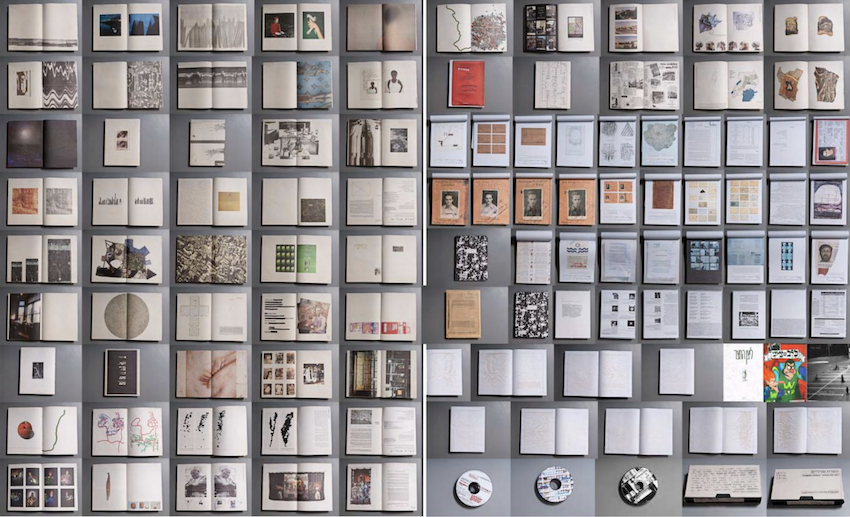
*Heara – Independent Art in Jerusalem at the Beginning of the 21st Century – Book

Ronen Eidelman, Lea Mauas, Diego Rotman (eds.), *Heara – Independent Art in Jerusalem at the Beginning of the 21st Century, 2014, Jerusalem: Hearat Shulaym, 2014 [English and Hebrew | Book, 352 p.]

*Heara is a collection of testimonies, reflections, interpretations and documentations of Heara events, as well as images from issues of Hearat Shulaym (Note in the Margin), an independent contemporary art and literature journal published together and as an inherent part of the events. The book includes articles published in Hearat Shulaym and additional articles written especially for the book by Israeli artists and scholars, as well as artworks which were part of the Heara art project. The art events and journal were active in divided, grief-stricken Jerusalem of the Second Intifada, outside conventional art venues and without any cooperation or funding by the government or private corporations. Nevertheless, the events managed to form fascinating connections between artists operating in different media ־ visual art, theater, poetry, video and sounds, and created a platform of growth and articulation for hundreds of artists, producing exciting, unpredictable, inspiring and thought-provoking pieces.


To read it on-line:

To download it: 

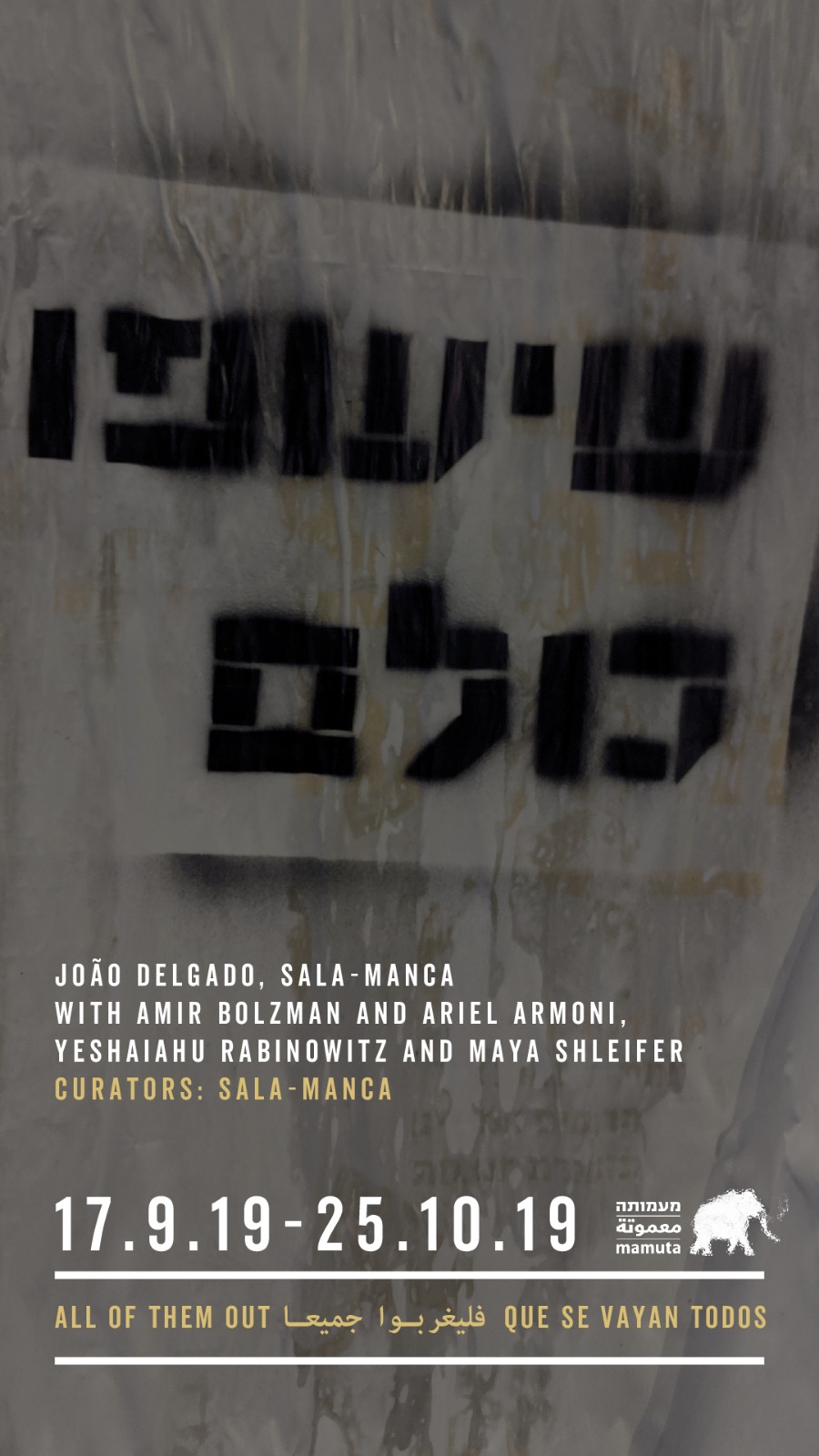
Que se vayan todos! New Exhibition at Mamuta at the Hansen House

17.9.19-25.10.19

All of them must go! Sala-Manca group, João Delgado, in cooperation with Amir Bolzman and Ariel Armoni, Yeshayahu Rabinowitz and Maya Shleifer Reconstruction of Que Se Vayan Todos! procession: Las Piratas Piratas & Sala-Manca Video of Delgado’s poetry: Collaboration with Dulce (Augusto Zaquetti and Gabi Luraschi)

Que se vayan todos! is a series of art interventions and an exhibition evoking the Argentinian civilian protests of late 2001, in which tens of thousands took to the streets across Argentina to protest the political, economic, and social situation in the country, resulting in changing the regime. The demonstrations came to a head in December 2001, prompting President Fernando de la Rúa to resign and flee in his helicopter from the “Pink House” (the President’s office), across from which the protests were taking place. The spontaneous mobilizations, which gave voice and strength to the citizens, had striking aesthetic, textual, visual, and acoustic manifestations. These aspects are the starting point of the exhibit, whose title, Que se vayan todos! (All of them must go!), is taken from the slogan that expressed the people’s frustration at their lack of representation in the government and the great disappointment from the political leadership. The mobilization and the slogan that came to represent it ultimately led to a change in government in Argentina in 2001 and have inspired popular movements across South America and around the world since then. The series of artistic events begins before the public opening of the exhibit, with two interventions in the public space. The first intervention is the hanging of posters with the slogan Que se vayan todos! . This action straddles genre, being simultaneously a citation, a call for change, and a teaser for the exhibit. The second action is a reenactment of the popular processions known as “cacerolazo” (casserole protest), which took place in Argentina during that period. In these processions, citizens with no specific political affiliation converged spontaneously into a civic carnival. Their kitchen pots (cacerolas) were transformed into the musical instruments that accompanied them in their calls for change. Unknowingly, the citizens were “cooking up” the downfall of the regime. In these processions, they consciously or unconsciously alluded to a different act of civic protest in which, according to Argentinian lore, the residents of Buenos Aires overcame the threat of British occupation by spilling hot oil from their kitchen pots on the conquering British army. Thus a basic kitchen utensil became emblematic of the demand for change, combining the political with the domestic space and being at once a sign of hunger and the sound of revolution. The exhibition includes: A sound installation tribute to the cacerolazo (a collaboration between Sala-Manca and Amir Bolzman together with Ariel Armoni) A reconstruction of the cardboard helicopter displayed at a demonstration in Argentina in 2017 by the artist-activist group Erroristas. The establishment interpreted it as an unequivocal call for toppling the regime, leaving no room for the complex and poetic interpretations intended by the artists. The reproduction is a collaboration between Sala-Manca with Yeshayahu Rabinowitz. A room dedicated to the Portuguese-Argentinian artist João Delgado, who aspired in his works to bring about change through poetry and a variety of artistic projects. Additional events, as well as a series of screenings of films and video, works throughout the exhibition period. The project is an extension of Sala-Manca group’s engagement with the subject of exorcism, which began with the Dybbuk project at the 14th Kola Shel Mila Festival. The project continues with the film-performance The Dybbuk 1937-2017 and in the exhibit There is no Place More Exalted than My Present Refuge.


Dubbing the Dead: Der Dybbuk 1937–2017 at the Jerusalem YMCA Hall by Zehavit Stern (TDR, 63, 2, 2019)

A great review about Der Dybbuk 1937-2017, by Dr. Zehavit Stern at the The Drama Review (TDR)

” Rather than embalming the dead (the origins of art according to Bazin), it endows them with an afterlife, or rather, to use Walter Benjamin’s words, with a “weak messianic power” , rooted not in a religious belief, but rather, in human empathy (Einfühlung) and sadness, and in the desire to resist the victor, give voice to those who are stepped over, and thus brush history against the grain.”

Stern, Zehavit. “Dubbing the Dead: Der Dybbuk 1937–2017 at the Jerusalem YMCA Hall.” TDR: The Drama Review, vol. 63 no. 2, 2019, pp. 158-166.

Link to the article

No Confidence, new video by Sala-manca and Amir Bolzman

In the frame of the exhibition “Barbarians” at Mamuta at the Hansen House, curated by Sagit Mezamer, Yehudit Shlosberg-Yogev, Nurit Dreamer, Ein Kristal and Amir Bolzman

No Confidence by the Sala-Manca group in collaboration with Amir Boltzman—including a recreation of Havilio’s speech in the Municipality’s court case against the Barbur Gallery. It is several years now that Barbur has been operating in the Mazkeret Moshe neighborhood in Jerusalem, and since 2005 it has had to contend with political persecution over its hosting of “controversial” political activity.  On August 30, 2018, a hearing was held at the Jerusalem Magistrate’s Court in the matter of the Jerusalem Municipality’s lawsuit against the gallery. In the video clip, at the artists’ request, the gallery’s attorney, Yossi Havilio, recreates the essence of his arguments at that historic hearing, in which Judge Amir Dahan ruled that the gallery must vacate its premises.

Link to the entire video work

video fragment

link to the exhibition