WordPress database error: [DELETE command denied to user 'sala-manca'@'localhost' for table `sala_manca_net`.`wp_options`]
DELETE FROM `wp_options` WHERE `option_name` = '_site_transient_wp_theme_files_patterns-3e81fb819c0831df69203ee558a709b9'

WordPress database error: [DELETE command denied to user 'sala-manca'@'localhost' for table `sala_manca_net`.`wp_options`]
DELETE FROM `wp_options` WHERE `option_name` = '_site_transient_timeout_wp_theme_files_patterns-3e81fb819c0831df69203ee558a709b9'

WordPress database error: [INSERT, UPDATE command denied to user 'sala-manca'@'localhost' for table `sala_manca_net`.`wp_options`]
INSERT INTO `wp_options` (`option_name`, `option_value`, `autoload`) VALUES ('_site_transient_timeout_wp_theme_files_patterns-3e81fb819c0831df69203ee558a709b9', '1792699135', 'off') ON DUPLICATE KEY UPDATE `option_name` = VALUES(`option_name`), `option_value` = VALUES(`option_value`), `autoload` = VALUES(`autoload`)

WordPress database error: [INSERT, UPDATE command denied to user 'sala-manca'@'localhost' for table `sala_manca_net`.`wp_options`]
INSERT INTO `wp_options` (`option_name`, `option_value`, `autoload`) VALUES ('_site_transient_wp_theme_files_patterns-3e81fb819c0831df69203ee558a709b9', 'a:2:{s:7:\"version\";s:3:\"4.0\";s:8:\"patterns\";a:0:{}}', 'off') ON DUPLICATE KEY UPDATE `option_name` = VALUES(`option_name`), `option_value` = VALUES(`option_value`), `autoload` = VALUES(`autoload`)

WordPress database error: [INSERT, UPDATE command denied to user 'sala-manca'@'localhost' for table `sala_manca_net`.`wp_options`]
INSERT INTO `wp_options` (`option_name`, `option_value`, `autoload`) VALUES ('_transient_doing_cron', '1792697335.7216889858245849609375', 'on') ON DUPLICATE KEY UPDATE `option_name` = VALUES(`option_name`), `option_value` = VALUES(`option_value`), `autoload` = VALUES(`autoload`)

Press & Articles (selected) – Sala-Manca

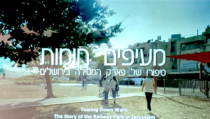
New Film: “Tearing Down Walls”by Solly Elfaks, about the Course “Art, Activism and Public Space”

Link to the film

The film documents, reviews, and describes the legendary course, “Art and Activism in the Public Space,” at the Bezalel Academy of Art and Design in Jerusalem. For a decade, Solly Elfaks follows art activism projects that are collaborations between art students and residents of the Gonnenim/Katamonim neighborhood in Jerusalem, in the struggle to save the Train Track Park. The projects include creating an alternative to the planned highway, interventions in the public space, bringing down walls, and the design and construction of street libraries which operate 24/7 and have become a Jerusalem neighborhood icon. The film comprises documentation of work processes and outcomes, interviews with lecturers and students at the art academy and with residents of the neighborhood directly affected and of the adjacent Arab neighborhood of Beit Safafa. It poses questions about the relationships between the academic world and the community, art and activism, and the right to public space as part of the struggle for equal rights and to help communities to make their voices heard.

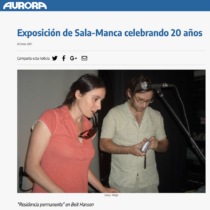
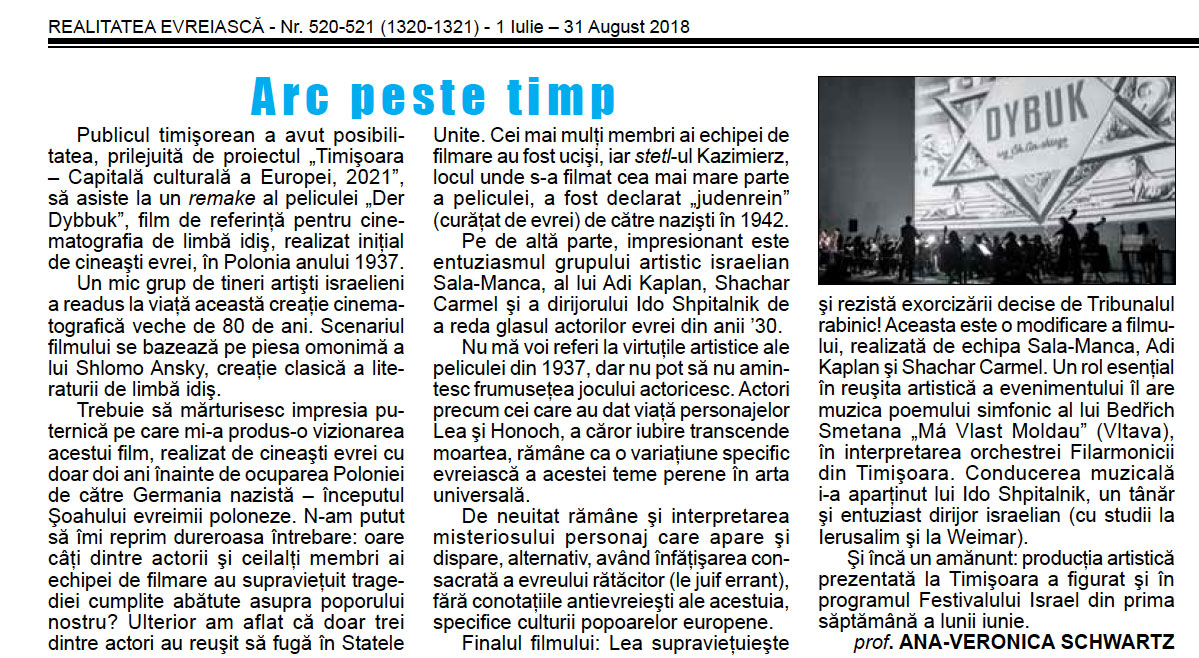
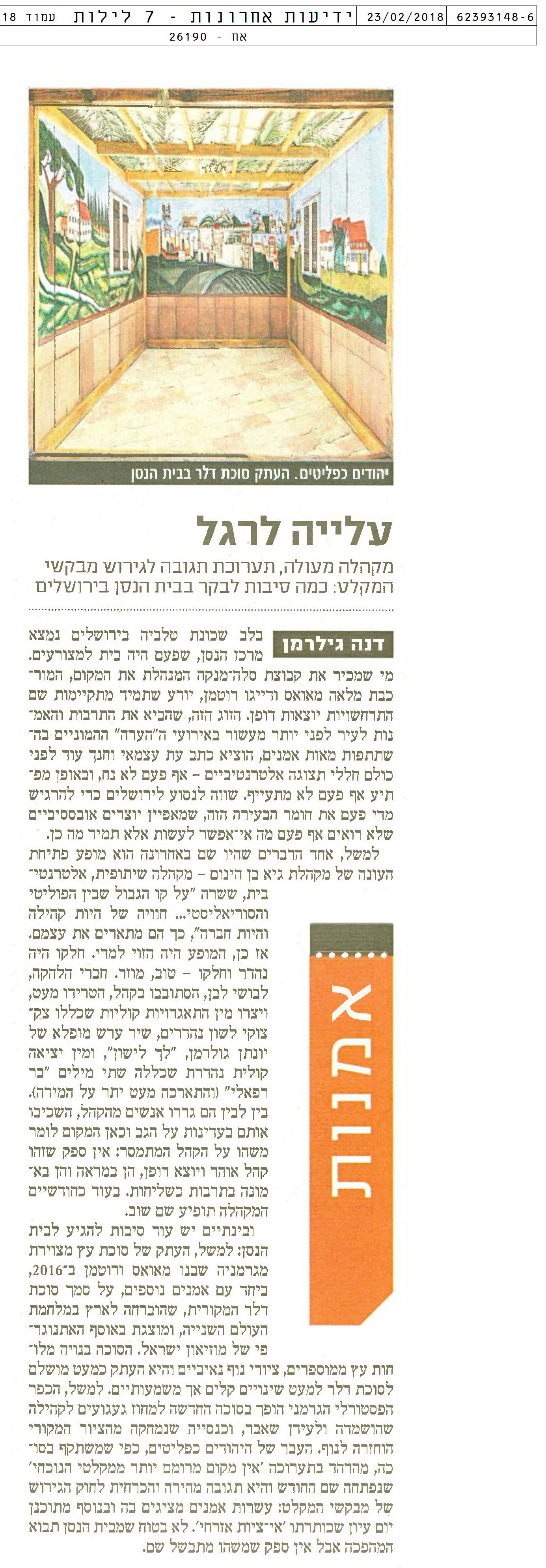
Exposición de Sala-Manca celebrando 20 años, por Chiquita Levov

“Residencia permanente” es una nueva exposición en el Beit Hansen, que surgió tras el viaje de los miembros del grupo Sala-Manca a una larga estadía en la provincia de Ontario en Canadá y su posterior regreso a la realidad israelí aproximadamente un año después. La muestra marca los 20 años de actividad de este innovador grupo independiente de Jerusalén, cuyos miembros son una pareja de artistas nacidos en Buenos Aires.[…]

Link

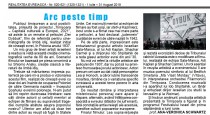
Dubbing the Dead: Der Dybbuk 1937–2017 at the Jerusalem YMCA Hall by Zehavit Stern (TDR, 63, 2, 2019)

A great review about Der Dybbuk 1937-2017, by Dr. Zehavit Stern at the The Drama Review (TDR)

” Rather than embalming the dead (the origins of art according to Bazin), it endows them with an afterlife, or rather, to use Walter Benjamin’s words, with a “weak messianic power” , rooted not in a religious belief, but rather, in human empathy (Einfühlung) and sadness, and in the desire to resist the victor, give voice to those who are stepped over, and thus brush history against the grain.”

Stern, Zehavit. “Dubbing the Dead: Der Dybbuk 1937–2017 at the Jerusalem YMCA Hall.” TDR: The Drama Review, vol. 63 no. 2, 2019, pp. 158-166.

Link to the article

Toward a Transversal Reading of Art and Politics in Israel by Mor Cohen

About Heara Events and Hearat Shulaym (among other interesting topics)  in an article by Mor Cohen, publisehd at
Cohen, M. (2018). Toward a Transversal Reading of Art and Politics in Israel, Israel Studies Review, 33(2), 105-122. Retrieved Jun 19, 2019.

Abstract: The 2011 Israeli protest for social justice marked a change in
the responses of Israeli citizens to political and social matters. The ways in
which art and social change intersected during the protest, and the emergence
of art collectives following the events, call for an understanding
of the relation between art and politics in Israel. This article suggests an
alternative reading of socially engaged art in Israel. To this end, I use Félix
Guattari’s notion of ‘transversality’ and Jacques Rancière’s theory on the
‘aesthetic regime’ to highlight significant periods where art and politics
have intersected in ways that have challenged Israeli art historiography,
often neutralizing the political within an artwork. By using a theoretical
framework that emphasizes notions of hybridity and the blurring of
boundaries, I make new connections between times, places, and practices
that go beyond the binaries of center and periphery, mainstream and alternative,
and aesthetics and politics.

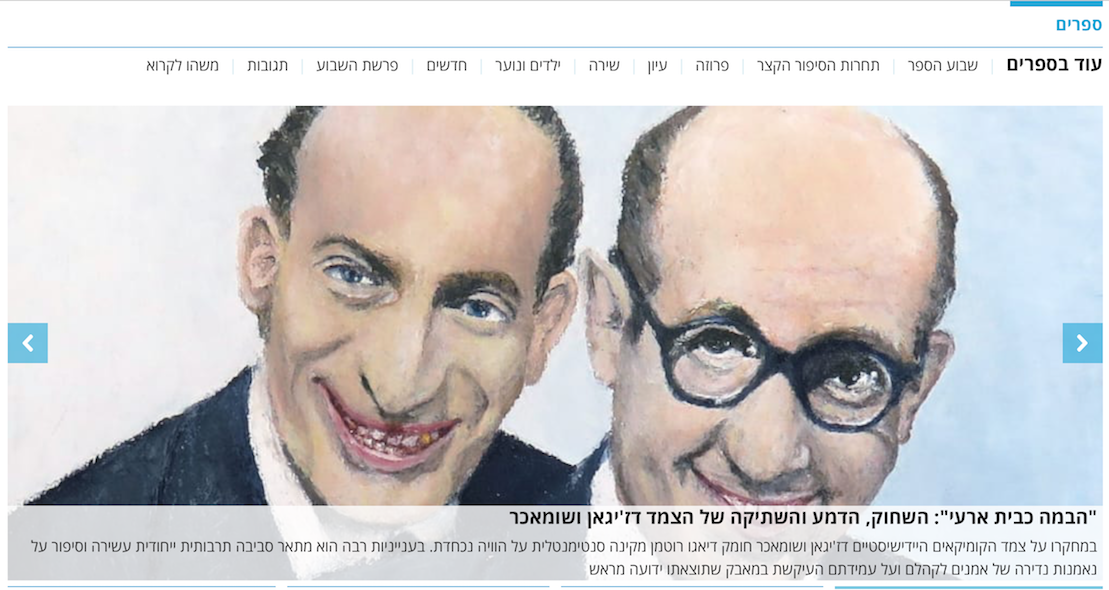
The Next Dybbuk | A review by Eppie Bat Ilan at Erev Rav [Hebrew]

to the entire review in Hebrew

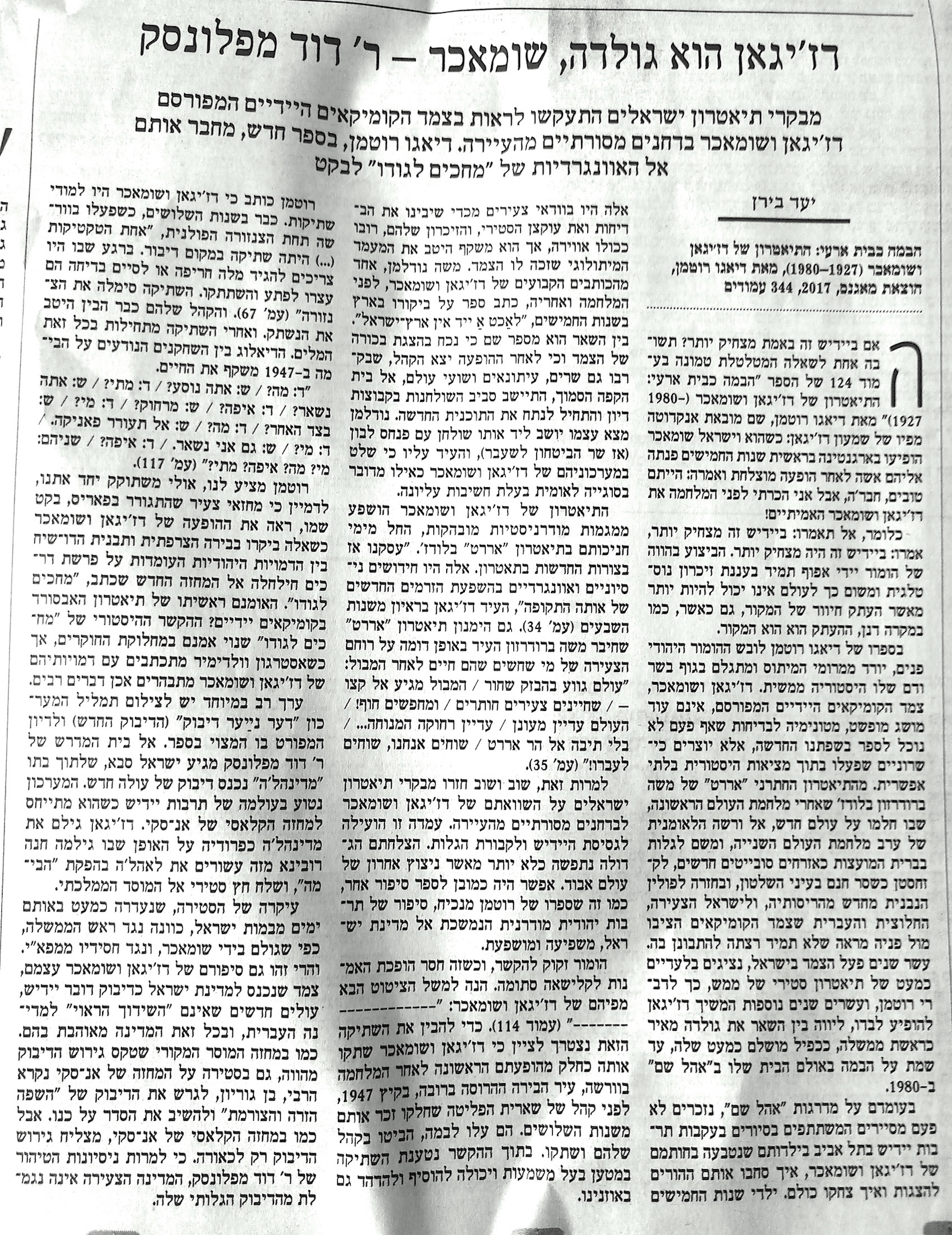
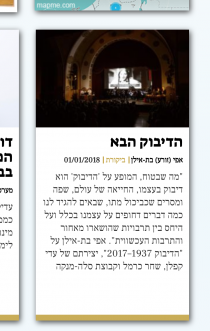
הדיבוק הבא

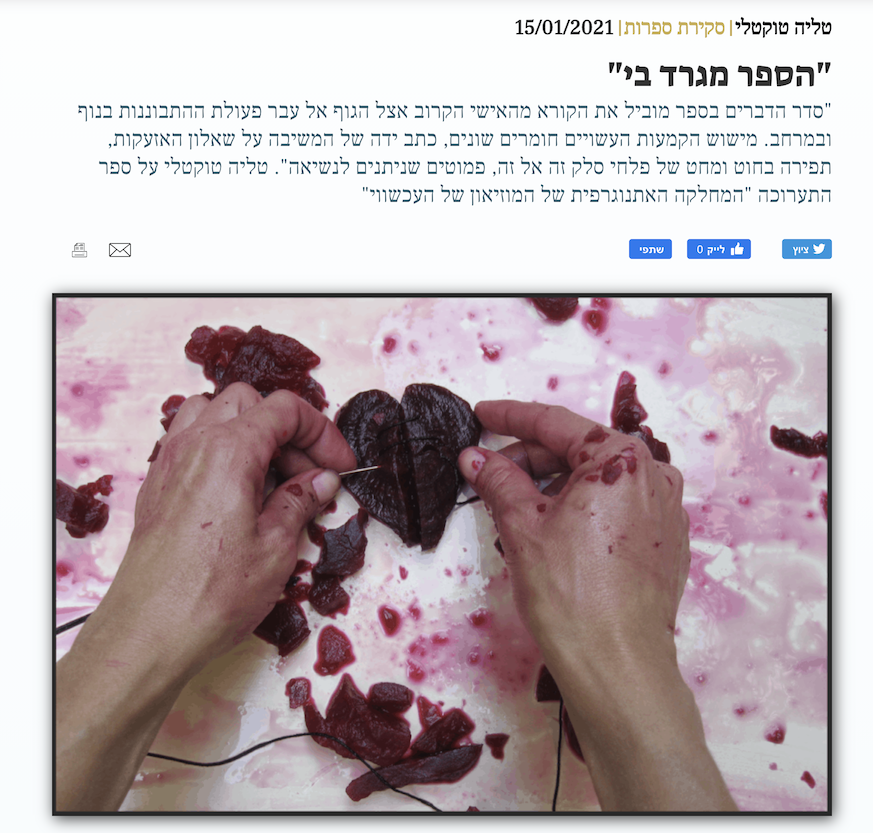
“מה שבטוח, המופע על ‘הדיבוק’ הוא דיבוק בעצמו, החייאה של עולם, שפה ומסרים שכביכול מתו, שבאים להגיד לנו כמה דברים דחופים על עצמנו בכלל ועל היחס בין תרבויות שהושארו מאחור והתרבות העכשווית”. אפי בת-אילן על “הדיבוק 1937–2017”, יצירתם של עדי קפלן, שחר כרמל וקבוצת סלה-מנקה

https://www.erev-rav.com/archives/47554

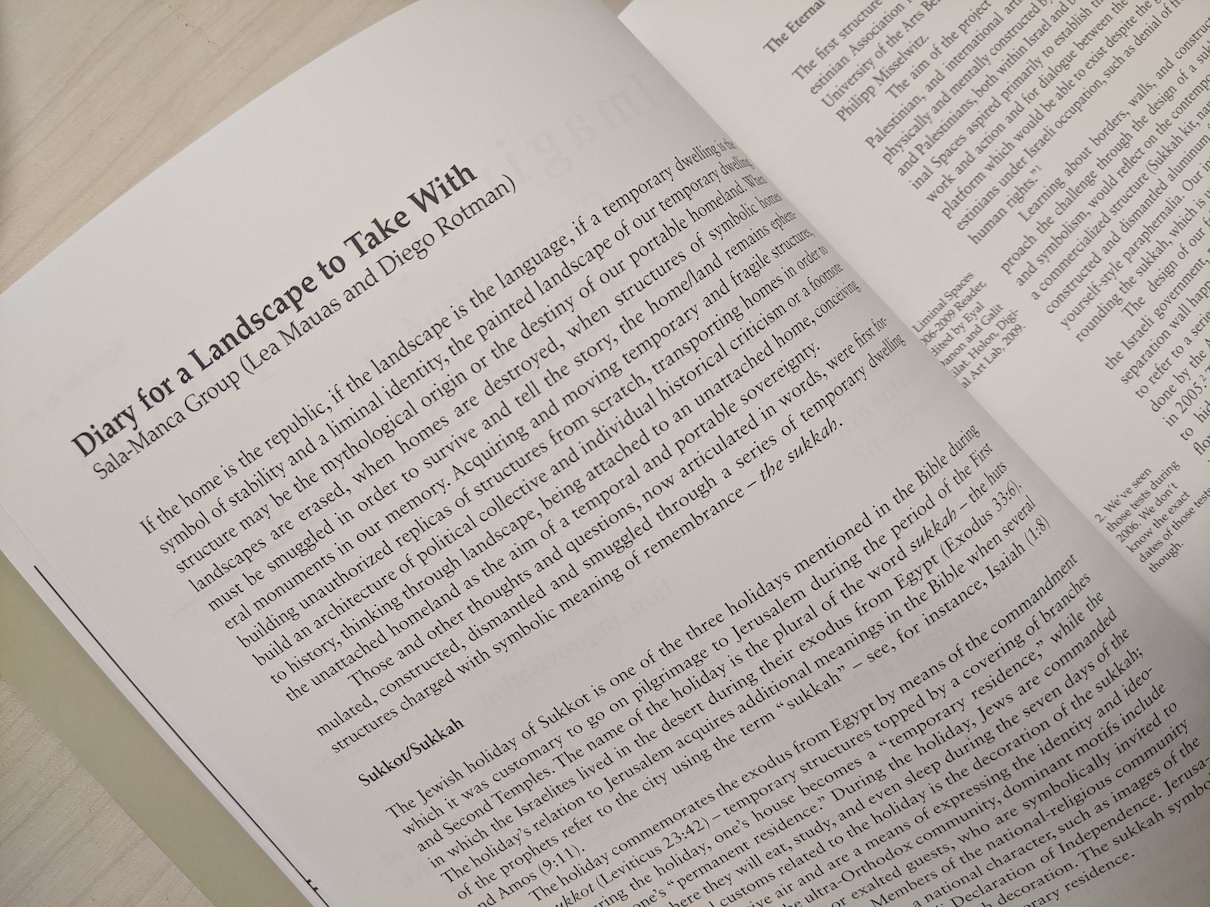
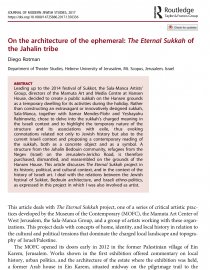
On the architecture of the ephemeral: The Eternal Sukkah of the Jahalin tribe, by Diego Rotman

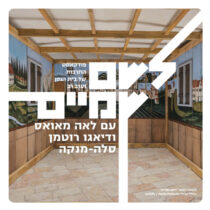
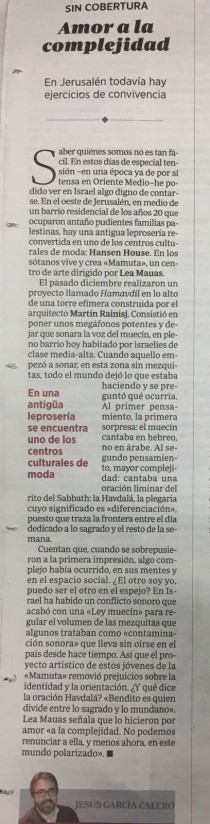
Leading up to the 2014 festival of Sukkot, the Sala-Manca Artists’ Group, directors of the Mamuta Art and Media Centre at Hansen House, decided to create a public sukkah on the Hansen grounds as a temporary dwelling for its activities during the holiday. Rather than constructing an extravagant or innovatively designed sukkah, Sala-Manca, together with Itamar Mendes-Flohr and Yeshayahu Rabinowitz, chose to delve into the sukkah’s charged meaning in the Israeli context and to highlight the temporary nature of the structure and its associations with exile, thus evoking connotations related not only to Jewish history but also to the current Israeli context and proposing a contemporary reading of the sukkah, both as a concrete object and as a symbol. A structure from the Jahalin Bedouin community, refugees from the Negev (Israel) on the Jerusalem-Jericho Road, is therefore purchased, dismantled, and reassembled on the grounds of the Hansen House. This article discusses The Eternal Sukkah project in its historic, political, and cultural context, and in the context of the history of Israeli art. I deal with the relations between the Jewish festival of Sukkot, Bedouin architecture, and Israeli ethno-politics, as expressed in this project in which I was also involved as artist.

[to the article]
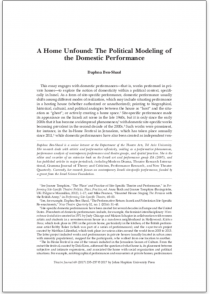
A Home Unfound: The Political Modeling of the Domestic Performance, by Daphna Ben-Shaul

his essay engages with domestic performances—that is, works performed in private homes—to explore the notion of domesticity within a political context, specifically in Israel. As a form of site-specific performance, domestic performance usually shifts among different modes of realization, which may include situating performance in a hosting house (whether authorized or unauthorized); pointing to biographical, historical, cultural, and political analogies between the house as “host” and the situation as “ghost”; or actively creating a home space.1 Site-specific performance made its appearance on the Israeli art scene in the late 1960s, but it is only since the early 2000s that it has become a widespread phenomenon,2 with domestic site-specific works becoming prevalent in the second decade of the 2000s.3 Such works were prominent, for instance, in the In-Home Festival in Jerusalem, which has taken place annually since 2011,4 while domestic performances have also been created as independent ventures  by Israeli theatres and ensembles, as well as being presented at festivals like the Site-Dependent Festival in Tel Aviv (2010-14). The form’s unique actual and potential aesthetic features, deeply related to the complex psychological, social, and political significance connected with the notion of a home, require much further exploration. Within the Israeli context I analyze The Peacock of Silwan by Alma Ganihar and directed by Chen Alon and Sinai Peter; The Apartment, an adaptation of Franz Xaver Kroetz’s Request Concert staged by Michael Ronen; and Eternal Sukkah by the Sala-Manca Group to examine performance that engages with domestic locations as found space.5 Unlike scenographic representations of a fictive dramatic home onstage, suited to the architectural space in conventional theatres, domestic space is a kind of ready-made found object (objet trouvé); it can be called a deliberately found space, not one that was “found” accidentally; it can involve a creative transformation, whose traits and their belonging to the domestic space take an active part in modeling the domestic environment and a new frame of reference. Yet, beyond being a venue of site-specific performance, this concept serves me essentially by way of negation: while the site of the domestic performance is a found space, it also manifests a lack of domesticity and is often presented as a home unfound.

[to the article]