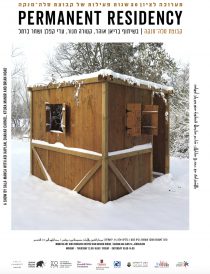
Link to the website: https://museumofthecontemporary.com/

WordPress database error: [DELETE command denied to user 'sala-manca'@'localhost' for table `sala_manca_net`.`wp_options`]DELETE FROM `wp_options` WHERE `option_name` = '_site_transient_wp_theme_files_patterns-3e81fb819c0831df69203ee558a709b9'
WordPress database error: [DELETE command denied to user 'sala-manca'@'localhost' for table `sala_manca_net`.`wp_options`]DELETE FROM `wp_options` WHERE `option_name` = '_site_transient_timeout_wp_theme_files_patterns-3e81fb819c0831df69203ee558a709b9'
WordPress database error: [INSERT, UPDATE command denied to user 'sala-manca'@'localhost' for table `sala_manca_net`.`wp_options`]INSERT INTO `wp_options` (`option_name`, `option_value`, `autoload`) VALUES ('_site_transient_timeout_wp_theme_files_patterns-3e81fb819c0831df69203ee558a709b9', '1792699164', 'off') ON DUPLICATE KEY UPDATE `option_name` = VALUES(`option_name`), `option_value` = VALUES(`option_value`), `autoload` = VALUES(`autoload`)
WordPress database error: [INSERT, UPDATE command denied to user 'sala-manca'@'localhost' for table `sala_manca_net`.`wp_options`]INSERT INTO `wp_options` (`option_name`, `option_value`, `autoload`) VALUES ('_site_transient_wp_theme_files_patterns-3e81fb819c0831df69203ee558a709b9', 'a:2:{s:7:\"version\";s:3:\"4.0\";s:8:\"patterns\";a:0:{}}', 'off') ON DUPLICATE KEY UPDATE `option_name` = VALUES(`option_name`), `option_value` = VALUES(`option_value`), `autoload` = VALUES(`autoload`)
WordPress database error: [INSERT, UPDATE command denied to user 'sala-manca'@'localhost' for table `sala_manca_net`.`wp_options`]INSERT INTO `wp_options` (`option_name`, `option_value`, `autoload`) VALUES ('_transient_doing_cron', '1792697364.4789900779724121093750', 'on') ON DUPLICATE KEY UPDATE `option_name` = VALUES(`option_name`), `option_value` = VALUES(`option_value`), `autoload` = VALUES(`autoload`)
Link to the website: https://museumofthecontemporary.com/

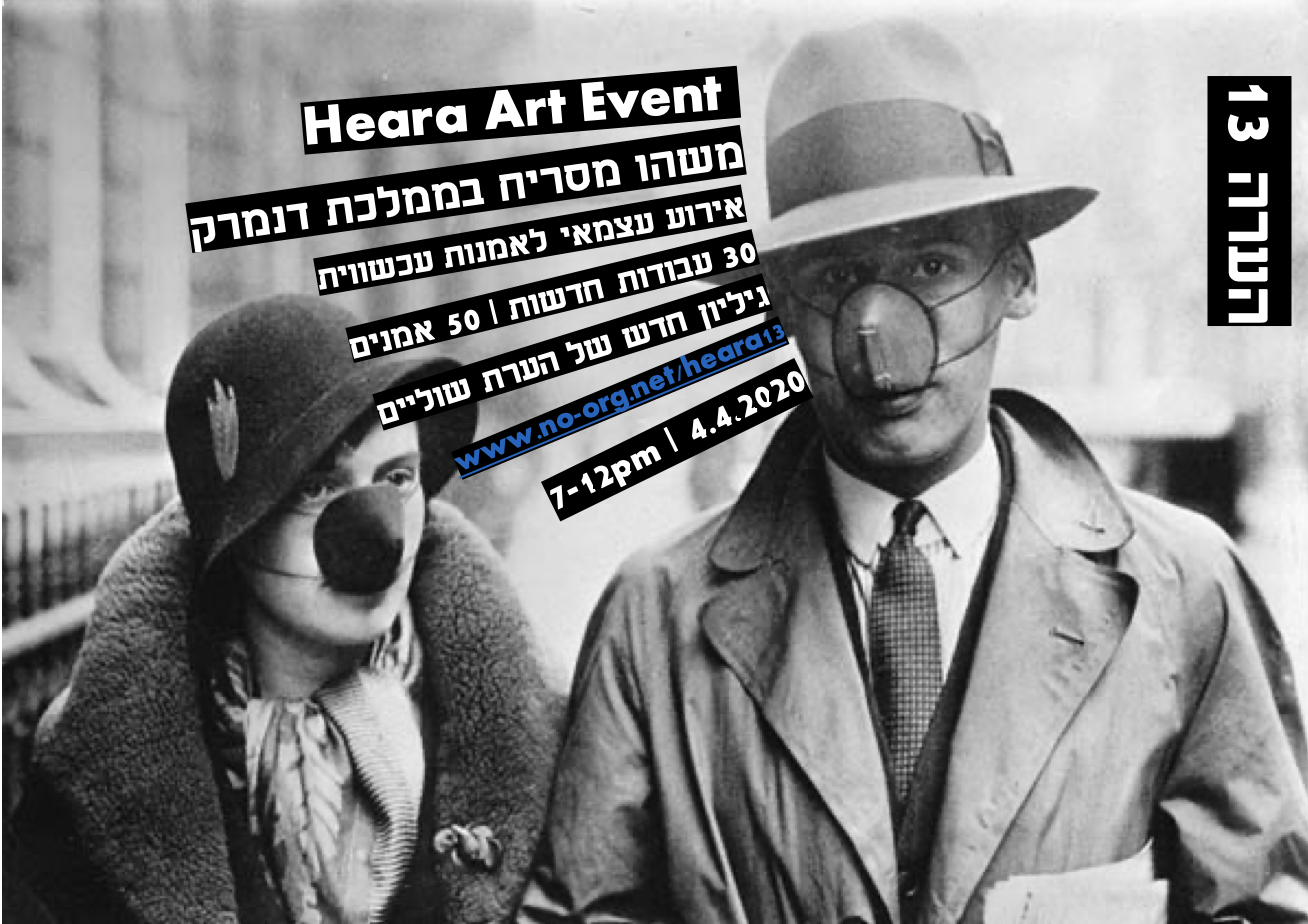
Heara 13: Something is Rotten in the State of Denmark (or a Threepenny Platform)
“From Zion will emerge the DictaTorah (Dzigan and Schumacher,1956)
Since the first event in 2001, the aim of Heara [Comment] events (multidisciplinary independent events for contemporary art) was to meet among new trends on art, artists and public, through the creation of alternative ways of art exhibition and creation from those that the artistic mainstream institutions propose. The Heara events were critical site and time specific events.
In these days, in which a virus is defined as terrorist and we all become rhetorical and practical potential terrorists, we seek to create a different discourse, a new platform and new and alternative hope through common action.
Heara 13 is also an independent response to the decision of the Minister of Culture from the 17th of March to invest 8 million NS in a digital platform, instead of to support artists.
Heara13 comes to offer a conversational space that forms, imagines and creates a rhetoric, visual and ideological alternative to that which the government offers us. This platform will enable meeting, discussion, support and creation of new content that responds to current reality. Heara13 will take place in a virtual space, both safe and sensitive and problematic.
We want to create a new space where we can meet in the times when the public space is being taken from us, when the freedom of speech is being under threat, when the distribution of [money] is being less and less equal, all done in the name of our security and our health. We can also find union in isolation and power in moments of weakness, hope in time of despair.
Heara 13 is not only done for fun, is done for change, organized and produced in the last two weeks.
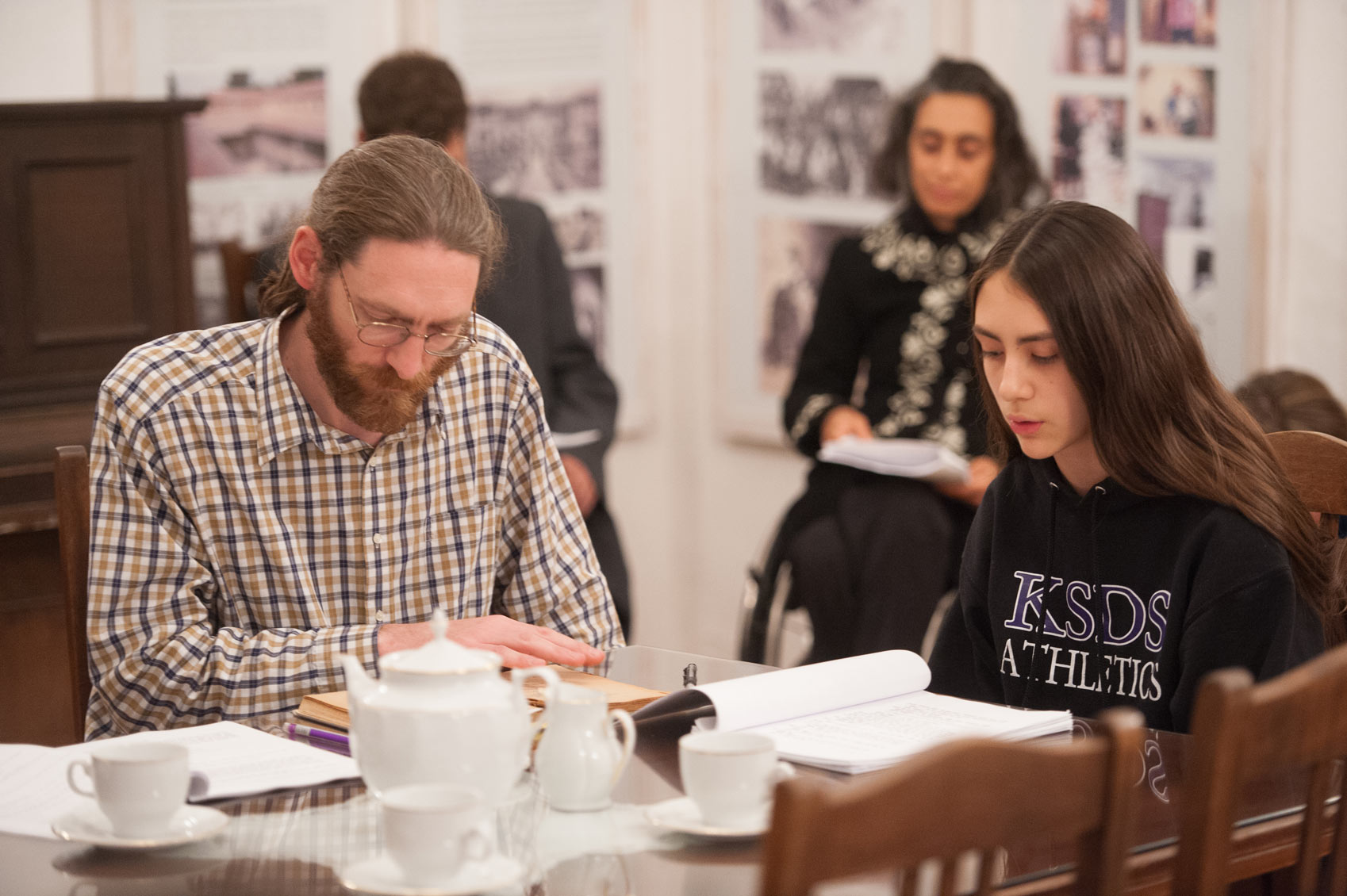
Please feel free to take a copy of a new issue of our Hearat Shulaym Art Journal, a response to an urgent call two weeks ago. The event is for free, but you are welcome to donate to any of the organizations listed.
The Sala-manca Group & all the participating artists
Itamar Mendes-Flohr
Curators: Sala-Manca Group
That we’ve forgotten the rain / we recall only when it rains / and there’s no longer any point in discovering what’s been forgotten / and grieving its absence” (Joao Delgado)
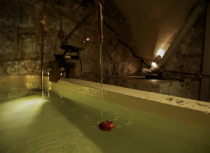
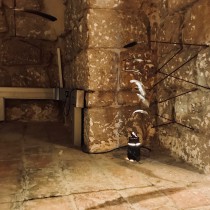
The conceptual point of departure for Itamar Mendes-Flohr’s first solo exhibit is the water cisterns at Hansen House in Jerusalem. These cisterns served from the early days of the Jesus Hilfe Lepers’ Hospital (mid-nineteenth century) as a source of freshwater for treatment of the hospital’s patients and for watering the trees and plants of the compound’s autarchic farm. The exhibit transforms the spaces of the Mamuta Art and Research Center into a laboratory for artistic research about the connection between water and stone(from which the walls of the cisterns are made), motion, and light.
Mendes Flohr’s works have a performative aspect to them: they are kinetic, often simulating motion in the natural world, and they change over the course of time. In the present exhibit water evaporates, is absorbed, and shapes the materials it comes into contact with. The clash between water and stone creates moments of aesthetic discovery related to the fact that they are the basic structural elements of the former lepers’ hospital. These materials, which served for healing, irrigation, purification, and protection, are also a source of myths. Mendes-Flohr detaches them from their natural context in order to build a unique poetic reality. As an alchemist and inventor with a unique ability to observe the world of materials and their movement, he reveals connections that are hidden from the untrained eye.
The exhibit presents fragments from a rich and unique world. In the past, Mendes-Flohr was the sole guest at the Paradise Inn, a temporary structure constructed in the Hansen House garden and which only the artist could enter. During his stay at the Paradise, Mendes-Flohr created survival systems out of what was at hand in the garden as well as kinetic sculptures, including a mythological snake trapped in perpetual motion in one of the cracks through which spectators could observe the Paradise. The snake’s vertebrae were made from a sawed branch from one of the historical cypress trees of the Hansen House garden.
In his present exhibit, a water system begins in one of the pools in the hospital’s cellar and travels between the exhibit’s works to create an autarchic artistic system. Beyond water’s natural force, human control over the presence or absence of water in the day to day (diverting it, blocking access to it, evaporation, over-use, etc.), can have an influence on life or death. Mendes-Flohr’s unique use of water emphasizes this potential: water drives the aesthetic and sculptural course of the exhibit; it is its designing force.
“That we’ve forgotten the rain…” also offers a look into Mendes-Flohr’s laboratory-studio, where visitors will discover the world of the artist, researcher, and inventor: preparatory sketches for the present exhibit, parts of previous works that undergo a metamorphosis into new works and works in progress.
The exhibit is a continuation of Mendes-Flohr’s ongoing collaboration with Sala-Manca Group, which began in 2011 when he was an artist-in-residence at the Mamuta Center in Ein Karem. Since then Mendes-Flohr has participated in dozens of projects curated by Sala-Manca, in which his works have stood out for their poetical quality and the way in which they interweave nature, the human touch, and mechanical structures.
That We’ve Forgotten the Rain
Curators: Sala-Manca Group | Production: Shahar Ben-Nun | Technical Assistant: Shimri Hagai | Text editing: Inbal Keidar | Arabic translation: Nagham Abuleil | English translation: Tamar Cohen | Thanks to Galia Lulko, Yehudit Shlosberg-Yogev, Sagit Mezamer, Michael Faust, Keren Ben Altabet and Or Avishay
17.9.19-25.10.19
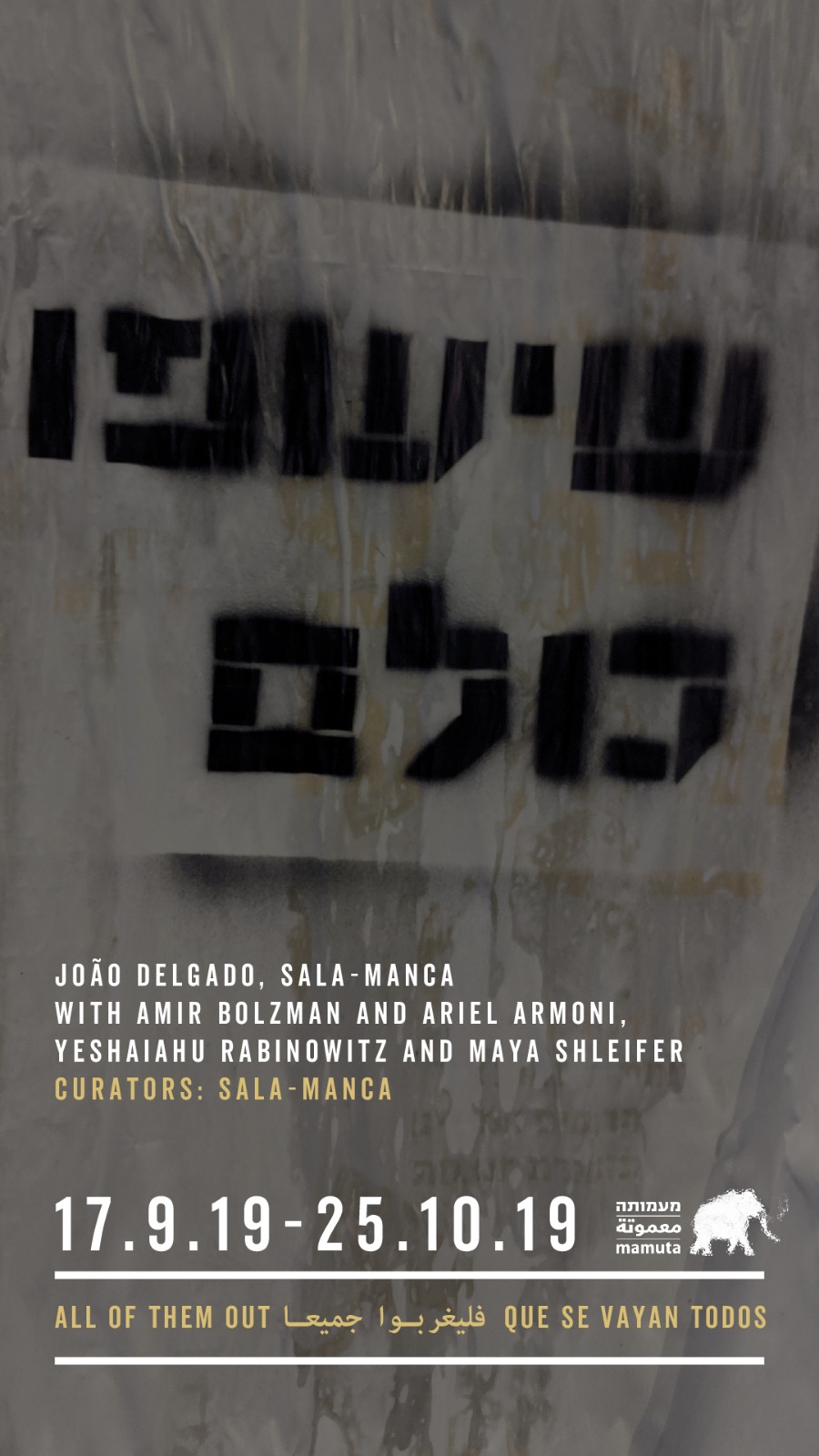
All of them must go! Sala-Manca group, João Delgado, in cooperation with Amir Bolzman and Ariel Armoni, Yeshayahu Rabinowitz and Maya Shleifer Reconstruction of Que Se Vayan Todos! procession: Las Piratas Piratas & Sala-Manca Video of Delgado’s poetry: Collaboration with Dulce (Augusto Zaquetti and Gabi Luraschi)
Que se vayan todos! is a series of art interventions and an exhibition evoking the Argentinian civilian protests of late 2001, in which tens of thousands took to the streets across Argentina to protest the political, economic, and social situation in the country, resulting in changing the regime. The demonstrations came to a head in December 2001, prompting President Fernando de la Rúa to resign and flee in his helicopter from the “Pink House” (the President’s office), across from which the protests were taking place. The spontaneous mobilizations, which gave voice and strength to the citizens, had striking aesthetic, textual, visual, and acoustic manifestations. These aspects are the starting point of the exhibit, whose title, Que se vayan todos! (All of them must go!), is taken from the slogan that expressed the people’s frustration at their lack of representation in the government and the great disappointment from the political leadership. The mobilization and the slogan that came to represent it ultimately led to a change in government in Argentina in 2001 and have inspired popular movements across South America and around the world since then. The series of artistic events begins before the public opening of the exhibit, with two interventions in the public space. The first intervention is the hanging of posters with the slogan Que se vayan todos! . This action straddles genre, being simultaneously a citation, a call for change, and a teaser for the exhibit. The second action is a reenactment of the popular processions known as “cacerolazo” (casserole protest), which took place in Argentina during that period. In these processions, citizens with no specific political affiliation converged spontaneously into a civic carnival. Their kitchen pots (cacerolas) were transformed into the musical instruments that accompanied them in their calls for change. Unknowingly, the citizens were “cooking up” the downfall of the regime. In these processions, they consciously or unconsciously alluded to a different act of civic protest in which, according to Argentinian lore, the residents of Buenos Aires overcame the threat of British occupation by spilling hot oil from their kitchen pots on the conquering British army. Thus a basic kitchen utensil became emblematic of the demand for change, combining the political with the domestic space and being at once a sign of hunger and the sound of revolution. The exhibition includes: A sound installation tribute to the cacerolazo (a collaboration between Sala-Manca and Amir Bolzman together with Ariel Armoni) A reconstruction of the cardboard helicopter displayed at a demonstration in Argentina in 2017 by the artist-activist group Erroristas. The establishment interpreted it as an unequivocal call for toppling the regime, leaving no room for the complex and poetic interpretations intended by the artists. The reproduction is a collaboration between Sala-Manca with Yeshayahu Rabinowitz. A room dedicated to the Portuguese-Argentinian artist João Delgado, who aspired in his works to bring about change through poetry and a variety of artistic projects. Additional events, as well as a series of screenings of films and video, works throughout the exhibition period. The project is an extension of Sala-Manca group’s engagement with the subject of exorcism, which began with the Dybbuk project at the 14th Kola Shel Mila Festival. The project continues with the film-performance The Dybbuk 1937-2017 and in the exhibit There is no Place More Exalted than My Present Refuge.
In the frame of the exhibition “Barbarians” at Mamuta at the Hansen House, curated by Sagit Mezamer, Yehudit Shlosberg-Yogev, Nurit Dreamer, Ein Kristal and Amir Bolzman
No Confidence by the Sala-Manca group in collaboration with Amir Boltzman—including a recreation of Havilio’s speech in the Municipality’s court case against the Barbur Gallery. It is several years now that Barbur has been operating in the Mazkeret Moshe neighborhood in Jerusalem, and since 2005 it has had to contend with political persecution over its hosting of “controversial” political activity. On August 30, 2018, a hearing was held at the Jerusalem Magistrate’s Court in the matter of the Jerusalem Municipality’s lawsuit against the gallery. In the video clip, at the artists’ request, the gallery’s attorney, Yossi Havilio, recreates the essence of his arguments at that historic hearing, in which Judge Amir Dahan ruled that the gallery must vacate its premises.
The Sala-manca Group (ISL/ARG) presents the OFF/SITE series
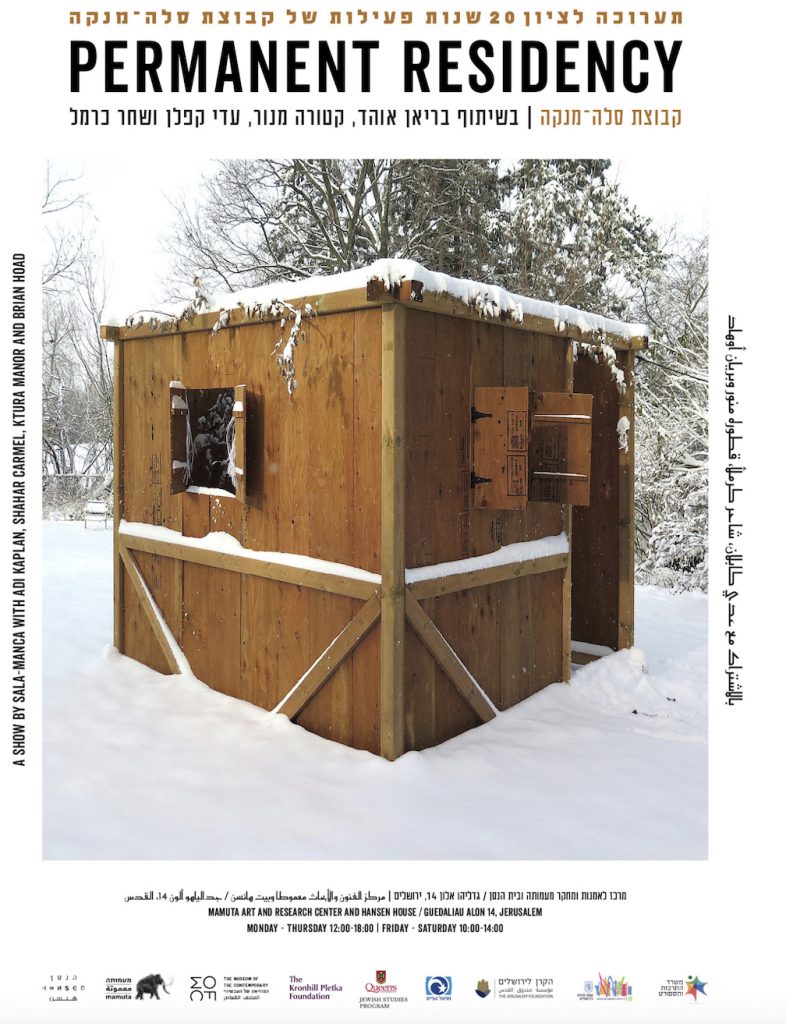
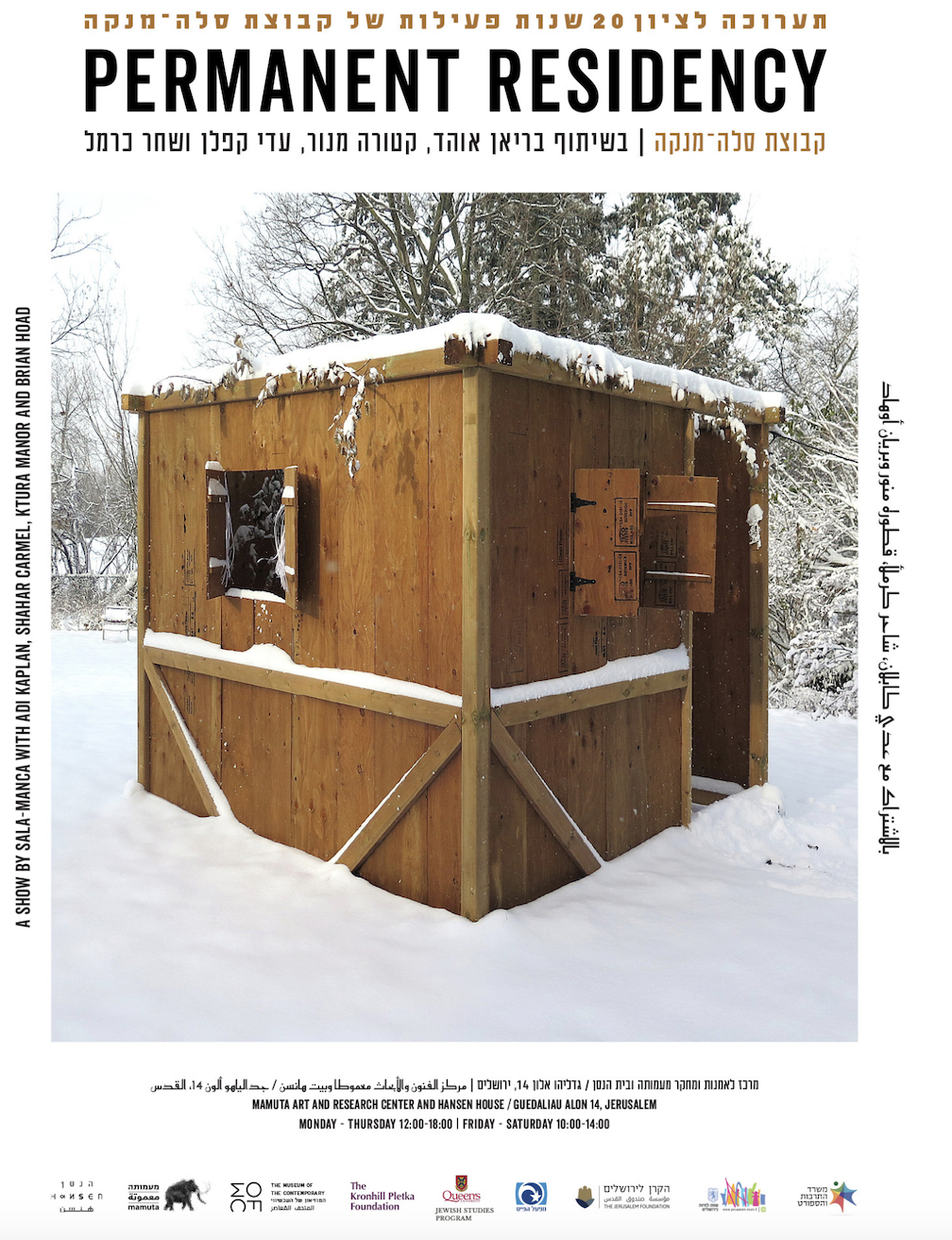
Sukkot (Jewish tabernacles) is a seven-day Jewish celebration commemorating the forty years of travel through the desert after the exodus from Egypt. During the celebration, temporary dwellings called sukkah are built with simple materials and are used for seven days for for eating, entertaining, and even sleeping.
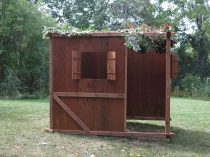
During the coming holidays of Sukkot, the Sala-manca group (see below) are constructing a Sukkah (Jewish tabernacle) in their front garden referring to their actual temporary migration to Kingston and are opening their (rented) house for a series of talks, performances, and workshops dealing with topics related to Sukkot: Temporary Dwelling, Forced and Voluntary Migration, Hybrid Identities, Fragile Structures.
September 23, 7:00-9:00 pm
A temporary Dwelling in our Rented Garden
A sukkah by Sala-manca family Informal Opening, refreshments will be served at the Sukkah
September 25, 7:00-9:00 pm
Panel on Sukkot
Sukkot Basics | Rabbi Erin Polansky
Rabbi Polansky is originally from Montreal, Quebec and grew up in Thornhill, Ontario. She was the first graduate of the Jewish Studies program at Queen’s University and subsequently attended the Hebrew Union College-Jewish Institute of Religion in Jerusalem and then in Cincinnati, earning ordination in 2000. Upon ordination, Rabbi Polansky served as Assistant Rabbi and Rabbi Educator at Bet Shalom Congregation in Minnesota. In 2004, she returned to Toronto where she served as Associate Rabbi at Temple Sinai and was the spiritual leader at Neshamah Congregation of York Region in Vaughan, Ontario from 2011 – 2018. And now Rabbi Polansky begins the next phase of her career as Rabbi at Beth Israel Congregation in Kingston
Absentee Landscapes | Sala-manca
Sala-manca will present two projects on Sukkot: In the lead-up to the 2014 Sukkot holiday, the Sala-Manca Group together with Itamar Mendes-Flohr and Yeshaiahu Rabinowitz decided to create a public sukkah on the Hansen grounds in Jerusalem, a temporary dwelling for its activities during the holiday. They collaborated with Al Korshan family of the Jahalin bedouin tribe to delve into the sukkah’s charged meaning in the Israeli context and to highlight the temporary nature of the structure and its associations with exile – thus evoking associations not only with Jewish history but also with the modern Israeli context, and proposing a contemporary reading of the sukkah, both as a concrete object and as a symbol. The Sukkah was bought a year later by the Israel Museum for their collection of Contemporary Art.
The second project is the Deller Sukkah (2017). In the winter of 2017 (the SalaManca Group, Nir Yahalom and Ktura Manor began building an unauthorized but accurate replica of a painted wooden sukkah from Germany (dating to 1850), which with the outbreak of World War II, was smuggled to Palestine to save it from the Nazis and is on display in the permanent collection of the Israel Museum and is known as The Deller Sukkah.
Tahany Okbi, a Palestinian Bedouin woman from Beer Sheva, southern Israel, currently living in Montreal, Canada.
Tahany holds MSW from McGill University, Canada and BSW from Ben- Gurion University, Israel.
September 26, 7:00-9:00 pm
Lois Klassen: “Books and Libraries in Migration”
What happens when migration stories are held still within a book? Can a library become nomadic? Vancouver-based artist and writer, Lois Klassen, will present two participatory art projects that take up the subject of migration and its cultural representation. Artist book examples from Reading the Migration Library (2016, ongoing) and Renegade Library (1998) will be available for reading and handling.
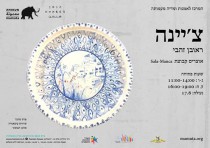
Lois Klassen is a Doctoral Candidate in the Cultural Studies Post-Graduate Program at Queen’s University.
https://www.loisklassen.com/ http://www.readingthemigrationlibrary.com/
September 27, 1:00-3:00 pm Workshop: On the Museum of the Contemporary | Curating and Public Scholarship Lab @1400 de Maisonneuve Blvd W., LB 671, Concordia University, Montreal
Diego Rotman, from the Sala-manca group, will present and discuss the critical thinking standing behind the Museum of the Contemporary, concentrating in some key projects done in its frame. The Sala-manca group will share their tactics, way of working and their experiences as founders, directors, guides, guards and staff cleaners of the MofC.
https://www.facebook.com/events/327627557987608/?notif_t=plan_admin_added¬if_id=1536699104658146
September 27 , 7:00-9:00 pm
The Sukkah – Between Eternal and Ephemeral @ Musée du Montréal juif – Museum of Jewish Montreal 4040 Boulevard St-Laurent, Montreal
Join Diego Rotman of the Sala-manca group to discover the incredible stories and migrations behind their work and collaborative efforts creating two sukkot originally from Germany and Bedouin communities.
https://www.facebook.com/events/1219262371547070/
September 29, 1:00-4:00 pm
A Library of Temporary Shelters – A book arts workshop about migration and displacement @ Agnes Etherington Art Centre, Kingston
Join artists Lois Klassen (CA) Sala-Manca (AR/IL) in a hands-on workshop and discussion about the representation of human displacement issues through art and text. Participants will hear about art and publishing projects that take up the urgency of migration, refugee issues, and will be invited to make artist books in a studio session. The hands-on portion of the workshop will focus on the way book structures can reflect a need for shelter, whether temporary or permanent.
https://agnes.queensu.ca/event/details/a-library-of-temporary-shelters/
About Lois Klassen
Lois Klassen is an artist, writer and researcher based in Vancouver, Canada. Known for long-range projects that invite and engage participants in collective actions. Her current project Reading the Migration Library, addresses the cultural production of migration stories. Her work has been hosted by Emily Carr University of Art + Design, bruna press + archive, The Glenbow Museum, Santa Fe Art Institute, and more. She is currently a doctoral candidate in the Cultural Studies program at Queen’s University in Kingston, Ontario, Canada.
About Sala-Manca Group
Lea Mauas and Diego Rotman, were born in Buenos Aires and now live and work in Jerusalem. Since 2000, they have created performances, videos, installations, and new media projects. Their work explores the poetics of cultural translation with a focus on language, media, the urban environment, and new technologies. Their projects frequently address the tension between low and high-tech aesthetics as well as sociopolitical issues. Last August they moved to Kingston. Lea Mauas is a graduate student in Cultural Studies and Diego is the Regina Rosen Visiting Artist in Residence in Cultural Studies and Jewish Studies and Visiting Professor at the Dan School for Drama and Music at Queen’s University.
—
With the support of the Regina Rosen Fund in Jewish Studies and Cultural Studies at Queen’s University, the Ethnographic Department of the Museum of the Contemporary and the Mamuta Art and Research Center in Jerusalem
All the events are free of charge and are made in the spirit of Ushpizin ( Aramaic for guests, a reference to the seven supernal guests). The events will be held at the artists’ house, in Kingston. Off-site events will also take place at the Agnes Etherington Art Centre, Kingston, the Museum of Jewish Montreal, and the Curating and Public Scholarship Lab at Concordia.
For further info contact: salamanca00@gmail.com
Opening: 15.3.18 20:00
Opening hours: Mon. and Tuesd: 12:00-16:00, Wed. 14:00-18:00, Friday: 10:00-14:00
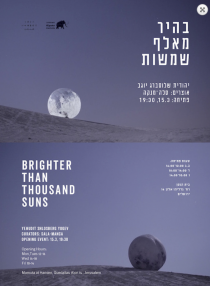
In 1978, atomic scientist Anatoli Petrovich Bugorski shoved his head into a particle accelerator to fix a malfunction. A photon beam that was shooting around in the accelerator hit his head at the speed close to the speed of light. The scientist claimed he did not feel pain, but saw a light that was “brighter than a thousand suns.”
Yehudit Shlosberg-Yogev’s first solo exhibition, titled “Brighter Than a Thousand Suns” (after the book of that title on the Manhattan Project) contains apocalyptic and poetic images that are fascinating and disturbing at the same time. Like Bugorski, for Shlosberg-Yogev, too—who created these works as part of her tenure as Artist in Residence at the Mamuta Art Center, the atomic bomb is the driving force.
The exhibition is an invitation to experience the basement space of Mamuta at Hansen House as a sanctuary for visual remains moments after the great disaster—images that appear to be taken from an archeological journey through the realms of human terror—from dread of the magnitude of human power to fear of no return.
In one of the works—A Small Step for a Man—an artificial moon appears in the desert, next to a single man fighting the wind. Is this how Shlosberg-Yogev envisions the dream of the last survivor? And what lies in the man’s futile action? Is it beauty, pathos and solitude—or humor and hope, as well?
In another work—The Journey of the Dead—Shlosberg-Yogev created a documentary film shot from the locomotive of a freight train through in the Desert of Zin in southern Israel. The train is traveling from nowhere to nowhere, passing by the Israeli nuclear reactor that we are not supposed to know that we know is there. The train’s journey, which contains many references to the history of cinema, does not document the departure from the reactor complex—the plant, production and progress—but rather the void, the secret and the threat that it contains.
The series Encyclopedias expresses a yearning for an aesthetic form of absolute knowledge coupled with revulsion from the actions of man. The encyclopedias of 1908 seek to bring together all of world knowledge in beautiful volumes. The two world wars had not yet taken place, and the new century seemed promising and hopeful. Shlosberg-Yogev plays with the encyclopedias, adding simple mechanisms and creating childish games of beauty and magic, combined with documentary material from nuclear experiments.
Brighter Than a Thousand Suns offers a sensory preoccupation with existential questions: our relationship with nature, issues of control and restriction, and various aspects of art’s approach to nature—from observation to framing, from intervention to withdrawal. The human presence at the exhibition, mediated through camera and word, gives all of these fascinating interpretations and a great beauty.
– Lea and Diego
Video works: Photographer: Itamar Mender-Flohr | Actor: Eyal Flumendorf | Video Edition and Post Production: Ofek Shemer and Ada Rimon
“Watch From a Safe Distance” – Sound Editing: Ofek Shemer and Ada Rimon | Electronics: Amir Bolzman
Books – Electronics: Omri David | Cannon mechanism: Itamar Mendes-Flohr |
Monitors: Yaniv Sheinfeld
Thanks: Itamar Mendes-Flohr, Ori Mizrachi , Alon Gaash, Galia Lulko, Nava Frenkel, Michael Marziano – Israel Train, Eytan Yogev
The Only Weapon I have is the Quill Pen” | Itamar Mendes-Flohr, Eran Sachs, Ayala Landau, Lior Pinsky
Opening: Saturday, December 30, 2017, 19:00
Opening Hours: Monday and Tuesday: 12:00-16:00, Wednesday: 14:00-18:00, Friday : 10:00-14:00
Curators: Lior Pinsky and Sala-Manca Group
Mamuta Art and Research Center
“The Only Weapon I have is the Quill Pen” is a sound exhibition comprised of three works by four artists – Ayala Landau and Lior Pinsky, Itamar Mendes-Flohr, and Eran Sachs. The works, presented in the art space/shelter of Hansen House, render fragile moments of silence and the state uncertainty and threat contained in these moments.
A hiding place, an unexpected movement, imagined landscapes reconstructing actions unfolding in the open space (a Japanese garden sculpture, a forest of feathers, a city under siege) – the three works need motion in order to exist; or in Einstein’s words: to keep your balance you must keep moving. In the tension of potential energy, on the continuum between eruption and vacuum, we hear the voice of João Delgado (1921-1976?) challenging his adversaries: “Our only weapon is the quill.”
Each of the participating artists in the exhibition has spent extended periods in the artist-in-residence program at Mamuta. These works, created after their residencies, return to the sub-conscious discursive and intellectual space of the Mamuta Center of Art and Design, to the basements of the former lepers’ hospital, which is paradoxically one of the few spaces where it is (still) possible to reflect quietly about the possibility of a different reality.
Ofri Cnaani’s exhibition, ‘For Her Own Good’, was originally commissioned by The American Jewish Historical Society and was curated by Shirly Bahar. After visiting the show when it was presented in New York in the fall of 2017, and in light of the ongoing escalation of the silencing policy in the Israeli public discourse, we decided to invite Cnaani to present it at Maamuta’s space at the Hansen House. Before we even contacted Cnaani, she decided to remove her show as an act of solidarity with theater maker Dan Fishback whose play was cancelled because of his political beliefs. Cnaani, who focused her project on different aspects of silencing, felt that the topic of the show is what led to its only possible end under these circumstances. In her statement, the artist wrote: “speech and critical thoughts were Emma’s only weapon, and they seem to be a threat to democratic society today as much as they were 100 years ago.”
IN THE FACE OF SILENCING
“She arrived at the auditorium ready to speak in Berkman’s behalf just in time to be told by a federal marshal that unless she promised not to speak he would lock the audience out of the hall. Ordinarily, Goldman would simply have disregarded such an ultimatum, but feeling the urgency of this particular rally, she reluctantly gave the marshal her promise, then took a seat in the auditorium. When the preliminaries were over and several speeches had been delivered, the time came for Goldman’s speech. As the chairman began explaining her regrettable absence, out onto the stage strode Red Emma, a large handkerchief stuffed in her mouth. There she stood facing her audience without a word, as she had promised. It brought down the house.” (Alix Kates Shulman, Red Emma Speaks).
For Her Own Good is a mixed media installation poetically reshuffling textual and visual snippets from the multiple archives and accounts associated with the life and career of Emma Goldman. Indebted to and building on a myriad of texts, films, and exhibitions about Goldman, For Her Own Good
takes a close look at the 3 significant months of the summer of 1917 during which she was trialed, convicted, sent to two-year imprisonment and subsequently– deported to Russia. On June 15th 1917, Goldman and Alexander Berkman were arrested under the newly initiated Espionage Act and charged with encouraging people to refuse enlistment to the US Army which just entered WWI. On September 11th, 1917, Goldman made one of her most powerful – and as it turned out, her final -public appearance in the US. In that appearance, Goldman was on bail and thus not allowed to speak, as she was told, “for her own good.” Yet as the quote above indicates, Goldman staged a performance of both silencing and persistence that spoke for her instead. Although quite forgotten, For Her Own Good retrieved the memory of that performance, re-collecting the threads that guaranteed it lived on through the incarceration and exile of the reluctant returnee who kept writing her-story tirelessly.
Echoing the inspiring interplay between authoritative decrees and personal expressions that Goldman’s finale performance embodies, For Her Own Good weaves together her own words about her experience of that performance with words employed by officials to scrutinize and incriminate her during her trial. 21 etched glass boards display, fragment, and scatter Goldman’s story of her performance as she recounted it in her autobiography Living My Life. A video projection arbitrarily couples and scuffles between verbal procedures from the closed hearings and Dada-like visual collages juxtaposing various found objects with portraits of Goldman. A printed book with the same images and quotes rests open and available for leafing. The various media inhabit a bureaucratic-seeming setup composed of repurposed items typically or
traditionally used by archivists. As the Xerox machines assist the installation in casting its shaped shadows on the back wall, choreographed only to the subtle ticking soundtrack of a slide carousel, we are left with discreet specters of the discursive circumstances that once constituted the “The Most Dangerous Woman in America.” For Her Own Good invites us to read between the lines and cracks of light; contemplate questions of archiving, re-arranging, sorting, storing, and storytelling; and trace infinite perspectives on and narrations of the closed hearings and public non-speech of a powerful orator and performer. Perhaps we can even sense some remnants of Goldman’s rebellious spirit and affective presence that history had shed and deposited around her favorite speaking public space of Union Square.
“Have you ever been told to stay silent ‘for your own good?” Cnaani posed the question on social media, and the responses poured. In a special performance conducted on opening night of For Her Own Good, Cnaani sits down behind a desk amidst the installation and shares the stories that she collected from the responders – overwhelmingly, women– with individual spectators, who also receive a stamped copy of the heard story. Cnaani addresses her audience like a clerk granting an applicant their long desired, finally signed visa documents. Yet, instead of numbered papers that secure certain rights, the reports she reads and hands them articulate interpersonal, legislative, and/or systematic acts of deprivations and denial of the voice. The stories that Cnaani tells include testimonies of anonymous women as well as quotes from interviews with various political activists and public figures that have experienced silencing. For example, one might listen to a quote from Dareen Tatour, a Palestinian poet and citizen of Israel who has been under house arrest for almost two years in Israel for posting a poem in Arabic consisting of the word
“resist” on her Facebook account. The souvenir delivered to the spectator here is actually the very opportunity to relate to the experience of being hindered from ability to speak one’s poems, ideas, wishes, needs, or distress. Like a note from a self-help booklet, the stories convey some useful everyday tactics of how to communicate a message in the face of conditions that silence the spoken voice, despite oppression and against all odds. As this installation highlights, such tactics comprise an important part of Goldman’s legacies as an activist whose thought and action remain unpopular and challenging even after 100 years.
Shirly Bahar
September 2017
Special Thanks to: The Emma Goldman Papers, Berkeley Library, University of California The Arthur and Elizabeth Schlesinger Library on the History of Women in America, Radcliffe Institute for Advanced Study, Harvard University The Hathi Trust Records of the War Department General and Special Staffs Series: American Unofficial Collection of World War I Photographs NYPL Digital Collection Library of Congress Prints and Photographs Division
Opening: Saturday, 16 September 2017 Closing: Saturday, 11 November 2017 Gallery talk: Tuesday, 17 October 2017 18:00
7th exhibition in the 20th Nidbach series Shuali’scurrent exhibition, her first one, is much like her art: a constantly evolving work that changes in the process. The exhibition refers concurrently to the space at the Jerusalem Artists House and to the place in which she lives and works in her everyday. Most ofherworksheretoforewere implemented in public spaces or in those which are not defined explicitly as artistic venues, where she sought to link situations of gallery displaywithperformativeworkin a non-sterile space. The rhythm of Shuali’s visual works isalwaysperformativeandbreathing. Arriving at a given space, her gaze looks for those spots where the space breaches itself, and it is there that she aims.Shualidraws links between the space and the world outside. She struggles with the constraints of the space, while also struggling to create trust and reciprocity with it; she does not enforceareadymadeworkon the space, nor does she let its walls delimit her work. The same is also true of her approach to artistic practice. Questions regarding her place in the world (and in the field of art) guide the work process, at whose conclusion she lends both the space and her own practice a new life. The exhibition “Re~life” is an invitation to confront a lab-like situation which metamorphoses throughout its duration of presentation in the Nidbach space.

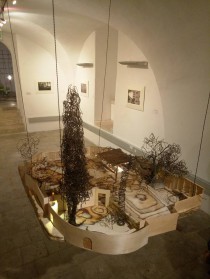
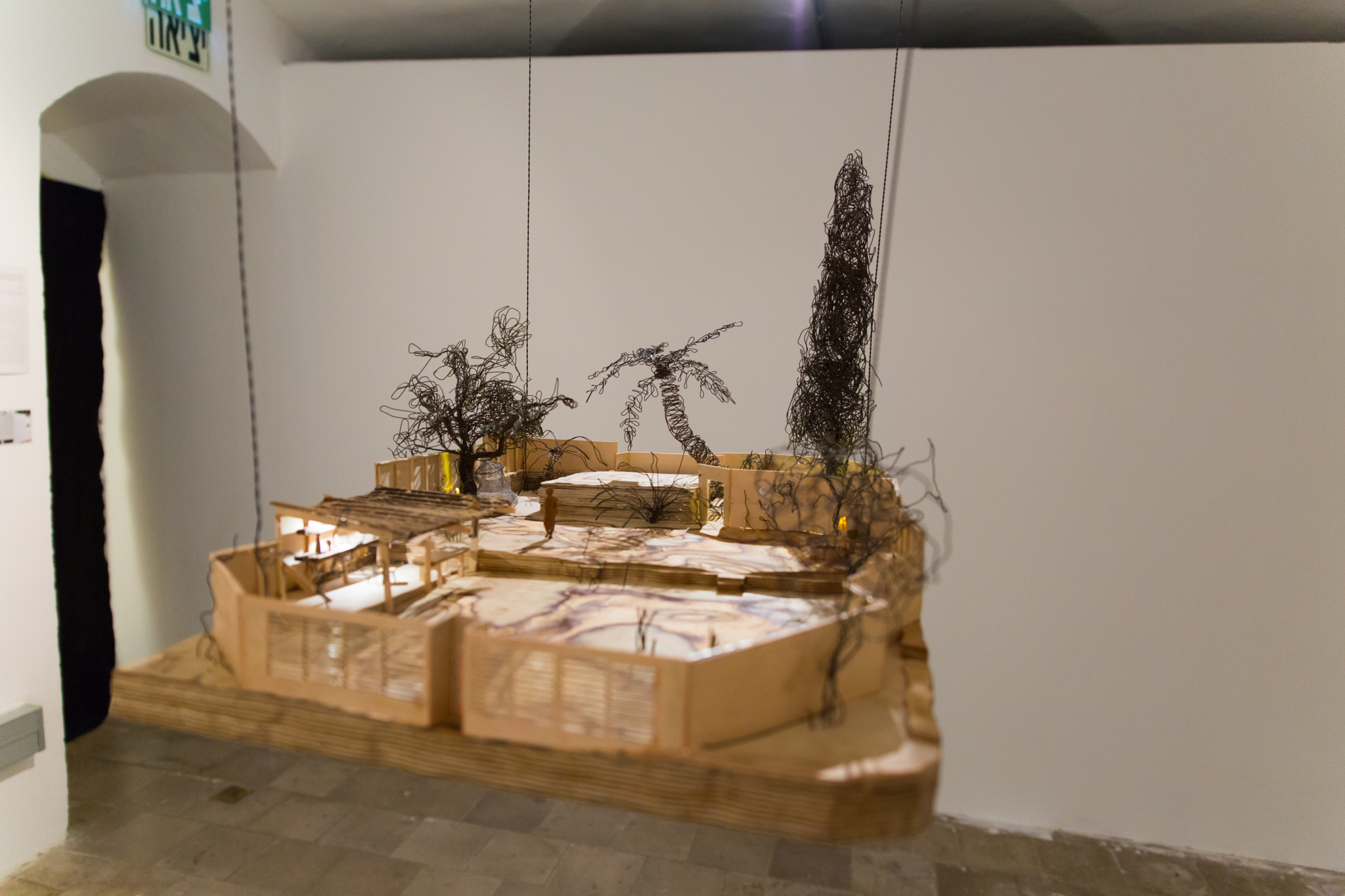
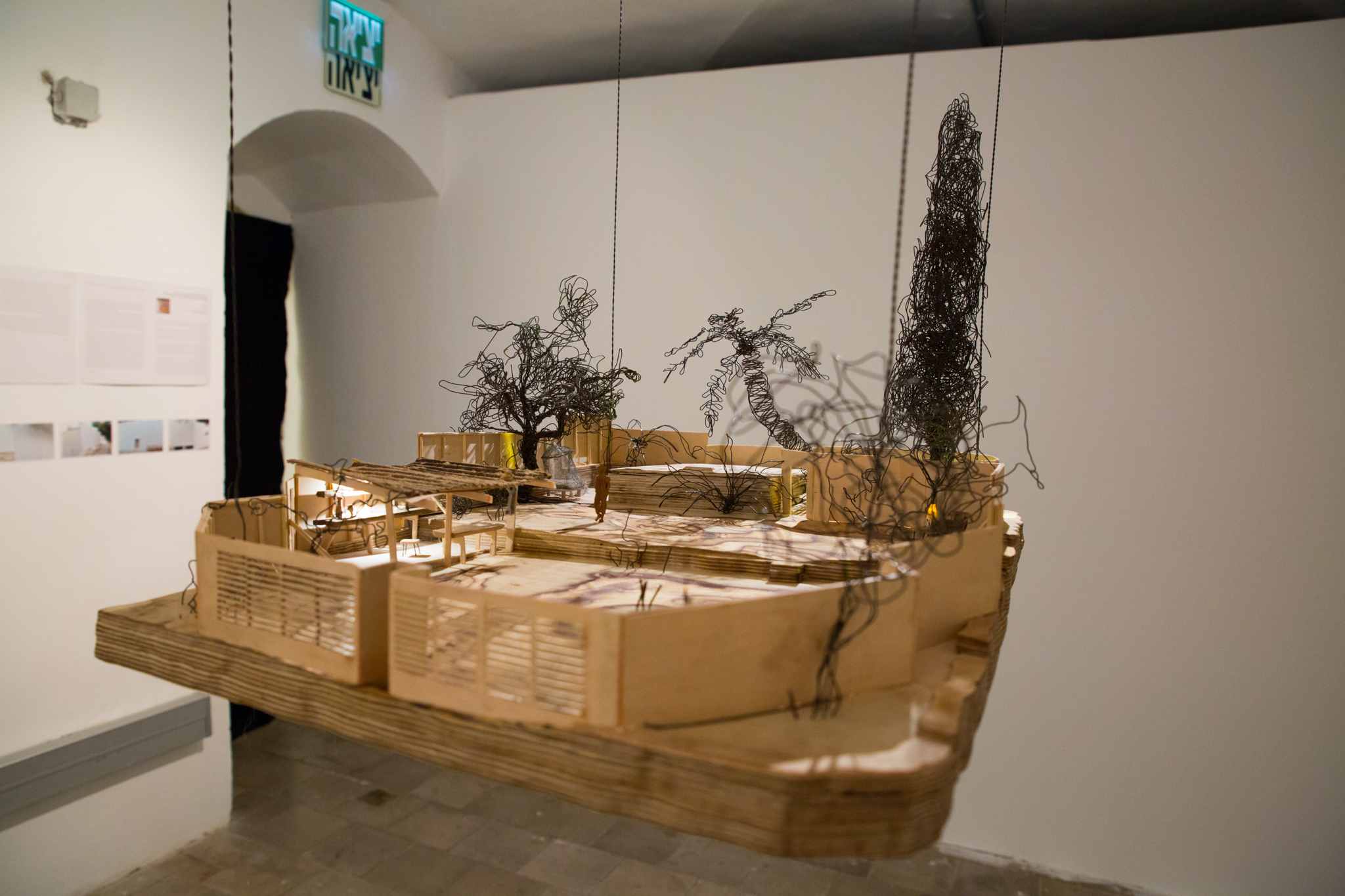
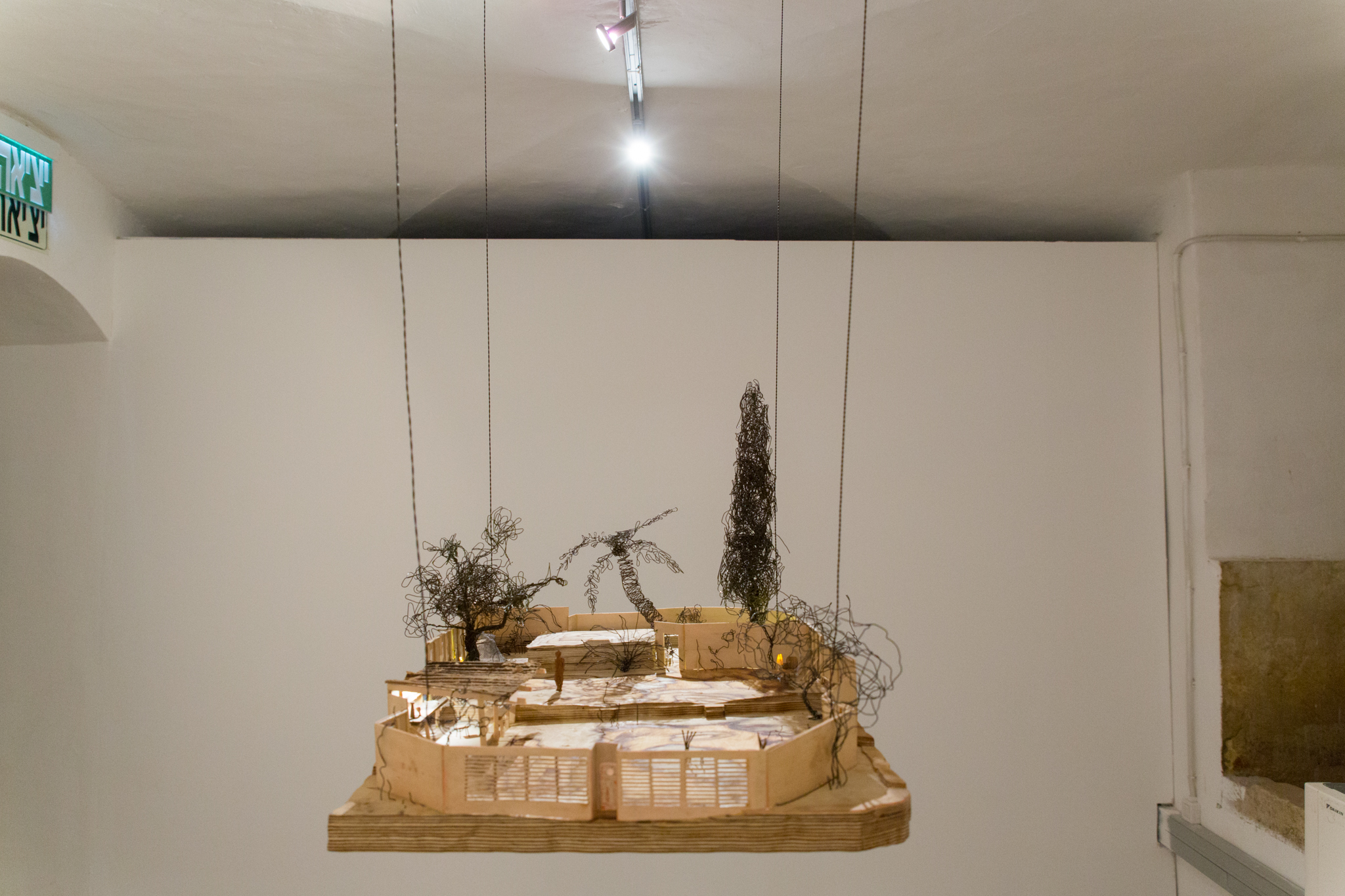
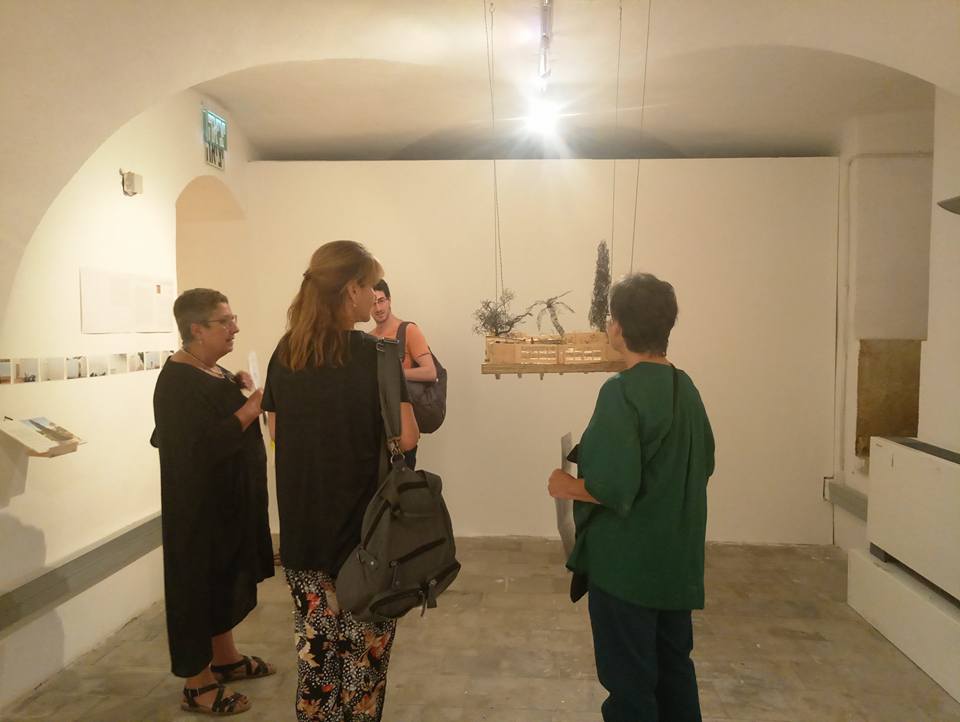
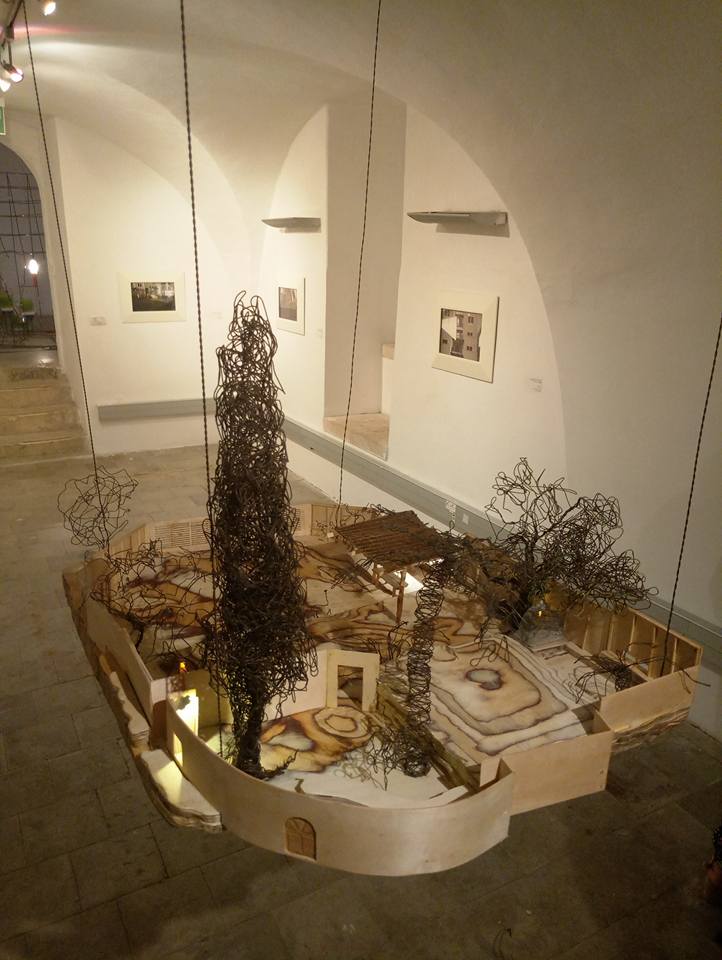
On Paradise Inn Hotel (model)
curated by Yaakov Israel, in the frame of “Autarkic Economy”, Hansen House, September-October 2017
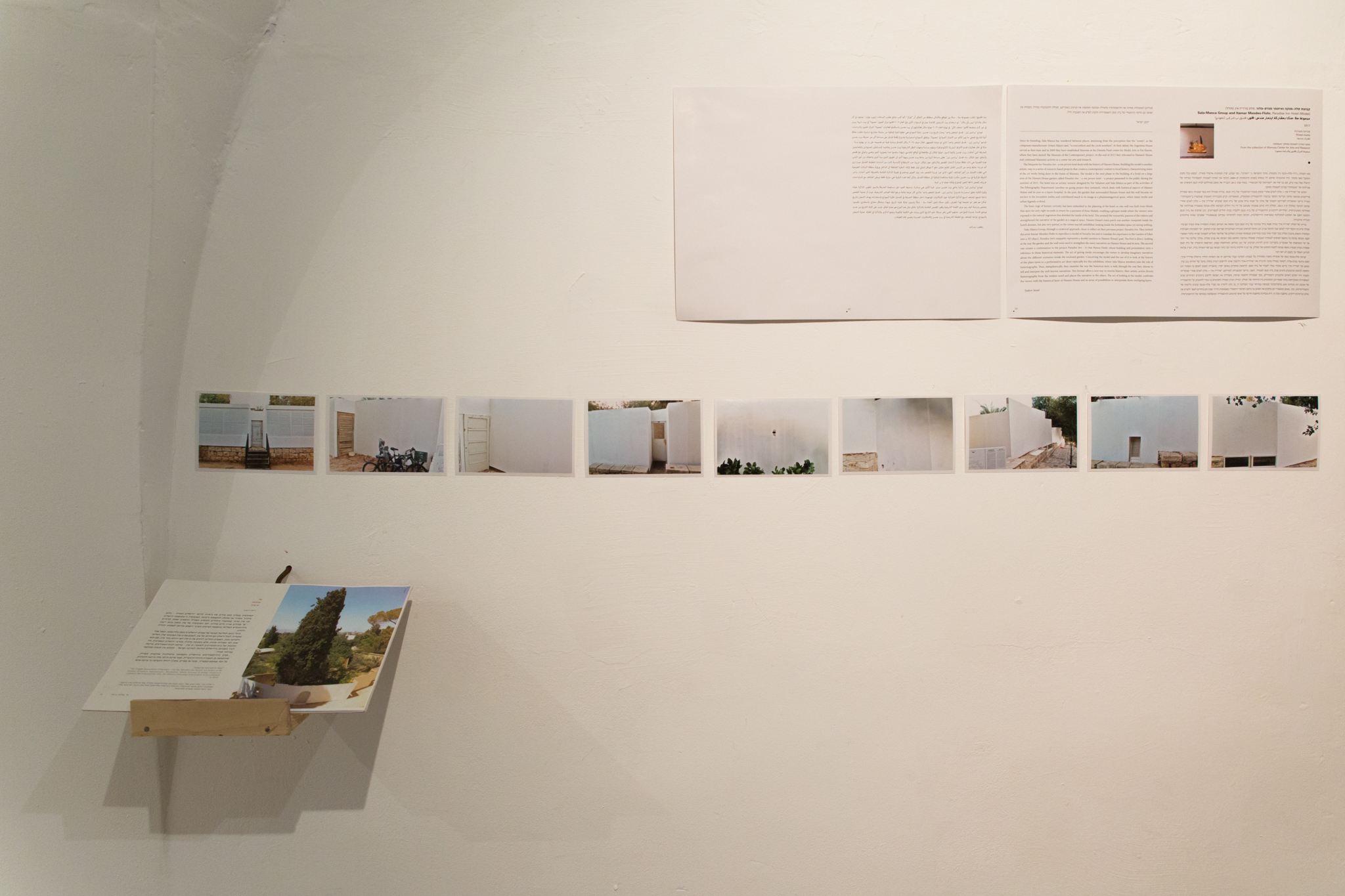
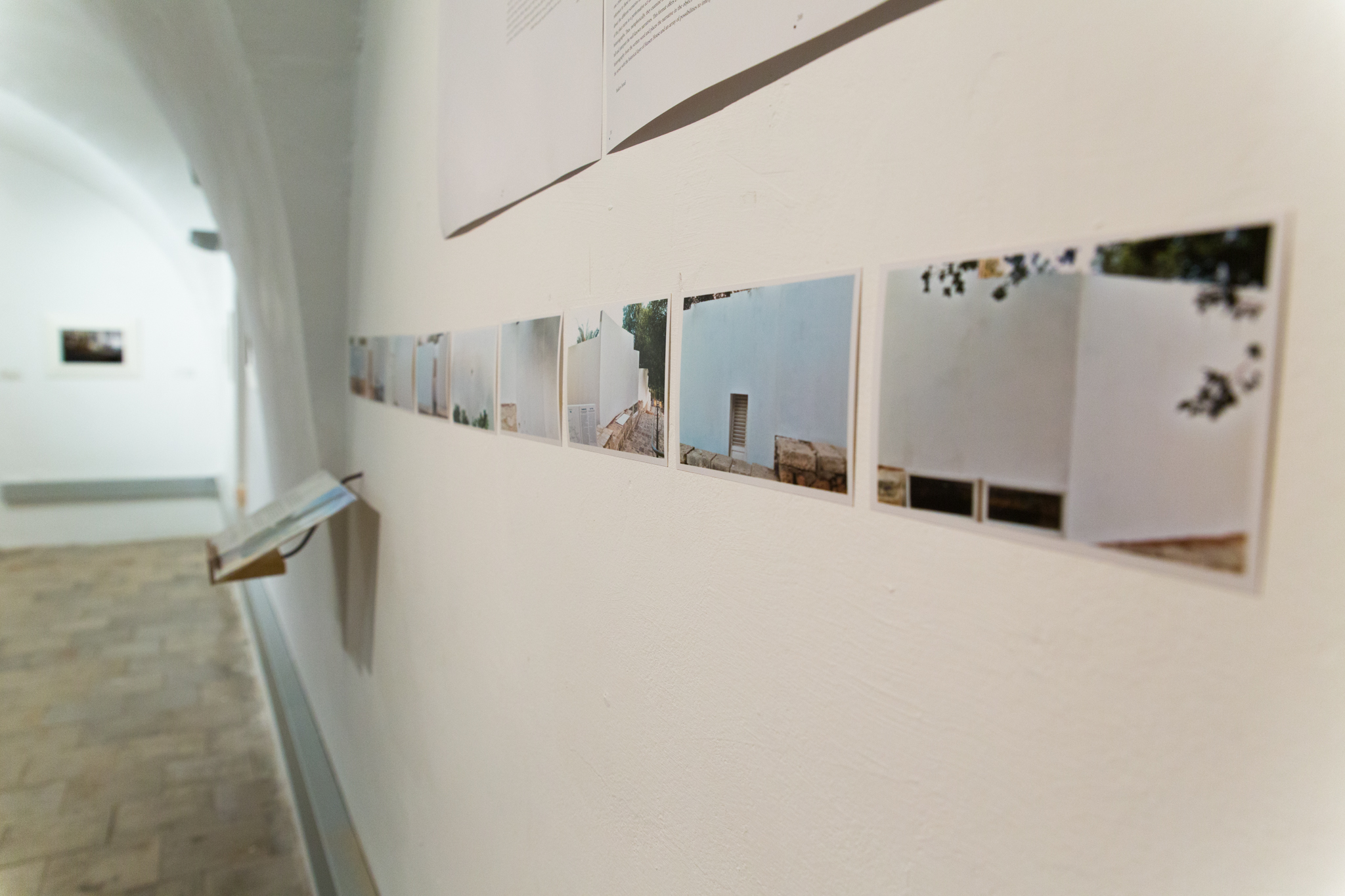
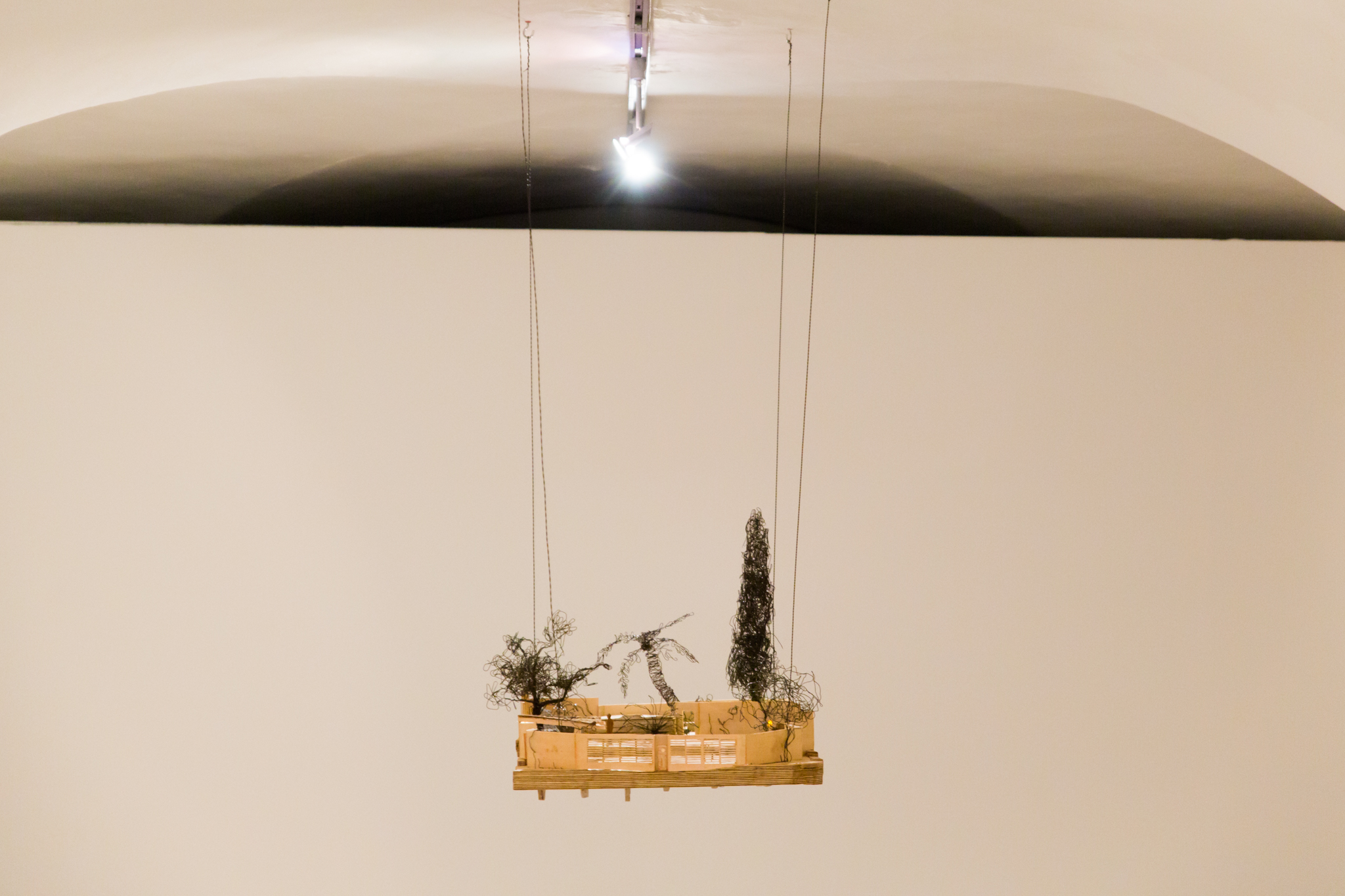
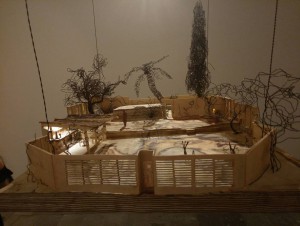
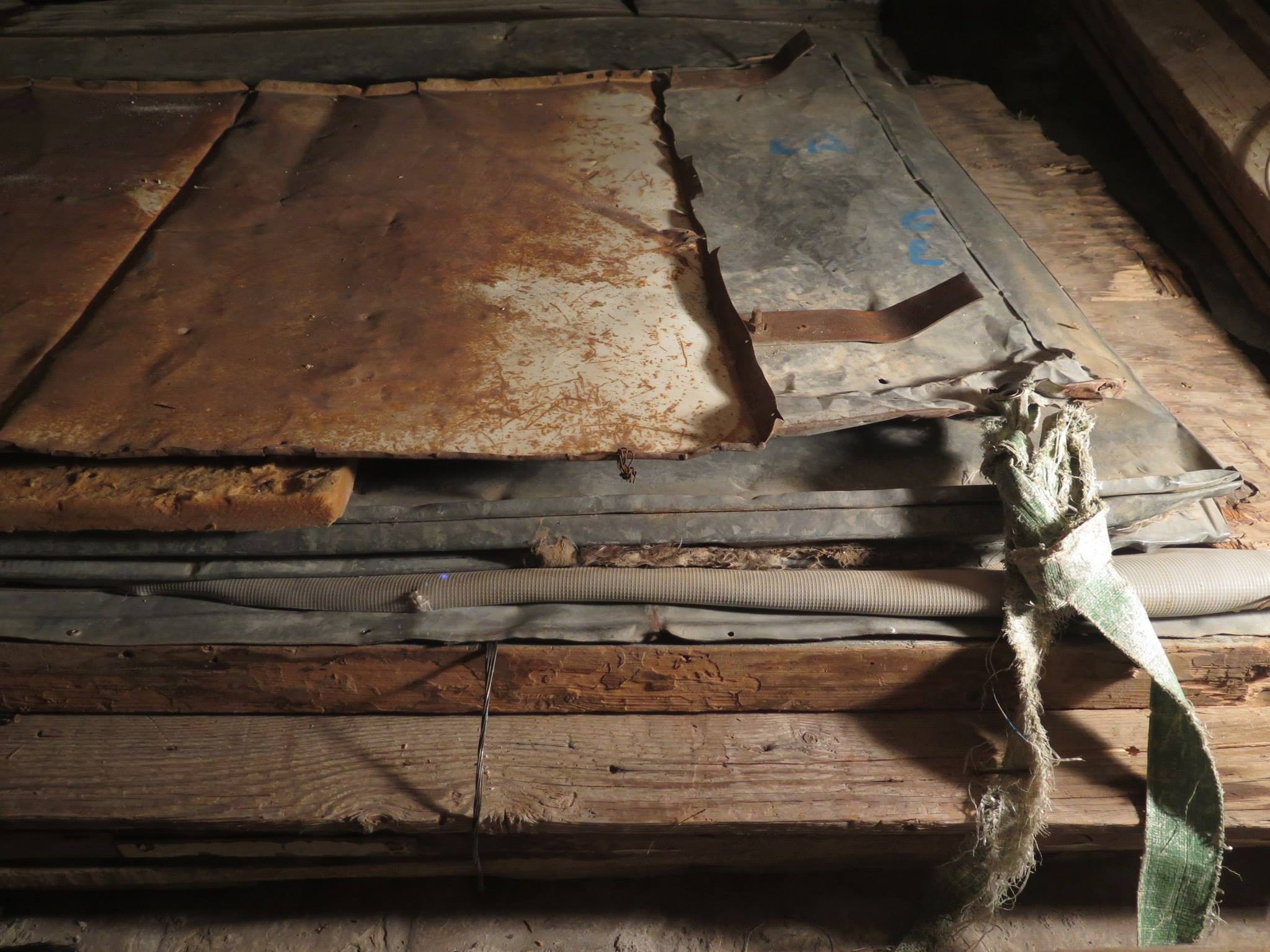
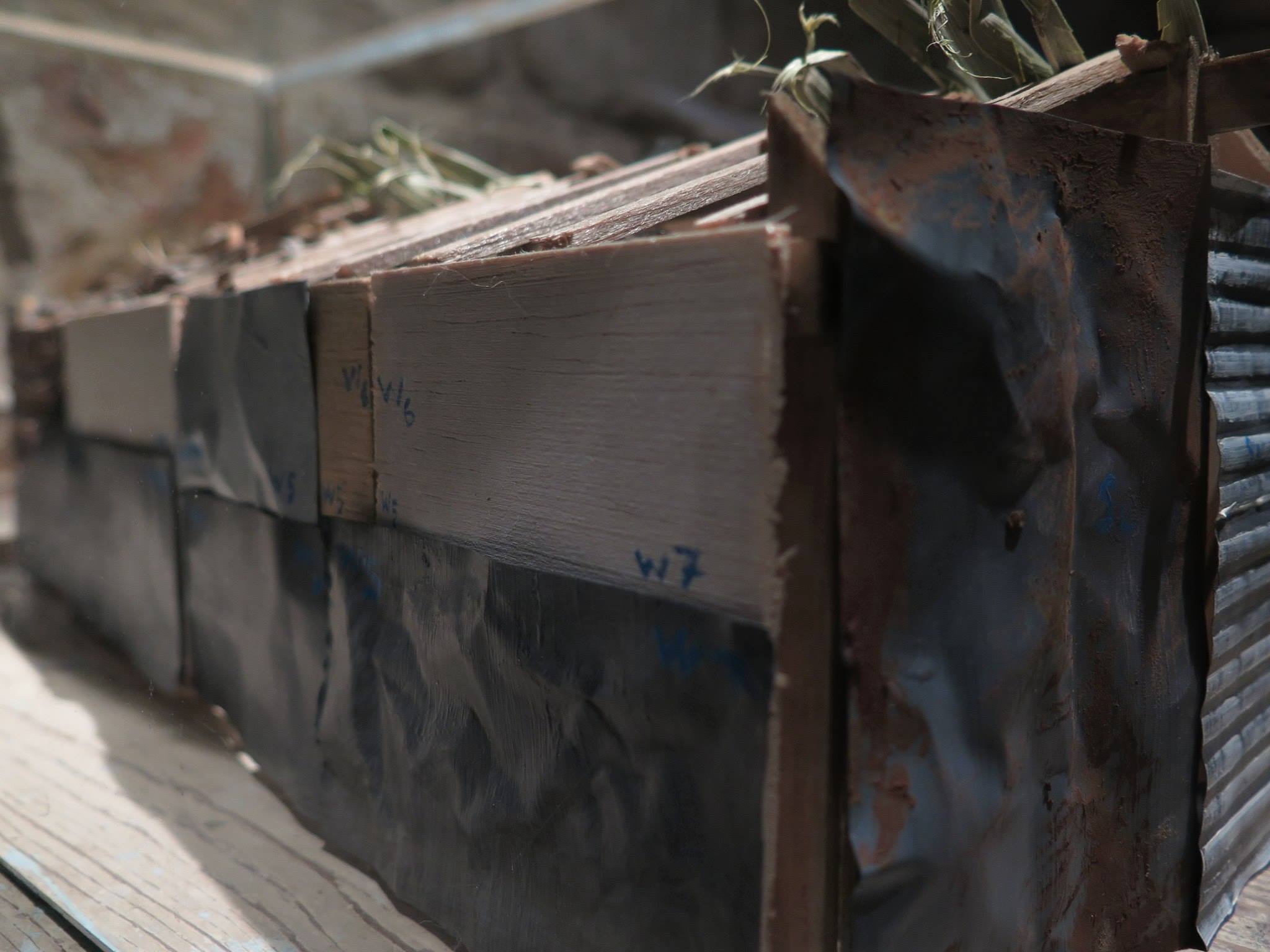
Since its founding, Sala-Manca has wandered between places, stemming from the perception that the “center”, as the compasses manufacturer Arturo Maura said, “is everywhere and the circle nowhere”. At their debut, the Argentina House served as their base and in 2009 they have established Mamuta at the Daniela Pasal center for Media Arts in Ein Karem, where they have started The Museum of the Contemporary project. At the end of 2013 they relocated to Hansen’s House and continued Mamuta’s activity as a center for arts and research. The Maquette for Paradise Inn – a one person hotel deals with the history of Hansen House. Building the model is another artistic step in a series of research-based projects that creates a contemporary context to local history, characterizing many of the art works being done in the frame of Mamuta. The model is the next phase to the building of a hotel on a large area of the Hansen House garden called Paradise Inn – a one person hotel – a project presented to the public during the summer of 2015. The hotel was an artistic venture designed by Nir Yahalom and Sala-Manca as part of the activities of The Ethnographic Department (another on-going project they initiated), which deals with historical aspects of Hansen House and its past as a lepers hospital. In the past, the garden that surrounded Hansen house and the wall became an enclave in the Jerusalem reality, and contributed much to its image as a phantasmagorical space, where many myths and urban legends evolved. The basic urge of human curiosity has been embedded in the planning of the hotel, so one wall was built from blinds that open for only eight seconds in return for a payment of three Shekels, enabling a glimpse inside where the viewers were exposed to the natural vegetation that shielded the inside of the hotel. This aroused the voyeuristic passion of the visitors and strengthened the narrative of the garden as a magical space. Hansen House’s main porch was another viewpoint inside the hotel’s domain, but also very partial, so the viewer was left unfulfilled, looking inside the forbidden space yet seeing nothing. Sala-Manca Group, through a curatorial approach, chose to reflect on their previous project Paradise Inn. They invited the artist Itamar Mendes-Flohr to reproduce a model of Paradise Inn and to translate his experience in the Garden of Eden into a 3D object. Paradise Inn’s maquette represents a double mention to Hansen House’s past. The first is direct, looking at the way the garden and the wall were used to strengthen the many narratives on Hansen House and its area. The second one creates a continuation to the project Paradise Inn – A One Person Hotel, whose building and presentation were a reference to these historical elements. The act of gazing inside encourages the viewer to develop imaginary narratives about the different scenarios inside the enclosed garden. Conceiving the model and the use of it to look at the history of the place turns to a performative act done especially for this exhibition, where Sala-Manca members take the role of historiographs. Thus, metaphorically, they examine the way the historical story is told, through the way they choose to tell and interpret the well-known narratives. This format offers a new way to rewrite history: their artistic action diverts historiography from the written word and places the narrative in the object. The act of looking at the model, confronts the viewer with the historical layer of Hansen House and an array of possibilities to interpretate these overlaping layers.
Yaakov Israel
Link to the Paradise-Inn project: http://old.sala-manca.net/?p=973 and review: http://old.sala-manca.net/?p=995
Pics by Yaakov Israel
Pics by Sala-manca:
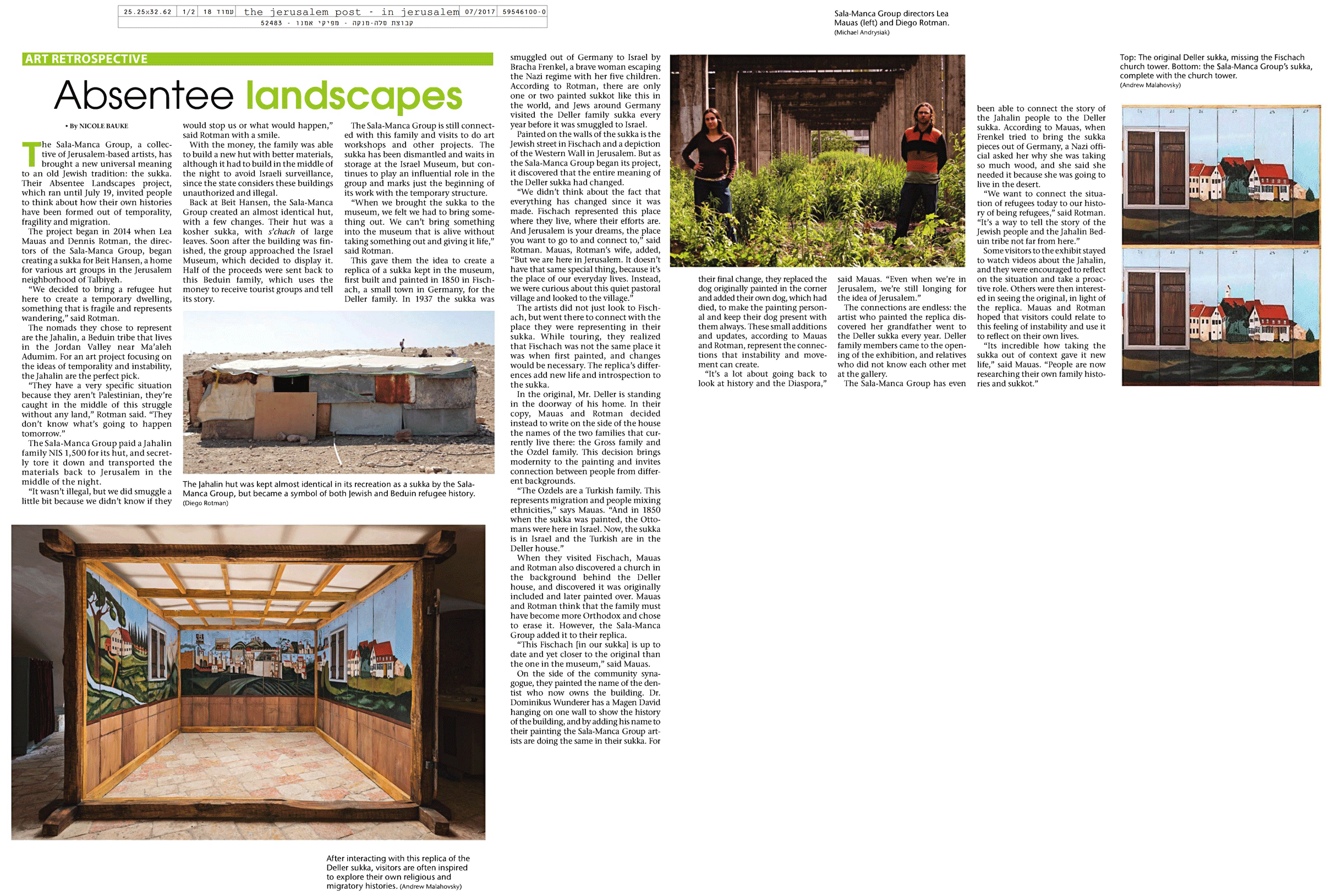
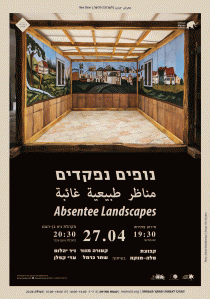
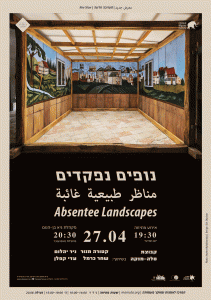
Absentees Landscapes (review by Nicole Bauke), Jerusalem Post, 28.7.2017
Click the image or on-line version

In the winter of 2017, a group of artists (the SalaManca Group, Nir Yahalom, Ktura Manor and Max Epstein) began building an unauthorized but accurate replica of a painted wooden sukkah from Germany (dating to 1850), which is on display in the permanent collection of the Israel Museum and is known as The Deller Sukkah.
The artists photographed the original sukkah at the museum, read articles about it, and even traveled to Fischach—a small town in Bavaria—where the original sukkah had been built and subsequently, with the outbreak of World War II, smuggled to Palestine to save it from the Nazis. At Fischach, some of the artists met with the local mayor, visited the graves of the Deller family members (owners of the original sukkah), toured the local synagogue (which now serves as a dental clinic), and documented at all on video.
At the same time, back in Jerusalem, the artists Adi Kaplan and Shahar Carmel created replicas of postcards from the town from 1920 (circa), and, in the bowels of the basement of the old leper colony building in Jerusalem, reconstructed one of the most beautiful sukkot in the world. The replica is a perfect copy of the original, but for a few deliberate differences between it and the original—some substantive and some symbolic.
As a consequence of the replication process, the paintings on the walls of the sukkah subtly transformed: the image of Jerusalem on one of the walls, which in the original was an object of yearning, became a kind of proprietary statement; the scenes of the pastoral German village on the three other walls, which used to provided a kind of visual record of the original landscape, became a wistful memorial of a community and a time that no longer exist. Other changes that were made to the replica effectively rendered it a new original: while the sukkah at the Museum is an ethnographic object that can be viewed but not entered, its replica, as created by contemporary artists, is an artwork into which entry is not only allowed, but encouraged, and can even serve as a bona fide sukkah.
The paintings themselves have also undergone small but significant changes: in them, the walls of the synagogue feature graffiti inscriptions that attest to its transformation into a clinic, and the house of the Deller family (the former owners of the sukkah) now bears the names of the two families who live in it today—one German, the other Turkish.
The replica sukkah is on display at the Absent Landscapes exhibition at Hansen House in Jerusalem (the former leper colony/hospital). The exhibition also features a film titled Eternal Sukkah—a past project by the group—which tells the story of how a hybrid Bedouin/Jewish sukkah became an exhibit at the Israel Museum in 2015, heralding the idea of transporting a sukkah from the museum into real life. A complex dialogue takes place between the Bedouin/Jewish “Eternal Sukkah” and the physical, metaphorical, and historical composite that is the “Deller Sukkah” at the Absent Landscapes exhibition. It is a dialogue between a nomadism and ownership; between enforced transience and transience as a religious value; between absentee landscapes and present ones; and between individual artistic endeavors of different historical periods, each of which, in its own way, exemplifies the drama of its time
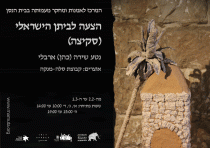
Neta Shira (Cohen) Arbeli’s exhibition, A Proposal for the Israel Pavilion (Sketch), is presented in two of the basement spaces of the former leper hospital in Jerusalem. This is Arbeli’s first solo exhibition, who hitherto has created mainly site-specific works. On this occasion, she has chosen to present a series of sculptures that she created in 2016, made of readily-available and inexpensive materials—such as wood cutoffs, plaster, paper pulp, sand and glue, acrylic and cardboard.
In one of the exhibition’s two spaces of the show is a series of sculptures dealing with a construal of urban space in Israel, with references to local architecture—both Arab and Israeli. One of the sculptures is a building in vernacular style (a DIY structure, or “architecture without architects”) with a date palm tree that has either collapsed, or been placed, or fallen asleep on it—a caress, as it were, by nature of a man-made object—or perhaps a subtle allusion to demolition.
Another sculpture depicts the Kakal (JNF) Square—a circular traffic island sculpted in sea sand, with a sign of the Jewish National Fund and three trees stuck on top. This is a kind of model of Israeli urban planning, based on a work of hybrid form of nature. The foreignness of the trees is underscored by the decision to envelope them in plastic wrap.
In another installation, Arbeli presents the front of a two-storey residential building clad in Jerusalem stone—in reference to the British Mandatory law that sought to preserve local architectural traditions, as a kind of intra-cultural reference to the aesthetic politics of pseudo conservation. Arbeli’s preoccupation with the import and export of nature and culture is a recurring theme in other works in this space.
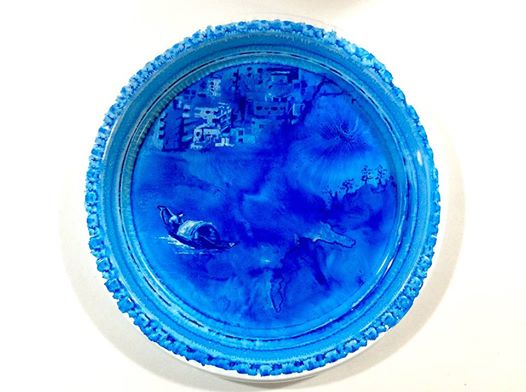
In the other space of the exhibition is an artificial sea, made of newsprint and sanitary wipes soaked in plaster and painted blue, like an everyday ephemeral reality. On this artificial sea floats a Venetian gondola, bearing several decorated camels—modified trinkets from a tourist souvenir shop in the Old City of Jerusalem, en route to becoming a memory of a visit to the Holy Land. The juxtaposition of the two icons of popular culture—the gondola and camels—undermines their status as symbols of a particular culture, and turns them into a hybrid symbol of consumerism as a product of modern tourism. The gondola is taking the camels to an unknown, horizon-less destination. Together they are sailing forth on an artificial sea, in the basement of a former leper hospital.
The Artist
Neta Shira (Cohen) Arbeli studied for a Bachelors degree at the Ceramics Department of the Bezalel Academy of Art and Design. After a stint as Artist in Residence at the Mamuta Center in Ein Kerem, she completed a Masters degree in Art at Bezalel. Her principal occupation is site-specific works, and sculpture.
In 2012 she took part in Ayelet Lerman’s project A Lot of Talk About Space, curated by the Sala-Manca Group at the Mamuta Center in Ein Karem.
In 2013 she presented a site-specific work at the Barbur Art Gallery in Jerusalem titled Inside Out, in which she collaborated with the artist Almog Ne’eman. In addition, she has taken part in group exhibitions at the Museum of Ashdod and at Menofim events.
Arbeli lives in Safed, where she has received an Artist-Teacher scholarship from the Ministry of Culture and Sport, and teaches art at the Chabad High School for Girls, at Hannah House in Safed.
Familiar Stranger | Maya Shleifer
Curators: Sala-Manca
Mamuta Art and Research Center
Opening hours: Tues.-Wed.: 10:00-14:00, Thurs: 15:00-19:00, Friday: 11:00-14:00
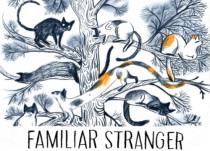
Passersby, people on the train, women who meet during walks, passengers on the bus – others and strangers are the inspiration for Maya Shleifer’s series of works, which explores the world of familiar strangers as she imagines it.
In the exhibition, Maya’s illustrations gain another dimension through various techniques: from mythological devices that hark back to the early days of cinema like Zoetrope to physical computing. The installations in the exhibition hold a dialogue with the world of pop up books and incorporate projections of moving images and static illustrations in varying degrees of interactivity. The space in which Maya’s images are scattered echo the world of filmmaker Georges Méliès and animator William Kentridge, as well as the world of old children’s books.
Maya is an illustrator and a designer. We worked together for the first time when she was still a student at Bezalel, when she designed the first issue of Hearat Shulayim and devised the journal’s aesthetic line. In the 15 years that have passed since, she designed fascinating children’s books, among them “It’s Not Easy Being a Superhero”, “Princess Zohara,” and “The Bunny Who Wanted to be a Tree,” and was chief designer at TheMarker newspaper. All the while, she continued to create her own personal works.
This exhibition, which is Maya’s first in the art field, brings us back together. In this reunion which also we joined forces with Guy Yitzhaki, Nir Yahalom, Yuval Kedem, Studio Poink, Ofir Gal and Yuri Smertenko creating for Maya’s world of motion a space that is somewhere between an open studio, a laboratory, and a cabinet of curiosities.
Programing: Guy Yitzhaki
The wheel mechanism in ”The World is Round”: Yuval (Galileo) Kedem
Technical supervisor and Zoetrope: Nir Yahalom
Technical assistant: Yuri Smertenko
Sound: Ofir Gal
Animation: Studio Poink
Opening: Tuesday July 12, 8pm
Exhibition hours: Monday to Thursday 10:00-15:00 — For group and guided visits in other hours please contact us
Curators: Sala-Manca
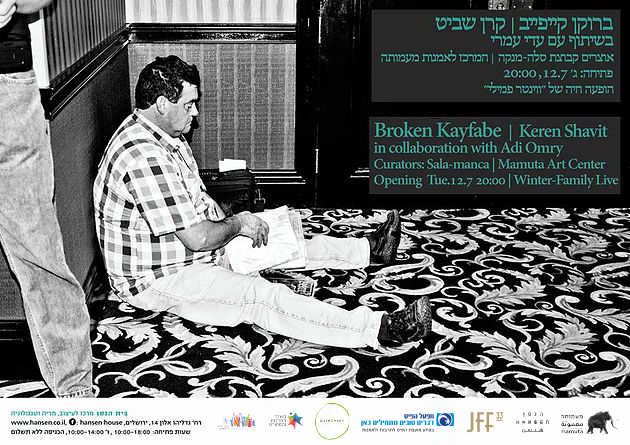
North Carolina. Brooklyn. Dallas. Keren meets a family on the subway, she meets another family when she wants to learn the harmonica. She is drawn to them. They are drawn to her. She asks to film in their homes. To film them. In exchange, in one case she is asked to come to the local church every Sunday for two months. In another case she moves to North Carolina with the family she has met.
Who is she for them? She is Trixie the lover, or mom Trixie, or sister Trixie. And so the game begins. She asks them to tell her everything they do not like about her. They write letters to her and start rehearsing. They play with reality. Everyone are filming and everyone are acting…or are they? Trixie-Keren uses manipulations, staging the relationships while they direct themselves. She asks permission to eat their leftovers. This is the starting point of “Shelf Life.” She eats the leftovers and in return she has to surrender. Change her identity. Keren will give them all in order to get what she is looking for. What she needs. Examining different family models. She looks not to be loved, to get the leftovers. The entire world is an edge. The assistant director becomes a character, a member of the family. Trixie the whore is Keren the artist. She eats the leftovers of the family, which in return, ask of her to take part in the filming of their own horror screenplay which we will not get to see. (The screenplay and footage are the property of the “father” in “Shelf Life”).
Between films, the stills and videos of “Broken Capefive/Kayfabe.” A story that links the two films. The story of the pro wrestling brothers Von Erich from Dallas, Texas, which an Israeli girl called Keren loved and admired. Keren wants to be a part of the famed wrestling family, this is her teenage dream. A fantasy that takes the form of a fictional story, through which she photographs and documents. One by one, the Von Erich brothers commit suicide. This is not a fiction. Keren looks for other families through which she could ask about her place. Keren sells herself senseless. “You cannot help but love Trixie,” says Danny. “It’s impossible not to love Trixie” says Dani
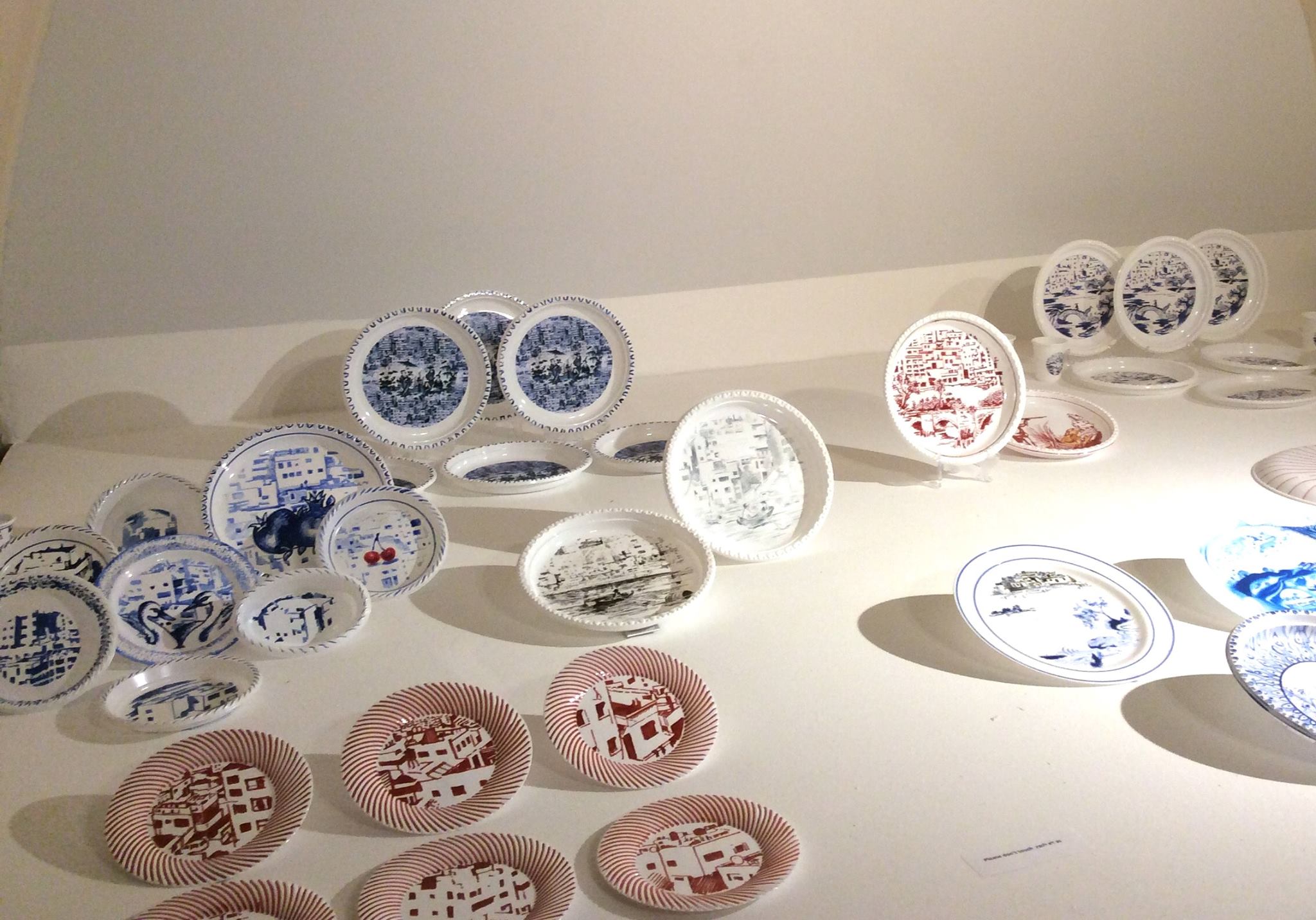
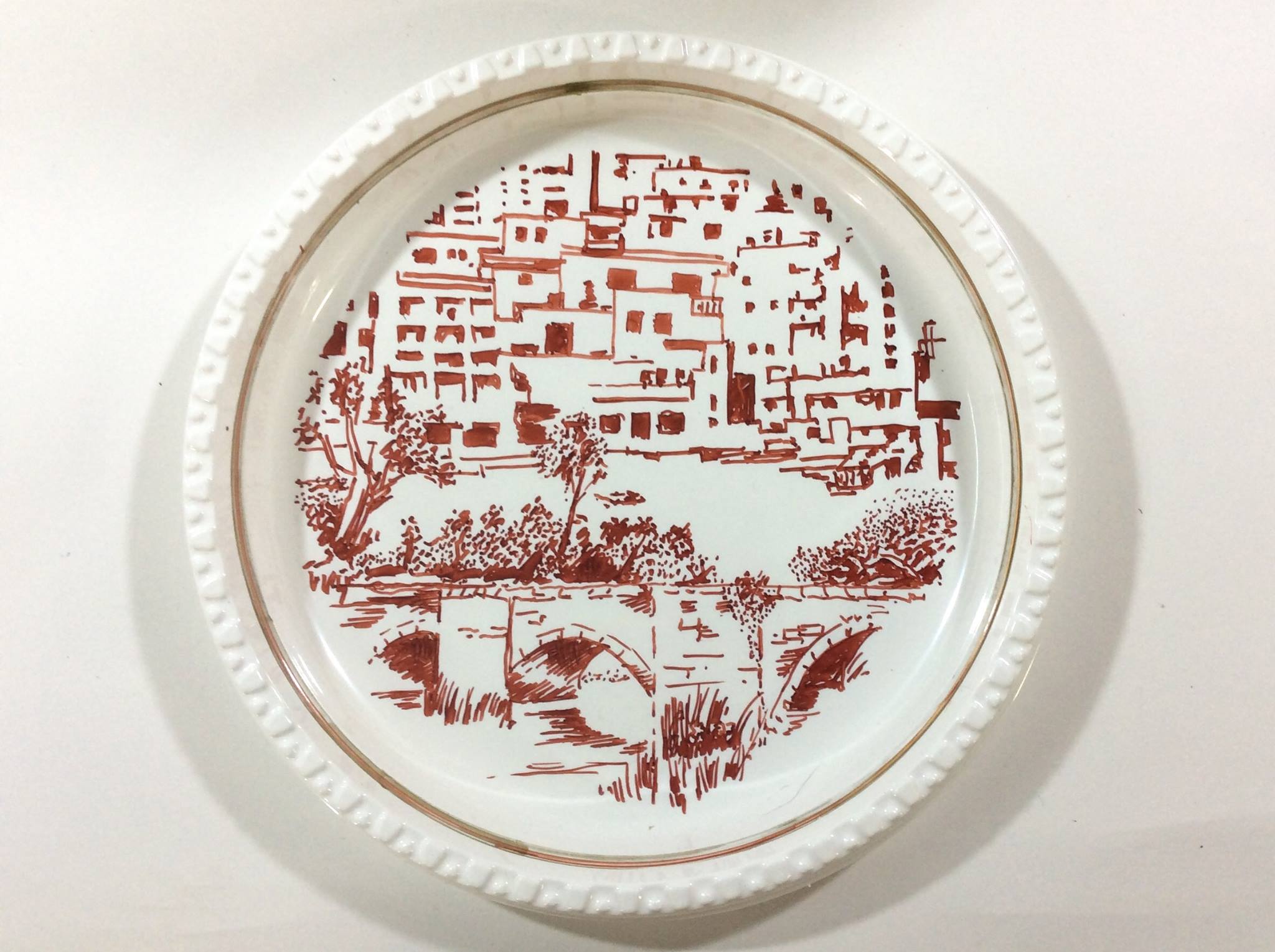
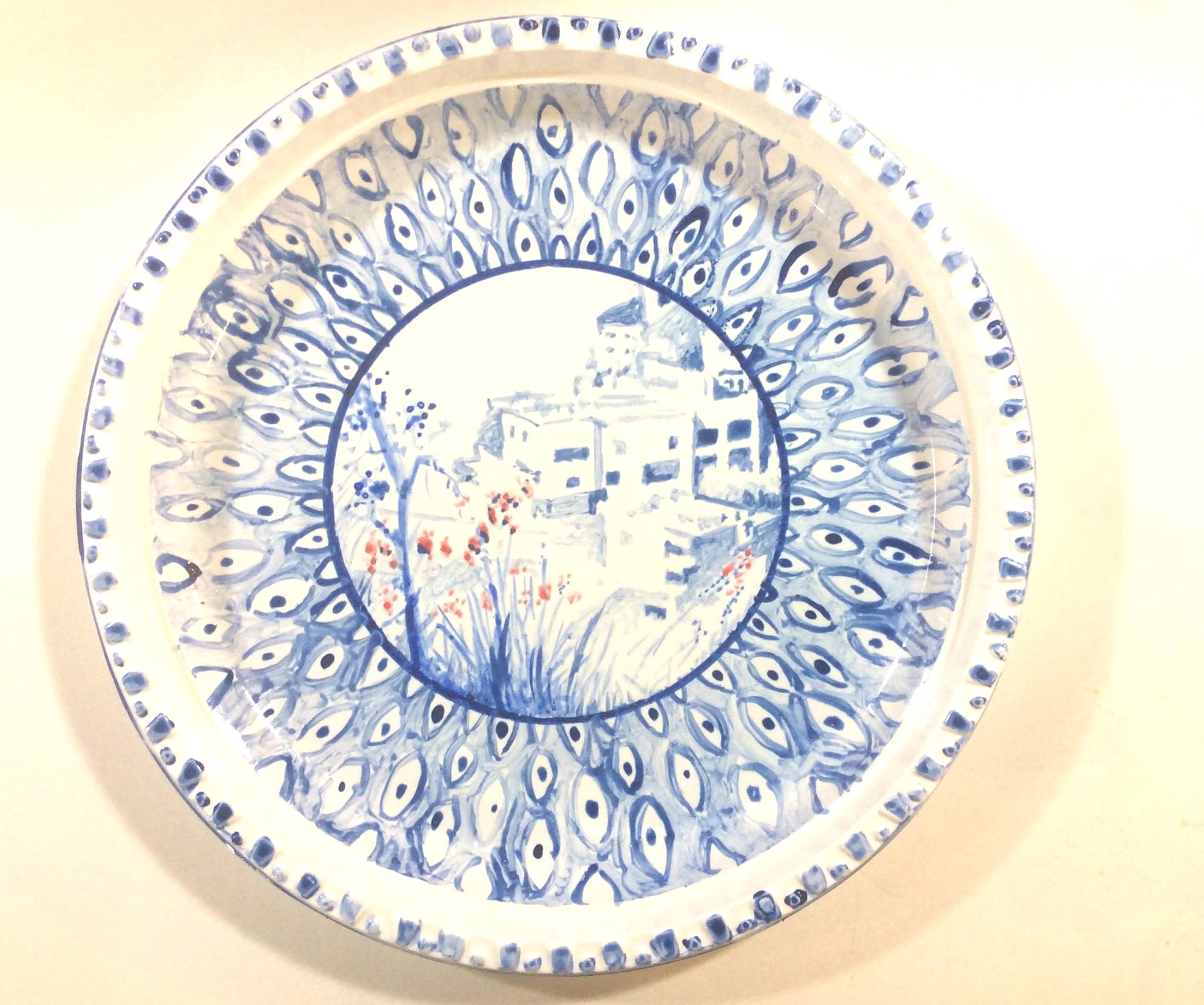
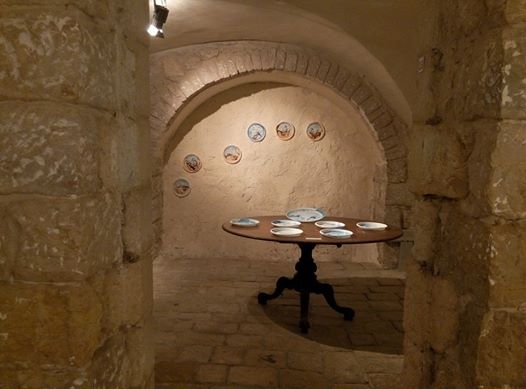
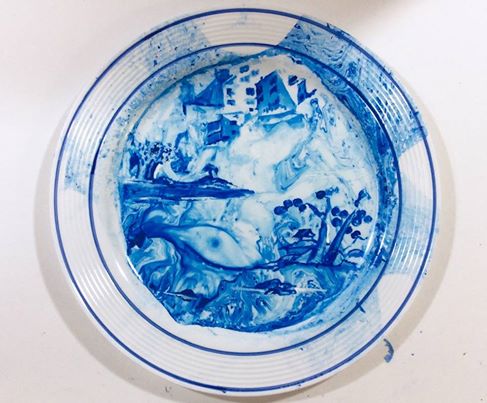
Reuven Zahavi’s exhibition “China” is named after traditionally decorated Chinese porcelain in common domestic use. Zahavi presents the Issawiyeh Tableware — a collection of disposable plastic plates which he uses as platters for his drawings. (The collection’s Hebrew name, Servis Issawiyeh comes from the Hebrewfication “servis,” meaning a dinnerware serving set.) The drawings offer a view of Issawiyeh, the large village at the foot of the Hebrew University on Mount Scopus, as seen from the windows of the Bezalel Academy of Arts and Design.
Sketches depicting the Palestinian village — whose inhabitants live in dire conditions despite its inclusion in Jerusalem’s expanded municipal borders of 1967 – replace the Chinese or European landscapes associated with “china.” At times it even seems that the familiar pastoral images meld with those of the crushed village. “The village,” says Zahavi, “where smoke rises daily and booming sounds are routine, stays transparent to the Mt. Scopus community.” This transparency is conveyed by the illustrative drawings that decorate the plastic plates – flora and fauna, lakes and bridges, gardens and hunting scenes or other “Chinese” and imaginary scenarios. All of these express Zahavi’s distant stance and the posture (or imposture) he assumes towards the village and its people.
Zahavi observes the village from the grand windows of the Bezalel academy with its distinguished artistic history, thus connecting his work to a tradition depicting the Jewish landscape in Israel. But his choice to sketch the village through a foreign aesthetic tradition defamiliarizes the Palestinian village. This defamiliarization invites both artist and viewer to direct their gaze at the transparent village, to take note of the art academy’s location and position, and to contemplate the artist’s relation to both.
The choice to sketch the drawings on disposable plastic raises riveting questions regarding the status of painting and of the artist. This choice boosts the plastic’s value and simultaneously raises doubt as to the artwork’s merit. “The white plastic plate,” Zahavi says, “stubbornly refuses any paint medium. It is a cheap imitation. It is recycled in a series of ‘reflexive exercises’ whose purpose is to concretize the problematic stand of the spectator, the object and the artist via a reality of transparent oppression.”
The collection presented in the exhibition presents the artist’s stand as seemingly ironic or perhaps self-reflexive. Is the choice to immortalize the village on a plastic plate meant for disposal an expression of contempt – even if unconscious – towards the transparent village? Does it reflect the brute quality of contemporary culture? Is it an allusion to the brutal Israeli policy towards Issawiyeh villagers who are currently under curfew? Or does the choice suggest doubt regarding simulation and posturing of materials, and perhaps artistic endeavor in general, not only via itself but in its relation to reality?
The exhibition of the collection in Mamuta Center’s Underground Academy at the Hansen House as part of Jerusalem Design Week positions Zahavi’s work not only in relation to the tradition of Israeli landscape painting, but in relation to the language of design, craft and mass production. Zahavi raises questions regarding the status of the functional, disposable object in relation to reality, to the immortality of art, and even to that of the nation. “China” – a beautiful collection of highly charged sketches on a set of cheap plastic plates – comments on the very act of drawing, and contends with the erasure involved in gazing at the village of Issawiyeh from the gorgeous windows of the university at Mt. Scopus.
Reuven Zahavi lives in Jerusalem, teaches at the Bezalel Academy for Arts and Design and at the Hebrew University of Jerusalem. He works with drawing and painting alongside digital media and is engaged in theoretical studies of craft, design and contemporary art-making.

Paradise Inn
Paradise Inn, Talbiyeh, Jerusalem. A dream for only one person. Infinite stars and a real gate to paradise. Reserve your room at the former Lepers’ home.
Jerusalem, where any piece of land can become your temporary dwelling.
In light of the policy of the city of Jerusalem to develop tourism and to use art and culture as a touristic tool, a group of local artists decided to be part of this new trend. In order to generate a new resource for tourism as well as some independent income for local artists and the Mamuta Art and Media Center, they established the luxurious Paradise Inn on part of the lands of the former Jerusalem Lepers’ Home at Hansen House.
Using a “green” approach to urban design as well as the idea of recycling electronic waste, the artists created a summer hotel for temporary residence, inspired by Bauhaus architecture, temporary techniques of modernist parcelization, and the new school of architecture, Growing Walls.
The artists participated in the design and implementation of all aspects of the hotel, with the goal of giving everyone the possibility of spending a few nights at Paradise Inn. The project synthesizes new visionary ideas for a modern Jerusalem: a hotel for only one person, a personal paradise built in the exquisite Hansen House gardens.
Image“Paradise Inn is an island surrounded by the walls of the former Jerusalem Lepers’ Home. A metaphor of differentiation and exclusivity. Paradise Inn is a luxurious paradise that originates from a public institution that was historically used to protect society from lepers and lepers from society. Paradise Inn dwells in the spirit of gentrification, inviting an artist to reside for free in the paradise for a month and a half. In return, the artist is expected to produce artwork for the comfort of future residents.” (From I Love Jerusalem Magazine)
In the year 2018, the utopia that Boris Schatz wrote about in his novella “The Rebuilt Jerusalem: A Daydream” (1923), is supposed to be fulfilled. A Utopian Jerusalem in which paradise exists; harmonious coexistence with nature and with the Arab residents of the city, and building of the Third Temple, which will serve as a museum, with the consent of the Arab minority.
Three years prior, in the year 2015, at the Hansen House gardens, Paradise is built – a haven in the middle of the city, a white façade bounding a garden that has been expropriated from the public. In Paradise, only one human being at a time can experience the ideal and modern natural living, leaving the public with a sense of longing, allowing a sneak peek into a free and peaceful world, at an affordable price.
The entrepreneurs of Paradise Inn have invited an artist to live and create for a month and a half in this daydream – an infinite-star hotel for one, a slice of nature in the middle of Jerusalem, in the historical garden of the former Lepers’ House.
From the middle of September, Paradise’s sole room will be available for rent at an outrageous rate for all interested.
Please visit us and reserve your nights: www.paradisehotel.co
Concept: Sala-manca
Architects: Sala-manca and Nir Yahaom
Interior Desing: Itamar Mendes-Flohr
Paradise Inn art collection: OZ Malul, Guy Yitzhaki, Itamar Mendes-Flohr, Sala-manca, Shaul Zemach.
Souvenirs: Silent Room 1, Chen Cohen | Room-Kit, Pessi Komar | A letter for you, Shiri Zinger, Elevator to Paradise, Lior Pinski
Avantgarde workers: Yuval Galili, Diego Rotman, Yeshaiahu Rabinowitz, Rotem Zuta, Ayala Shamir, Ktura Manor, Lea Mauas, Chen Cohen, Galia Lulko, Nahuel & Ayu
Paradise Inn website: www.paradisehotel.co
Observation post to Paradise: Conrad Shick
Press:
http://www.haaretz.co.il/gallery/art/artreview/.premium-1.2732894
http://old.sala-manca.net/wordpress/wp-content/uploads/2015/08/almost-paradise.png
Mamuta at Hansen | Artists: Yeshaiau Raboinowitz, Itamar Mendes-Flohr, Sala-manca, Ktura Manor, Ester Bires, Amitai Arnon, Nir Yaalom, Adi Kaplan, Shahar Carmel, Hanan Abu-Hussein, Samuel Rotman | Curators: Sala-manca
Opening Hours: Monday and Thursday 10-15, Wednesday 17-21 and Fridays 9-12
The Ethnographic Department addresses the link between an art museum and an ethnographic museum, between “fine” art and “folk” art, and the tension that exists between original, restoration, copy and adaptation. All of these are aspects central to the curatorial thinking that has guided the Museum of the Contemporary since its onset.
The Museum was founded in December 2009 at the Mamuta Center in Ein Kerem, in the home of Daniela Passal, formerly the home of Palestinian researcher Issa Manun and in the interim “absentee property”.
The first exhibition dealt with the museum as an institution, with the topography of Israeli memory, with the local historiography of the village Ein Karem and and with the home of the museum – the home of Daniela Passal. The Museum also developed a digital storage room of exhibitions which are not viewable on the net but are offered for downloading – each exhibition as a “package” for printing, exhibiting or re-installing – according to the physical and economic possibilities of the downloading body.
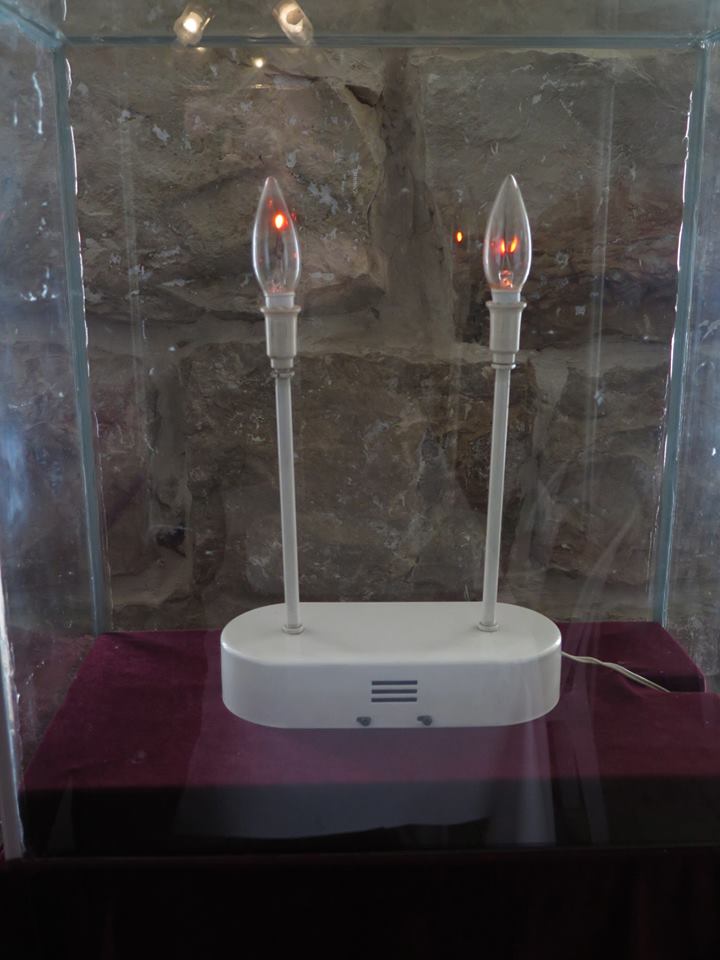
The Ethnographic Department also deals in part with the history of the structure in which it dwells. This is the Leprosarium Jesus Hilfe , founded as an isolatedrefuge for leprosy patients.

It was created by the German-Protestant Moravian community in 1867 and operated for twenty years in a building on today’s Agron Street, Jerusalem. In 1887 the institute moved to a new building in the Talbiya neighborhood of Jerusalem, planned by Konrad Shick.

Press:
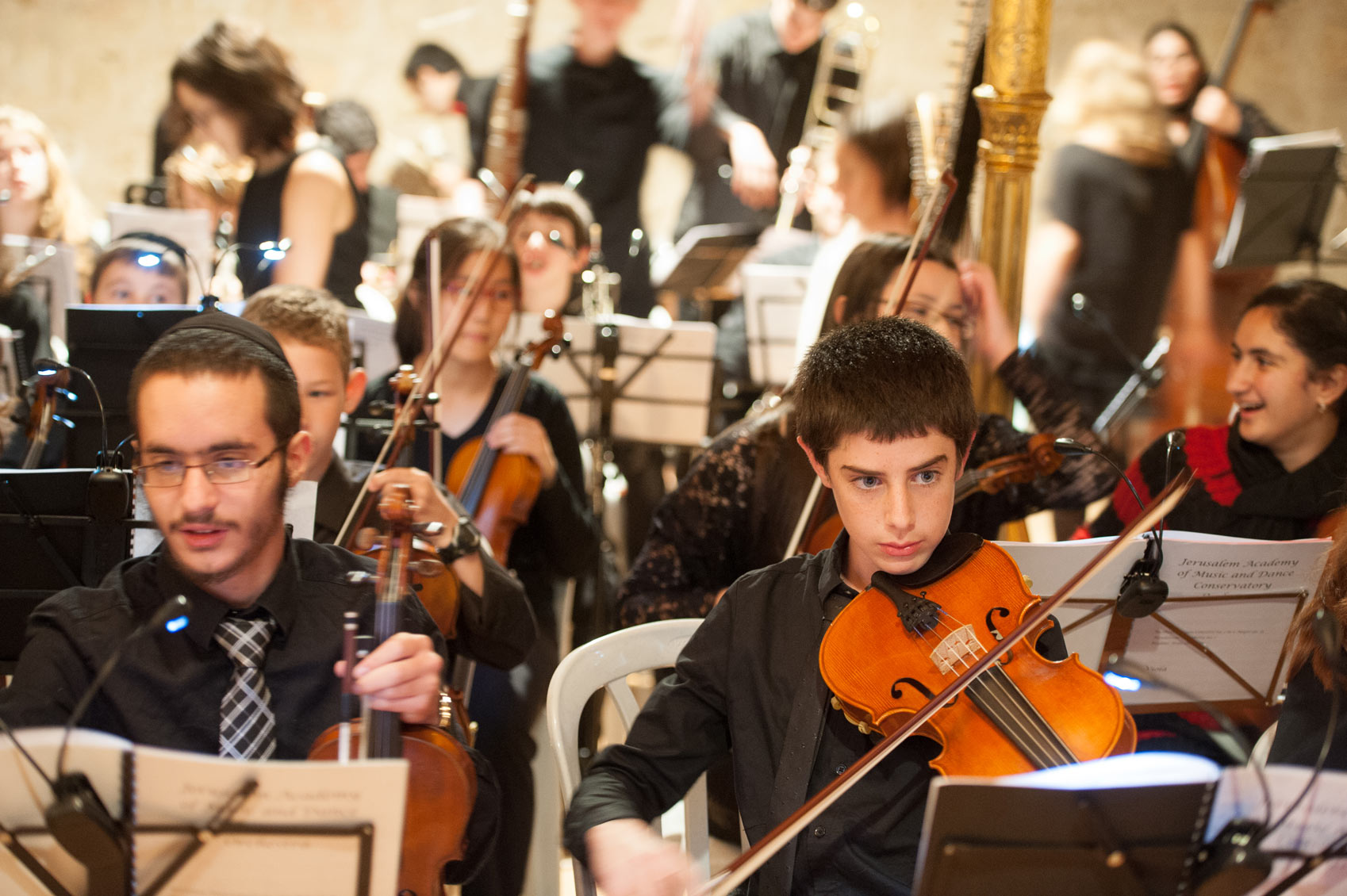
Participating Artists: Adi Kaplan, Shachar Carmel, Tom Soloveichik, Alex Drool, Josef Sprinzak, Carmel Bar, Li Lorian, Adam Yodfat, Victoria Hanna, Noam Inbar, Shira Borer, Jerusalem Conservatory Chamber Orchestra with Conductor Michael Klinghoffer, Ilan Volkov, Zohar Shafir, Tomer Damsky, Eran Sachs, Maya Dunitz
Curators: The Sala-Manca Group and Guy Biran
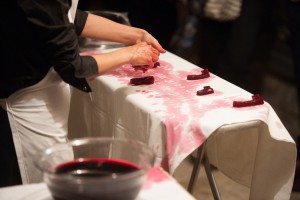
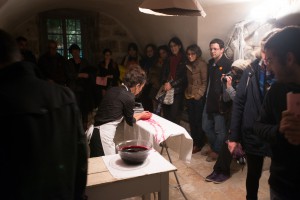
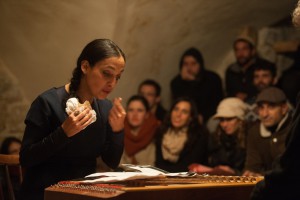
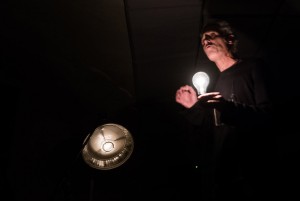
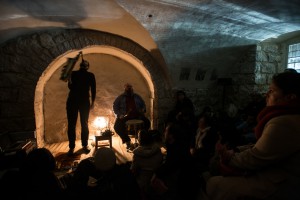
The 14 Kola Shel Ha’Mila Festival Named after Mario Kotliar Bekola Shelo Dybbuk The Hazira Performance Art Arena’s flagship festival, now in its 14th year, examines the relationship between word/text and performance art. This year, the festival is being held in participation with the ‘Mamuta’ Center for Art and Media at Hansen House. in the photo: Joseph Shprinzak The dybbuk (an evil spirit in Jewish folklore) phenomenon, through Ansky’s play, is the basis and inspiration for this year’s Kola Shel Ha’Mila festival (The Voice of the Word). The Mamuta spaces at Hansen House, formerly a leper colony, are transformed into an area for challenging one’s spiritual transformation, as a metaphor for the ancient building’s newly designated mission. In Kola Shelo, Hansen House is granted the suppressed forces of experience, which connect past and present, art and ritualism, healing and performance. The dybbuk is an external force that penetrates the human body and causes it to behave erratically. According to tradition, the dybbuk is the spirit of a deceased person, which takes over a live body and speaks through it in another voice. The dybbuk is a way of coping with harsh social situations, voice dissent, for which the afflicted have no words, and reveal dark occurrences from a community’s past.


Maybe it’s because the Leper Hospital was previously known as “Jesus Hilfe”, or,”Jesus Help Asylum”, and it reminds us of two of Jesus’ qualities – healing and banishing demons; maybe it’s because in 1950 a different, political and ideological spirit possessed the building, and it was decided to change the hospital’s persona and rename it after Dr. Hansen, who discovered Leprosy’s origin and seemed, to the building’s new owners (Israel’s Health Ministry) , like the right spirit for the public body they now represented; maybe it’s because the Leper Hospital lost its function, became an arts and technology center, and was named “Hansen House”, as if it is the home of the spirit that replaced Jesus; maybe it’s because today, instead of the lepers, artists and students are the ones who live in the building, and sometimes challenge the local cultural hegemony; maybe it’s because one hundred years have passed since S. An-sky’s ethnographic expedition, where he collected a part of the stories that functioned as the play’s basis, and a hundred years since the play’s first drafts were written in Russian and Yiddish; maybe it’s because of all these things, separately or together, that we decided, as a part of the “The Voice of the Word 14” festival, to return to one of the most profound traditions in Jewish culture, to dwell on an external spirit which possesses the body of a flesh and blood human being: the Dybbuk.


“Into the body of a living human being, with an individual, distinct soul, enters at a certain point in his life another soul – the soul of a person who died prematurely and was seen as a sinner so terrible, even entering hell was deprived from him, and he remains between two worlds, haunted and tortured by angels of destruction […] the Dybbuk seeks a refuge from its persecutors and enters the living body against its will, seizing it, sticking to it, possessing it and speaking from the mouth of the person possessed as a distinct personality” (Rachel Elior). Yoram Bilu writes that the urges and aspirations that stand at the base of this disorder were challenges that threatened the traditional Jewish lifestyle. The play was written during the years 1912-1917 in Russian and Yiddish, and was inspired by the traditions and stories of the Dybbuk that An-sky collected when he was the head of an ethnographical expedition to Volhynia and Podolia. The play was performed many times by different groups, and through the years became a canonical play in Jewish theater’s history, in Yiddish and in Hebrew.


“The Voice of the Word” festival deals with the connection between the text and its performative aspects. In “His Voice in Her: Dybbuk” we suggested a refraction of the play using its motives, texts, or characters. Each of the parts the artists chose takes place in the historical building the architect Conrad Schick designed. The play, whose acts develop on a timeline, develops in the festival with its dispersal throughout the different spaces: Time becomes territory.


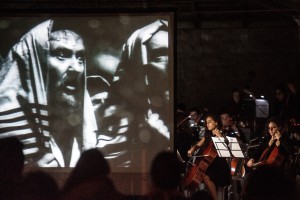
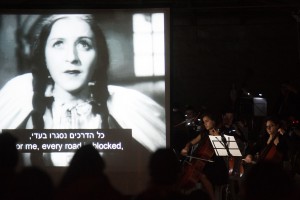
Divorce ceremonies, interpretations using auditory activities and works, mechanical theater, mixes of sounds and images, archived material and live happenings, edits of old movies mixed with live performances of a youth orchestra – all these give one of the Jewish theater’s classic plays in Hebrew and in Yiddish a modern take. The artists once again bring up questions on ownership, on national and gender identity, on possession, on sound and spirit and on the spirit of time and convey a feeling that must be similar to the one created during the play’s performances in the 1920’s: The feeling that one world of values is disappearing, and a new one is taking its place.