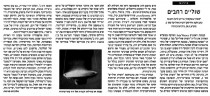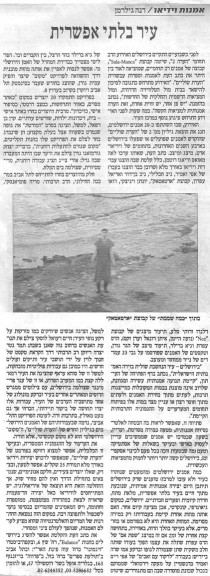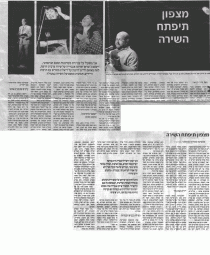
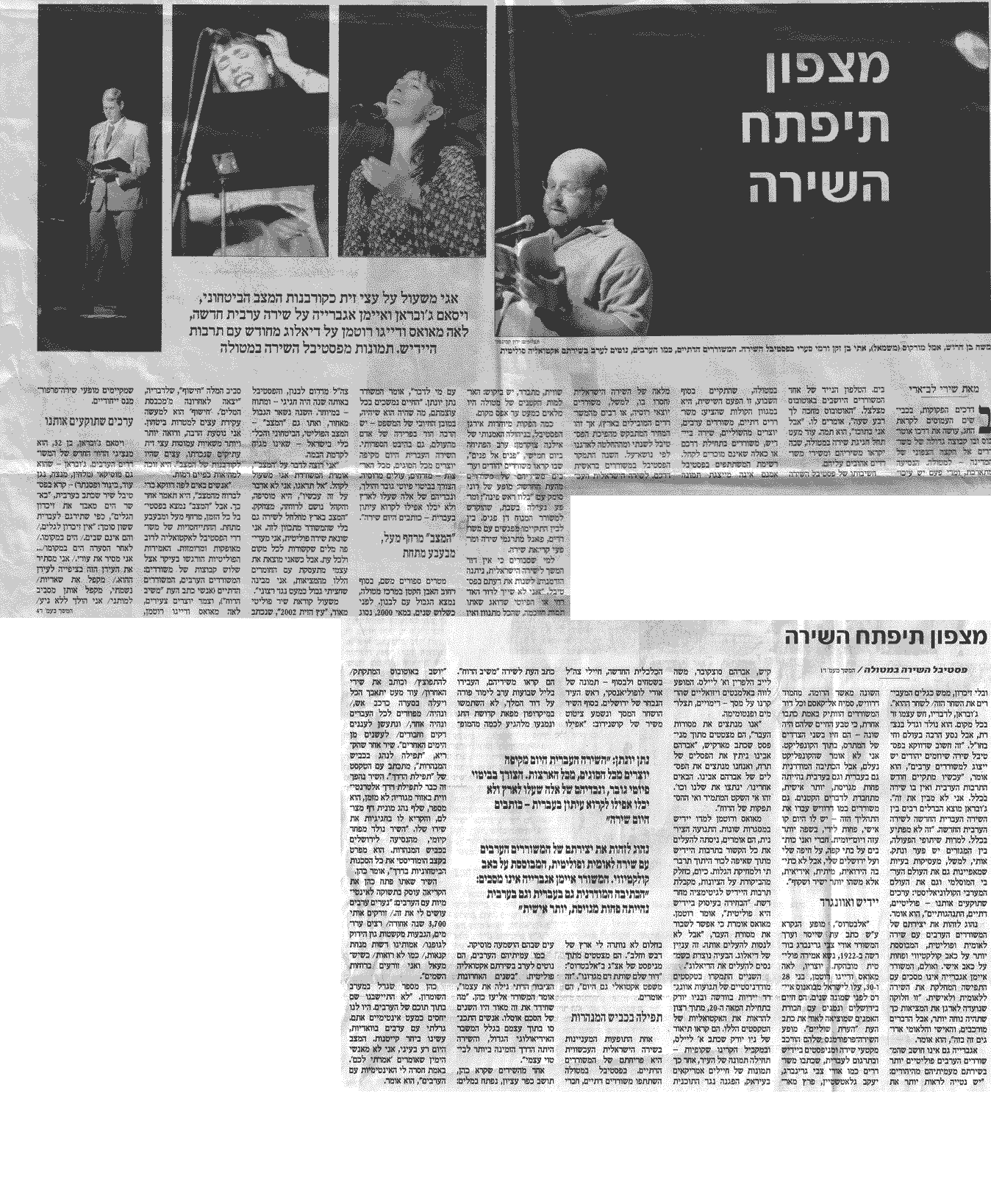
From the North, the Poetry, Shiri Lev-Ari, Haaretz, 9.6.03
Click to enlarge
WordPress database error: [DELETE command denied to user 'sala-manca'@'localhost' for table `sala_manca_net`.`wp_options`]DELETE FROM `wp_options` WHERE `option_name` = '_site_transient_wp_theme_files_patterns-3e81fb819c0831df69203ee558a709b9'
WordPress database error: [DELETE command denied to user 'sala-manca'@'localhost' for table `sala_manca_net`.`wp_options`]DELETE FROM `wp_options` WHERE `option_name` = '_site_transient_timeout_wp_theme_files_patterns-3e81fb819c0831df69203ee558a709b9'
WordPress database error: [INSERT, UPDATE command denied to user 'sala-manca'@'localhost' for table `sala_manca_net`.`wp_options`]INSERT INTO `wp_options` (`option_name`, `option_value`, `autoload`) VALUES ('_site_transient_timeout_wp_theme_files_patterns-3e81fb819c0831df69203ee558a709b9', '1792702854', 'off') ON DUPLICATE KEY UPDATE `option_name` = VALUES(`option_name`), `option_value` = VALUES(`option_value`), `autoload` = VALUES(`autoload`)
WordPress database error: [INSERT, UPDATE command denied to user 'sala-manca'@'localhost' for table `sala_manca_net`.`wp_options`]INSERT INTO `wp_options` (`option_name`, `option_value`, `autoload`) VALUES ('_site_transient_wp_theme_files_patterns-3e81fb819c0831df69203ee558a709b9', 'a:2:{s:7:\"version\";s:3:\"4.0\";s:8:\"patterns\";a:0:{}}', 'off') ON DUPLICATE KEY UPDATE `option_name` = VALUES(`option_name`), `option_value` = VALUES(`option_value`), `autoload` = VALUES(`autoload`)
WordPress database error: [INSERT, UPDATE command denied to user 'sala-manca'@'localhost' for table `sala_manca_net`.`wp_options`]INSERT INTO `wp_options` (`option_name`, `option_value`, `autoload`) VALUES ('_transient_doing_cron', '1792701054.8822429180145263671875', 'on') ON DUPLICATE KEY UPDATE `option_name` = VALUES(`option_name`), `option_value` = VALUES(`option_value`), `autoload` = VALUES(`autoload`)
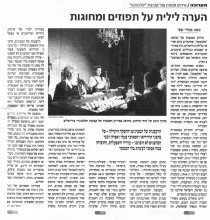
From the North, the Poetry, Shiri Lev-Ari, Haaretz, 9.6.03
Click to enlarge
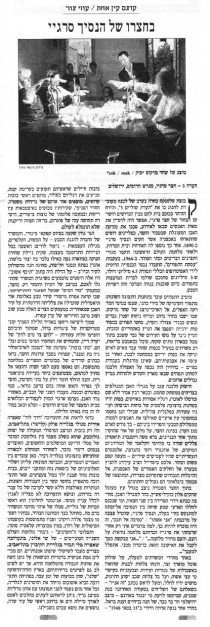
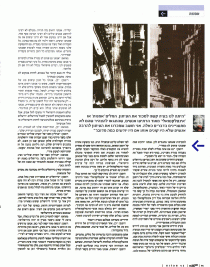
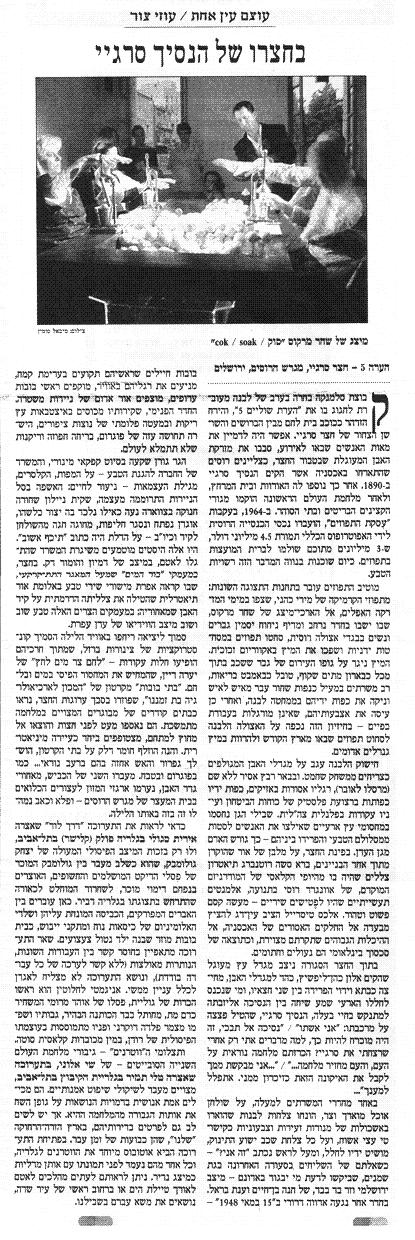
In Prince Sergey’s Courtyard, Ouzi Tsur, Haaretz, 26.5.03
Click to enlarge
 click image to enlarge
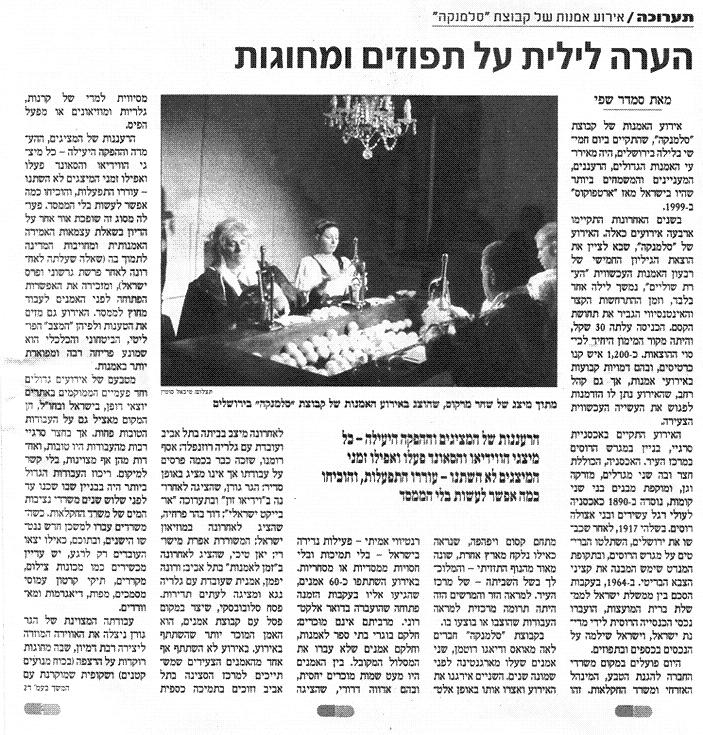
The artistic event of the group Sala-manca that took place Thursday evening in Jerusalem was one of the most important, refreshing, interesting and gladdening artistic event in Israel since “Artfocus” in 1999.
Four events of that kind took place in the last years. Sala-manca’s event, that notes the fifth issue of the quarterly magazine of contemporary art “Hearat Shulaym”, lasted only one night, and this short intensive occurrence amplified the magical feeling. The entrance fee was 30 NIS, and it was the only source to cover the event’s expenses. Among the 1200 persons that bought tickets, were the regular faces in the artistic events and also a large public, that was given the opportunity, thanks to the event, to encounter the young contemporary action.
The event took place in the Sergei Hostel, building located in the Russian Compound in the city centre. The hostel includes a courtyard and within, two towers, a fountain and a garden, which are surrounded by two-storeys buildings. It was founded in 1890 as an hostel for Russian rich pilgrims and nobles. At the end of 1917, after Jerusalem was conquered, the British occupied the Russian Compound, and during the Mandate, the building was used by British officers. In 1964, following the agreement between the Israeli and the soviet government, the properties of the Russian church passed in Israeli hands, and Israel paid for these goods with money and oranges.
Today, the place is used by the Society for the Protection of Nature in Israel, the civil administration and the Agriculture Ministry. It is a magic and very beautiful area, that seems borrowed from another country, very different from the frantic landscape of the city centre, dirtied because of the strike. This impressive and foreign appearance contributed a lot to the look of the exposed or performed worked.
Sala-manca’s members are Lea Mauas and Diego Rotman, two artists who immigrated from Argentina eight years ago. The two of them organized and curated the event in a real alternative way – which is rare in Israel – without any support nor institutional or commercial sponsorship. More than 60 artists participated to the event, following an open invitation that was transmitted by e-mail. Most of them aren’t famous; some graduated from Art schools, and some didn’t go through the conventional curriculum. Relatively few of the names of the artists were known, and among them, Adva Drori, who displayed an installation in her home in Tel Aviv, and works with the Rosenfeld Gallery; Assaf Romano, who already won some prices for his works but who isn’t displaying works in a regular way; Hagar Goren, who participated recently in “Video Zone” and to the exhibition “Israeli Object”; David Behar-Perachia, who displayed lately in the Israel Museum; the poet Efrat Mishori; Jan Tichi, who displayed recently in “Time for Art” in Tel Aviv; and Rona Yafman, who works with the Noga Gallery and who displays works regularly. Pesach Slabosky, who created a sculpture in the site with a group of artists, is the most famous artist among those who participated to the event. None of the young artists who belong to the main scene in Tel Aviv and receive massive financial support from official funds, galleries, museums or the lottery enterprise (Mifal Hapais) participated to the event.
The freshness of the performances, the efficient staging and the production aroused admiration (all the videos and the sound worked, and the timing of the performances wasn’t modified), and proved to what extend working without the establishment is possible. Such an event enlightens the discussion on the question of the independence of the artistic statement and of the state’s commitment to support it (a question that was raised recently following the Gershoni affair and the Israel Price), and reminds the artists of the possibility to work without the Establishment. The event contradicts the claims it is the political, security and economical “situation” that prevents a greater and more magnificent artistic development.
It is in the nature one-time big events located in exceptional sites, both in Israel and abroad, that the charm of the place inspires also works that are less good. But in Sergei courtyard, a lot of the works were good, even excellent, without link to the place. The most important concentration of works could be found in the building were the water commission offices of the Agriculture Ministry were until three years ago. When the offices moved into new dwellings, the previous ones were abandoned. Inside one can still find instruments such as photocopiers, refrigerators, carton files full of documents, maps, diagrams and fans – as if the workers had left only for a moment.
The excellent work of Hagar Goren used this strange atmosphere for a very inventive work, in which compasses dance on the floor (by virtue of small motors) and a slide projected on the open fridge shows part of the lower portion of the body. Assaf Romano “planted” pictures of plants from government offices in one of the offices of the building. The couple “Sala-manca” created “the bag of perpetuation”, a fax work that disappears thanks to light exposition, like the whole event. The installation of Adva Drori, “15th of May, 1948”, deals with the Palestinian “Nakba”: a television film on the “Nakba” was projected in a room where the carton files were emptied from their shelf, then the shelf was flooded with feathers.
Shachar Marcus made one of the most impressive performances: four people dressed in noble clothes (from an undefined historic period) squeezed oranges that were heaped on a board between them, and under this board, in the bath of juice, lied Marcus, naked. The scene – that makes reference to “Drowing by numbers”, from the director Peter Greenaway– succeeds in relating to the history of the site, its cruelty and its violence (today, it is still located in front of a main prison), and to the strange agreement according to which a building was bought in exchange for oranges.
Some of the works presented outside reminded an infinite number of similar festivals in the close or far past, but there were also brilliant ideas, among them, the video work of Eden Oprat, who presented a young girl either swimming or sinking in the bottom of a well, and refers to the terror and genocide regimes on the one hand, and to the legends dealing with wells on the other hand; the performance of Josef Sprinzak, who told an allegoric story about a bull who refused to fight in a “corrida”; and the sound work of P6 (Rafi Balbirsky and Moti Berger), which included a video and within, fragments of horror and pornographic movies, and video clips.
The next event will take place in another three months, and it will also last one night, as an artistic comment that flickers and disappears in the space, time and period.
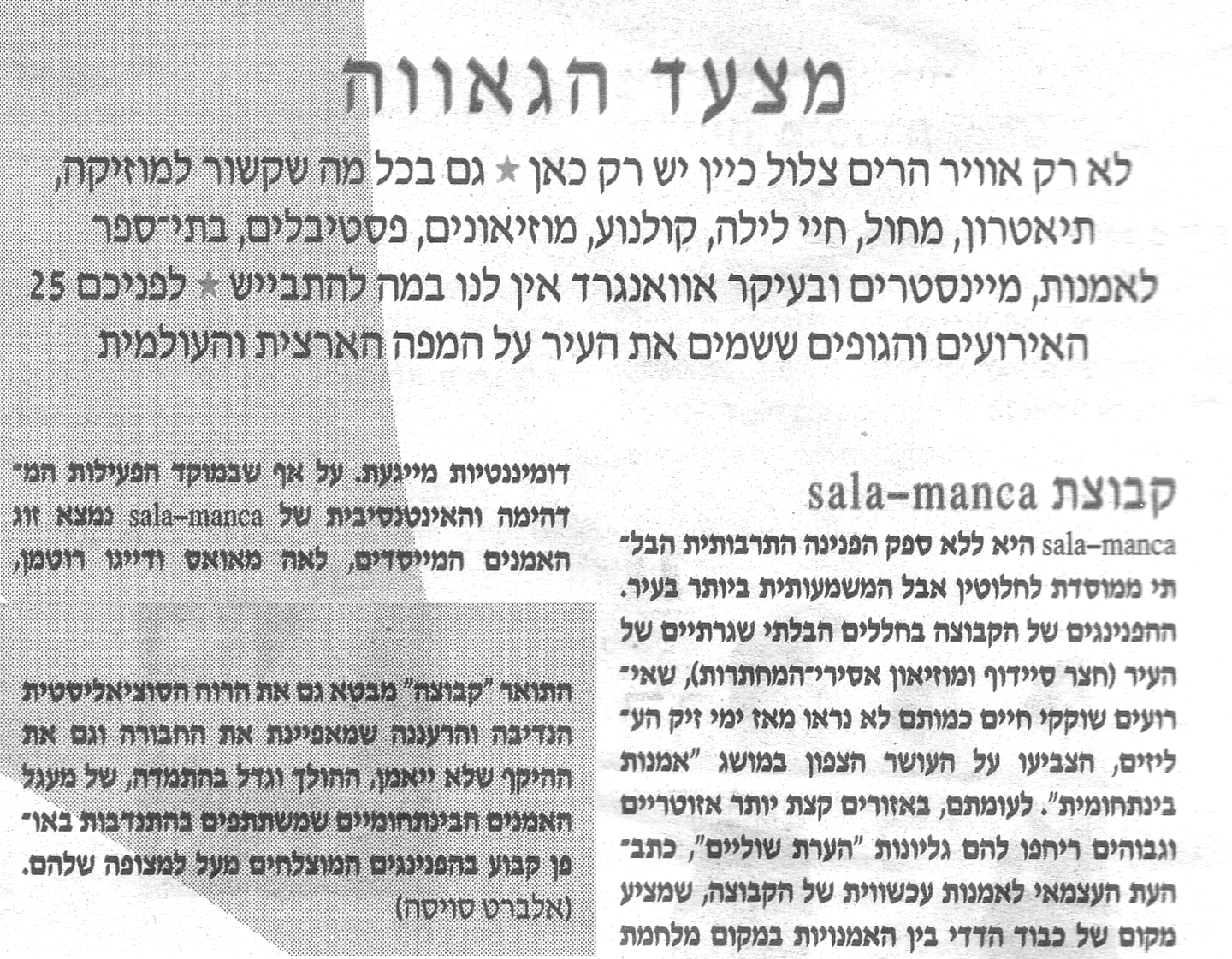
Proud Parade, Albert Suissa, Kol Hair, 20.3.2003
click to enlarge
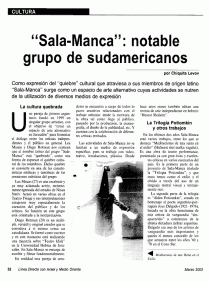
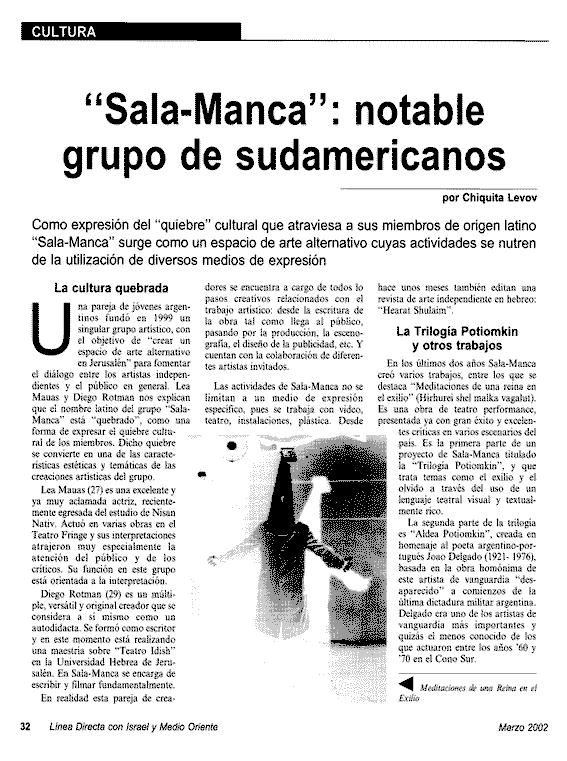
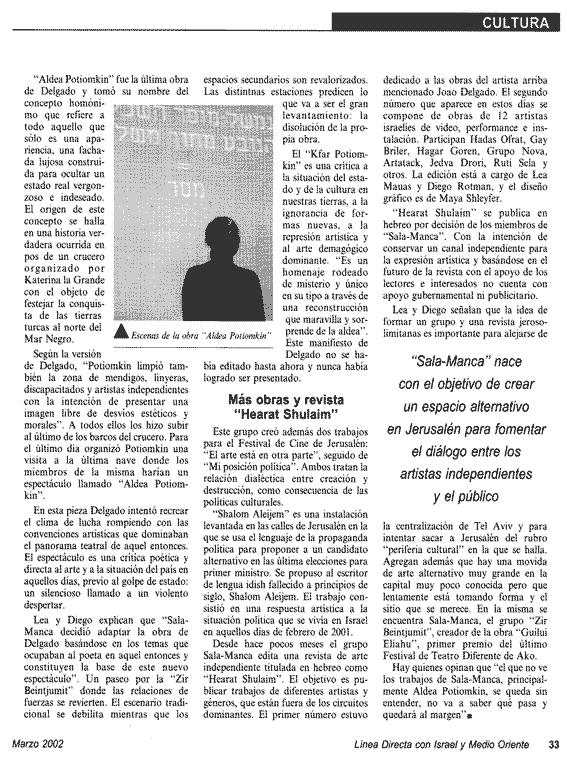
Sala-Manca: Notable grupo de Sudamericanos, Chiquita Levov, Linea Directa, 3.2003
Haga Click para agrandar la imagen
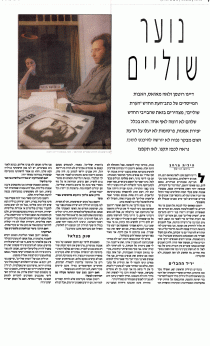
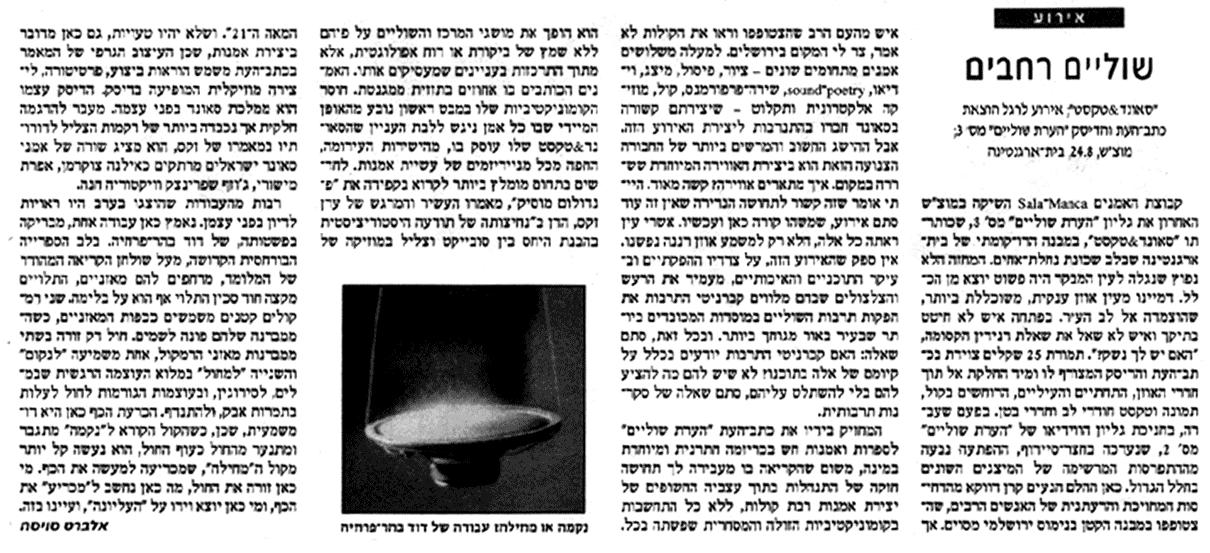
Large Margins, Albert Suissa, Kol Hair, 30.8.2002
Click image to enlarge
Sound and text, event on the occasion of the issue of the magazine and the disk Hearat Shulaym No 3; Saturday evening, 24.8, Argentina House.
The group of artists sala-manca launched last Saturday evening the magazine Hearat Shulaym No 3, whose title is “Sound & Text”, in the two-storey building of the Argentina House, at the heart of the Nachalat-Achim area. The unexpected sight was quite remarkable. Imagine a sort of huge ear, highly sophisticated, attached to the heart of the city. At the entrance, nobody rummaged into your bag, and nobody asked the magic question: “do you carry any arm?”. In exchange for 25 NIS, you were supplied with the magazine and the enclosed disk and you immediately slid into the lower and upper ear’s ventricles, vibrating with heart and belly penetrating voice, image and text. Last time, on the occasion of the issue of the magazine and the video of “Earat Shulaym” No 2, which took place in the Seidoff court, the surprise stemmed from the impressive deployment of the different artists in the big space. Here the agreeable shock shone precisely from the smiling and assertive density of the many people who crowded together in the small building in a certain Jerusalem politeness. But none of the many persons who crowded together and saw the voices said, Jerusalem is a narrow place. More than 30 artists from different fields – painting, sculpture, installation, video, sound-poetry, poetry-performance, voice, electronic music, and record making – whose works relate to sound, joined together on a voluntary basis for the creation of this event. But the more important and impressive achievement of this modest group is the creation of the special atmosphere that reigned in this place. How do you describe an atmosphere? It is very hard. I would say that it is related to a rare feeling that this is not just another event, that something is happening here and now. Hark! No doubt that this event, thanks to its production, but mainly its content and quality, sets up the noise and the rings, which accompanies the culture leaders of the production of the marginal culture of the most respected institutions in the city, in the most ridiculous light. And still, just a question: are the leaders of the culture aware of the existence of such artists in our midst? Not that they have something to offer them without taking control of them, it is just a question of cultural curiosity.
Holding the magazine Hearat Shulaym of literature and art, one feels the highly subversive and special charisma, since reading it transmits a strong feeling of going through in the exposed nerves of a polyphonic work of art, totally ignoring the cheap and commercial communicativeness which has become so widespread. The magazine completely reverses the terms center and margin without any criticism nor apologetic spirit, but rather focusing on its objectives. The artists who contribute to the magazine are frenetic writers. Its lack of communicativeness at first glance stems from the immediate way by which every artist approaches the core of the matter that his sound & text deals with, from the naked directness, clean from every mannerism of art making.
Latest Convention Breakers, Pil&Galia, 42 maalot, July 2002
| Lea Mauas and Diego Rotman, members of the group Sala-Manca, immigrated to Israel from Buenos Aires seven years ago. Since then, they managed to produce some multidisciplinary and multilingual performances, to display some exhibitions, to set up the art magazine “Hearat Shulaym”, and to organize some of the most interesting artistic events of the year…Sergei Eisenstein considered cinema as an art that would free the latent strength by creating a united collective conscience that would allow the public to experience the channel as if it was one single man…Without drowning their public, Rotman and Mauas succeed in raising questions about the ability of the public to experience a revolutionary instant, refined like the one Sergei Eisenstein talked about…Their affection for the proud and revolutionary modernism of the beginning of the 20’s century is reflected in all their works, from “Potiomkin Village” to “Hearat Shulaym” and a cultural avant-garde Yiddish evening, even through the conception of an exhibition of fax works made of ephemeral thermal paper… The following scene, taken from one of their performances, illustrates best the cat and mouse game that Rotman and Mauas run with modernism: on the ground of a big black and white slide, of two “sticks players” and a square pixel ball, Rotman declares “Delgado and Borges play tennis in Wimbledon” and erases in a second all what extends between “the garden of the divided paths” and the Atari. Something in that humor and in their readiness to integrate in their work a reference to their immediate environment, in their ability to break the abysmal seriousness that froze the dada, the surrealism, and the futurism into the glass of the museum, raises the suspicion that their faithfulness is divided. |
Click to enlarge
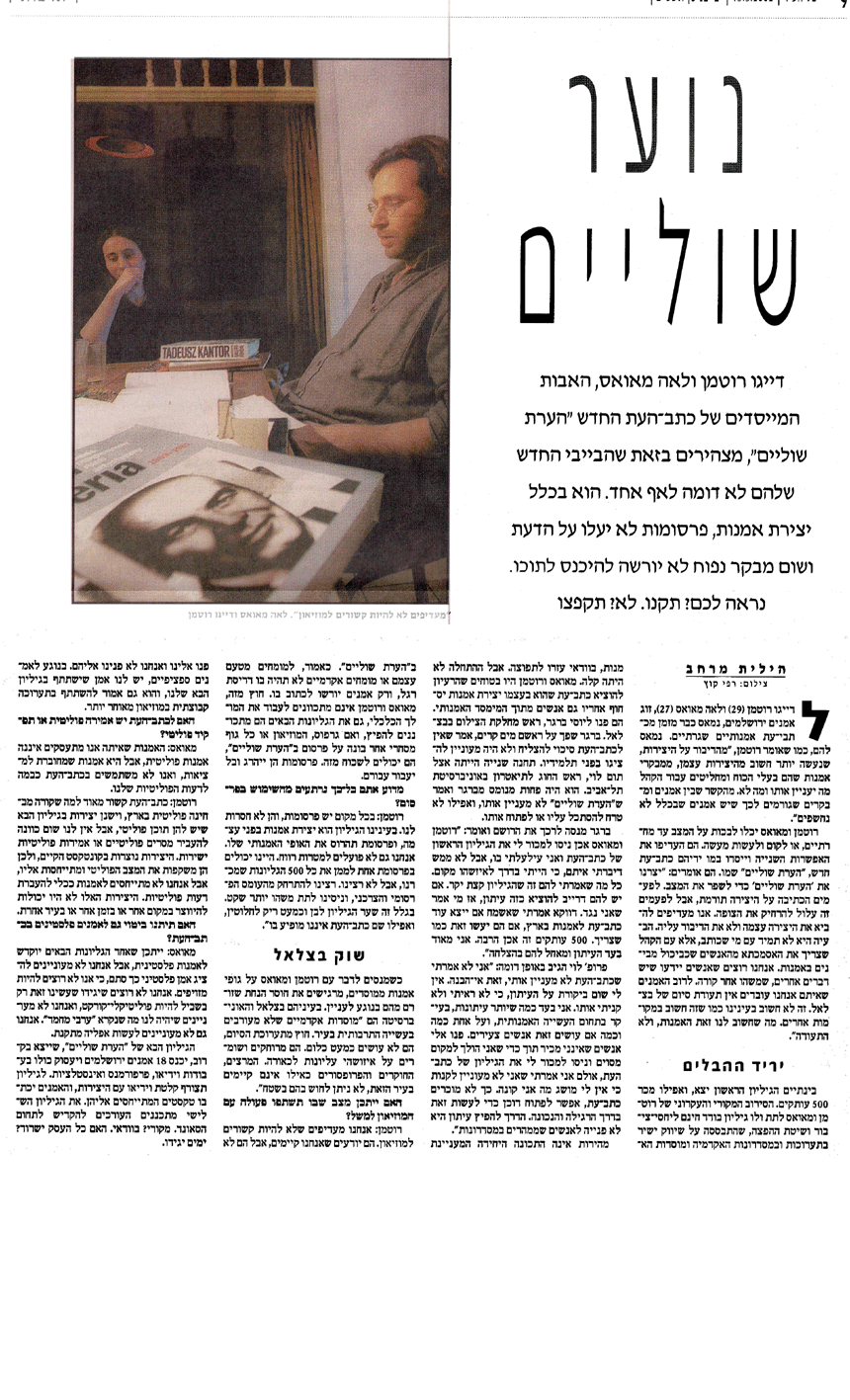
Marginal Young, Hilit Merhav, Kol Hair, 7.2002
Click to enlarge
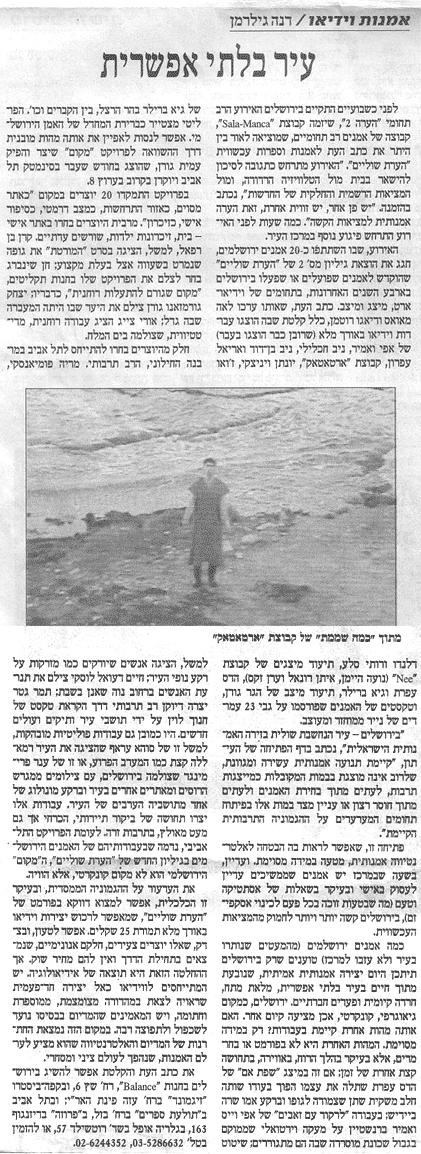
Future Journals, Yoram Melzer, Maariv, July 2002
Click the image to enlarge
Click the image to enlarge
Click the image to enlarge
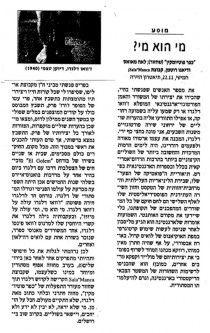
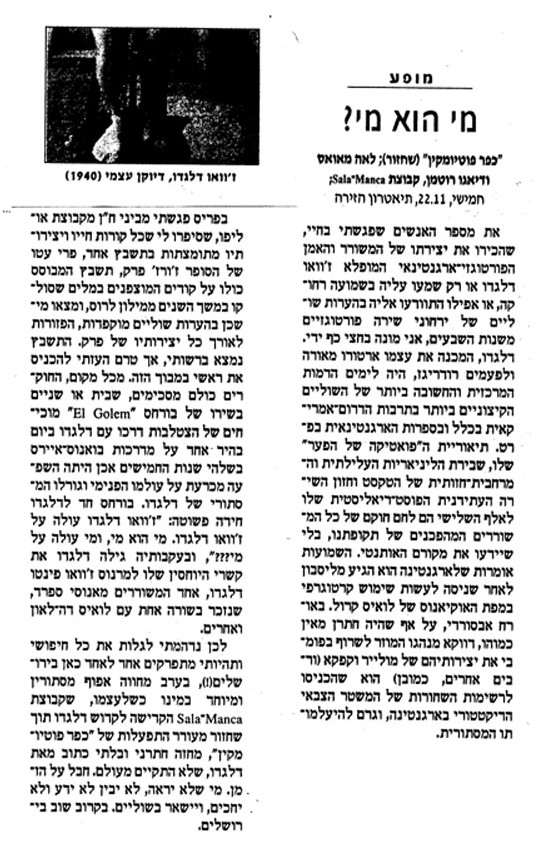
Who is who (mi hu mi), Albert Suissa, Kol Hair, 30.11.2001
Click the image to enlarge
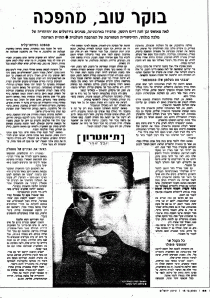
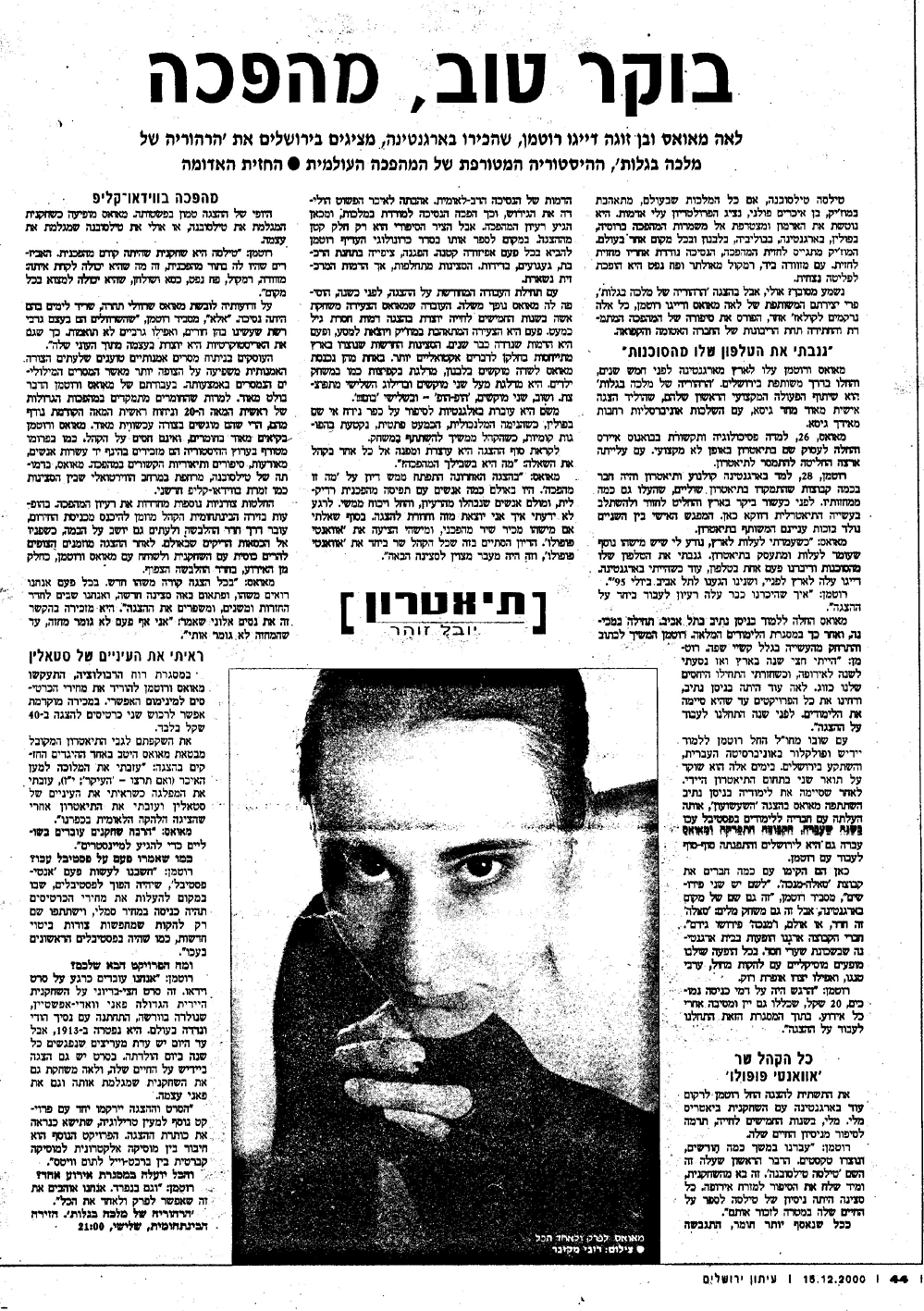
Good morning, revolution (Boker tov, mahapecha) (Hebrew), Zohar, Yuval, Iton, Yerushalaym, 15.12.00