WordPress database error: [DELETE command denied to user 'sala-manca'@'localhost' for table `sala_manca_net`.`wp_options`]
DELETE FROM `wp_options` WHERE `option_name` = '_site_transient_wp_theme_files_patterns-3e81fb819c0831df69203ee558a709b9'

WordPress database error: [DELETE command denied to user 'sala-manca'@'localhost' for table `sala_manca_net`.`wp_options`]
DELETE FROM `wp_options` WHERE `option_name` = '_site_transient_timeout_wp_theme_files_patterns-3e81fb819c0831df69203ee558a709b9'

WordPress database error: [INSERT, UPDATE command denied to user 'sala-manca'@'localhost' for table `sala_manca_net`.`wp_options`]
INSERT INTO `wp_options` (`option_name`, `option_value`, `autoload`) VALUES ('_site_transient_timeout_wp_theme_files_patterns-3e81fb819c0831df69203ee558a709b9', '1792706803', 'off') ON DUPLICATE KEY UPDATE `option_name` = VALUES(`option_name`), `option_value` = VALUES(`option_value`), `autoload` = VALUES(`autoload`)

WordPress database error: [INSERT, UPDATE command denied to user 'sala-manca'@'localhost' for table `sala_manca_net`.`wp_options`]
INSERT INTO `wp_options` (`option_name`, `option_value`, `autoload`) VALUES ('_site_transient_wp_theme_files_patterns-3e81fb819c0831df69203ee558a709b9', 'a:2:{s:7:\"version\";s:3:\"4.0\";s:8:\"patterns\";a:0:{}}', 'off') ON DUPLICATE KEY UPDATE `option_name` = VALUES(`option_name`), `option_value` = VALUES(`option_value`), `autoload` = VALUES(`autoload`)

WordPress database error: [INSERT, UPDATE command denied to user 'sala-manca'@'localhost' for table `sala_manca_net`.`wp_options`]
INSERT INTO `wp_options` (`option_name`, `option_value`, `autoload`) VALUES ('_transient_doing_cron', '1792705003.4428830146789550781250', 'on') ON DUPLICATE KEY UPDATE `option_name` = VALUES(`option_name`), `option_value` = VALUES(`option_value`), `autoload` = VALUES(`autoload`)

Digital Art Lab Holon – Sala-Manca

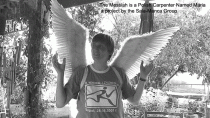
The Messiah is a Polish Carpenter Named Maria, 2008

Action/Video Documentation

“Chosen” | Wyspa Art Institut, Gdansk, Poland & Digital Art LAb Holon | Curators: Aneta Szylak, Galit Eilat

Foreshadowing the Past | ARTISTERIUM in Tibilisi, Georgia | 2010 |Curator: Eyal Danon

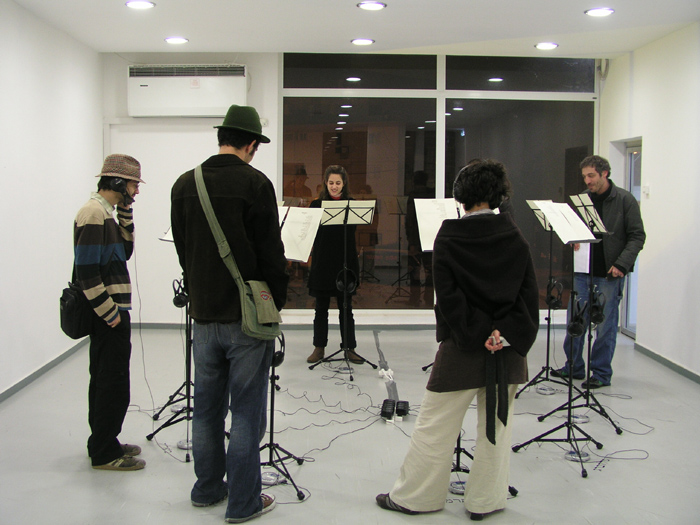
In one way or the other, most of the works of Israeli artists in this exhibition deal with the coming of the Messiah or with inducing his arrival. In “The Messiah is a Polish carpenter named Maria”, the group Sala-manca traveled from Jerusalem to Gdansk to hold auditions for a “Messiah”. The group published a want-ad in Polish stating that they are searching for a “Messiah” and that the “chosen” candidate will go to Israel as part of the project. Seven people, men and women of different backgrounds, arrived at the auditions, and were tested for the part. They were asked to read aloud “messianic” Hebrew texts by Jacob Frank, Theodor Herzl, Uri Zvi Greenberg, Yona Wallach and others, texts that were sent to them previously via email, to allow them to prepare for the audition. Finally the “Messiah” part was given to Maria Sahajko, whose visit to Israel took place in August 2008. The exhibition will present photos from a film documenting the “Messiahs” visit to Israel and her initial encounter with Israelis.
Interview with Eytan Buganim, Time Out

Seara/Storm, 2006-2007

vers 2.0 presented @ Hapzura Series, Digital Art Lab Holon | curator: Eran Sachs & Heara 10 | The Science Museum | curator: Sala-manca

Seara/Storm *

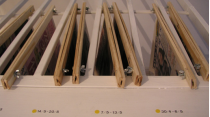
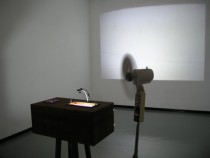
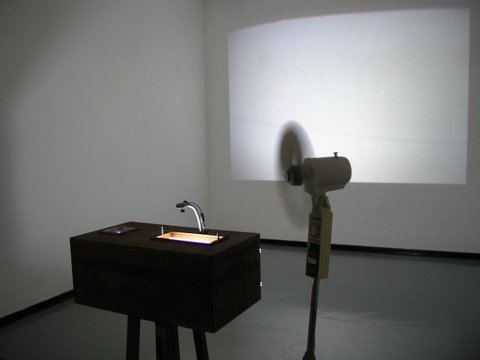
In 1950 during a party on the roof of Marian Loop, celebrating the 100 anniversary of Tomas Robinson’s invention of the wind meter, Regina Handke, Marian Loop and Joao Delgado decided to build a wind meter as a quotation to Robinson’s original machine.

OLYMPUS DIGITAL CAMERA Regina Handke, the Hungarian-Yiddish poet, who began in those days to learn Hebrew, told her friends that in Modern Hebrew there are two meanings to the word “seara”: hair and storm**. Delgado and Loop got excited from the linguistic discovery, and decided to build a wind meter based on a hair.

In 1955 the machine was brought to Israel and activated in a symbolic and nationalistic act, using David Ben Gurion’s hair. This experiment made Ben Gurion very disappointed from his hair quality, who sent the machine away.

In 2005 the machine was exhibit for the first time in fifty years in the frame of the Jerusalem Film Festival. In 2006 the machine is exhibited again , this time not only the wind meter has been repaired but also the sound-wind visual meter.

* This machine is part of sala-manca’s collection of Joao Delgado’s works.


** She was not aware that although the pronunciation is the same, “seara” for hair and “seara” for storm have a different Hebrew spelling.

vers. 1.0 – presented at the Intersection – Jerusalem Film Festival 2005, Heara 10-The Science Museum, Jerusalem, February 2006

Babylon Poems, 2006-2007

Translation, text, and sound works

Exhibited in the frame of “Free Radicals”, Digital Art Lab Holon, 24.2.2007-28.04.2007 | Curator: Eyal Danon

Hebrew to Hebrew translation of ten poems from the 2006-2007 matriculation exam list for Israeli high school students. The poems were translated using Babylon automatic machine translation software, passing through 14 different languages (from Hebrew to German, German to Dutch, Dutch to Spanish, Spanish to French, French to Italian, Italian to Portuguese, Portuguese to Japanese, Japanese to Chinese, Chinese to Arabic, Arabic to Korean, Korean to Turkish, Turkish to Russian, Russian to Polish, Polish to English, and from English back to Hebrew).
Babylon Poems
Poets: Haim Nachman Bialik, Nathan Alterman, Shaul Tchernichovsky, Uri Zvi Grinberg, Rachel, Dahlia Ravikovitch, Leah Goldberg, Natan Zach, David Avidan, Yehuda Amichai

The poems were read by Ilana Zuckerman, sound and radio artist, founder and director of the Metula Poetry Festival


Natan Zach

Uri Zvi Grinberg

Rachel

Chaym Nachman Bialik

Shown first as part of the project: “The Right to Copy”, 2006, Confederation House, Jerusalem

Minute Box Machine, 2004-2008

Exhibited in the frame of “Speed of Light”, Digital Art Lab, Holon | Curators: Galit Eilat, Eyal Danon | VideoZone 2008


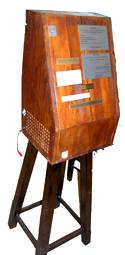
Minute Box Machine: A Reconstruction of Marian Loop’s Time Machine enables viewers to play with time. The Minute Box Machine invites the public to acquire a product—in this case, one minute. Inserting a one Shekel coin into the machine activates a clock inside the Box for 60 seconds. The clock is being filmed in real time by a surveillance camera, and the footage is projected from inside the Minute Box Machine onto a central wall at the open space, showing the minute running. After 60 seconds the purchased time is finished, and the clock stops. Time stops until another coin is inserted into the machine. The projection of the clock for 60 seconds becomes a visual representation of the economic transaction (the purchased minute), concurrently converting the private minute into a public one. At the same time, since the clock in not activated continuously, a gap is generated between the ”real” time and the time of the clock, ”degenerating” the local time where the Minute Box is installed. The backside of the box, from where the projection is screened, is transparent, showing the dark side of time generation to the curious public, juxtaposing the old-looking wooden machine with the electronic devices suggesting a homemade bomb. The Minute Box is an attempt to reconstruct Marian Loop’s (1920-1985) machine destroyed.

Electronics: Amir Marcovich

Urban Overmemory Archives 2 – The Periphery of the Center -Holon, 2004

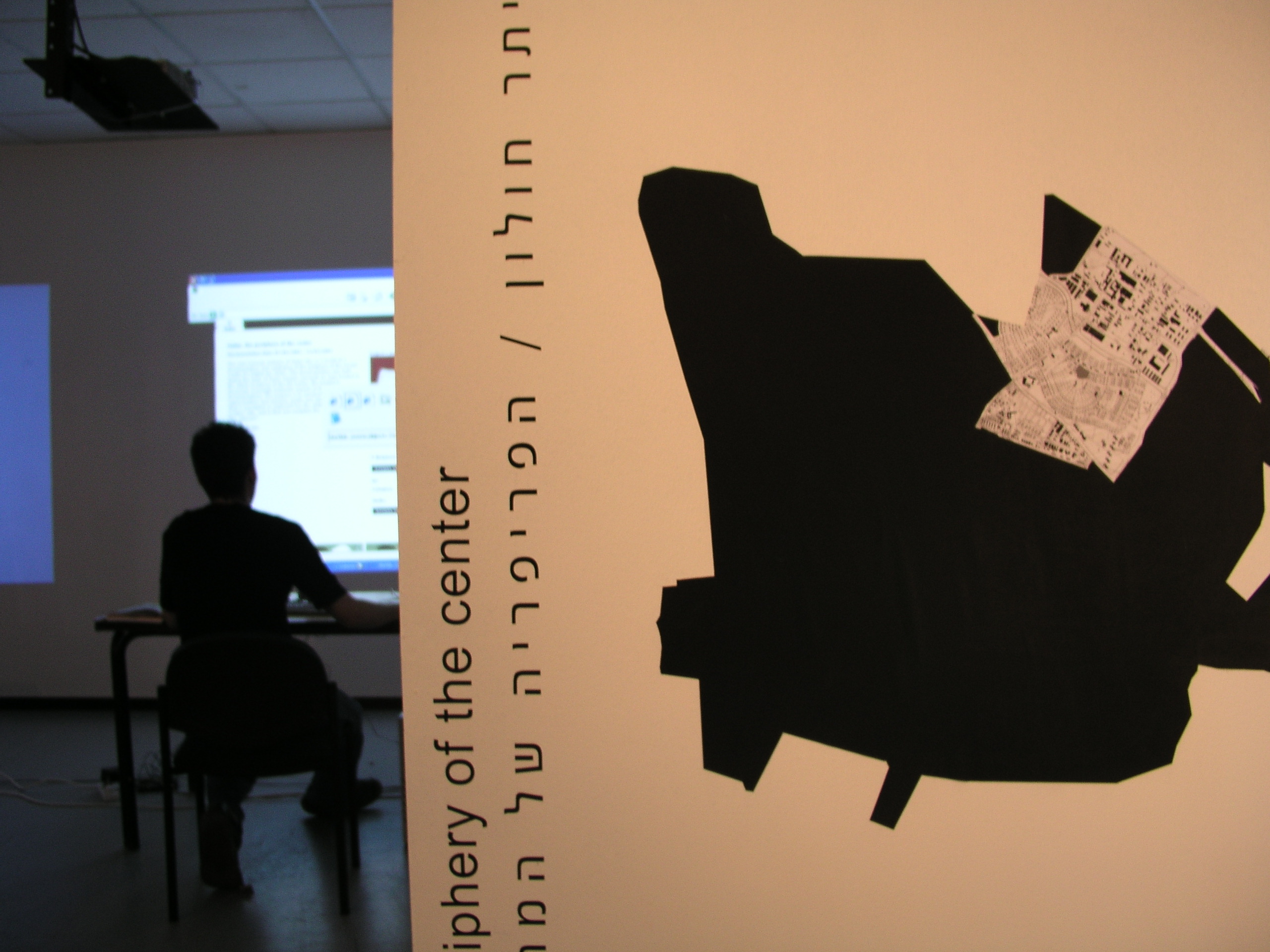
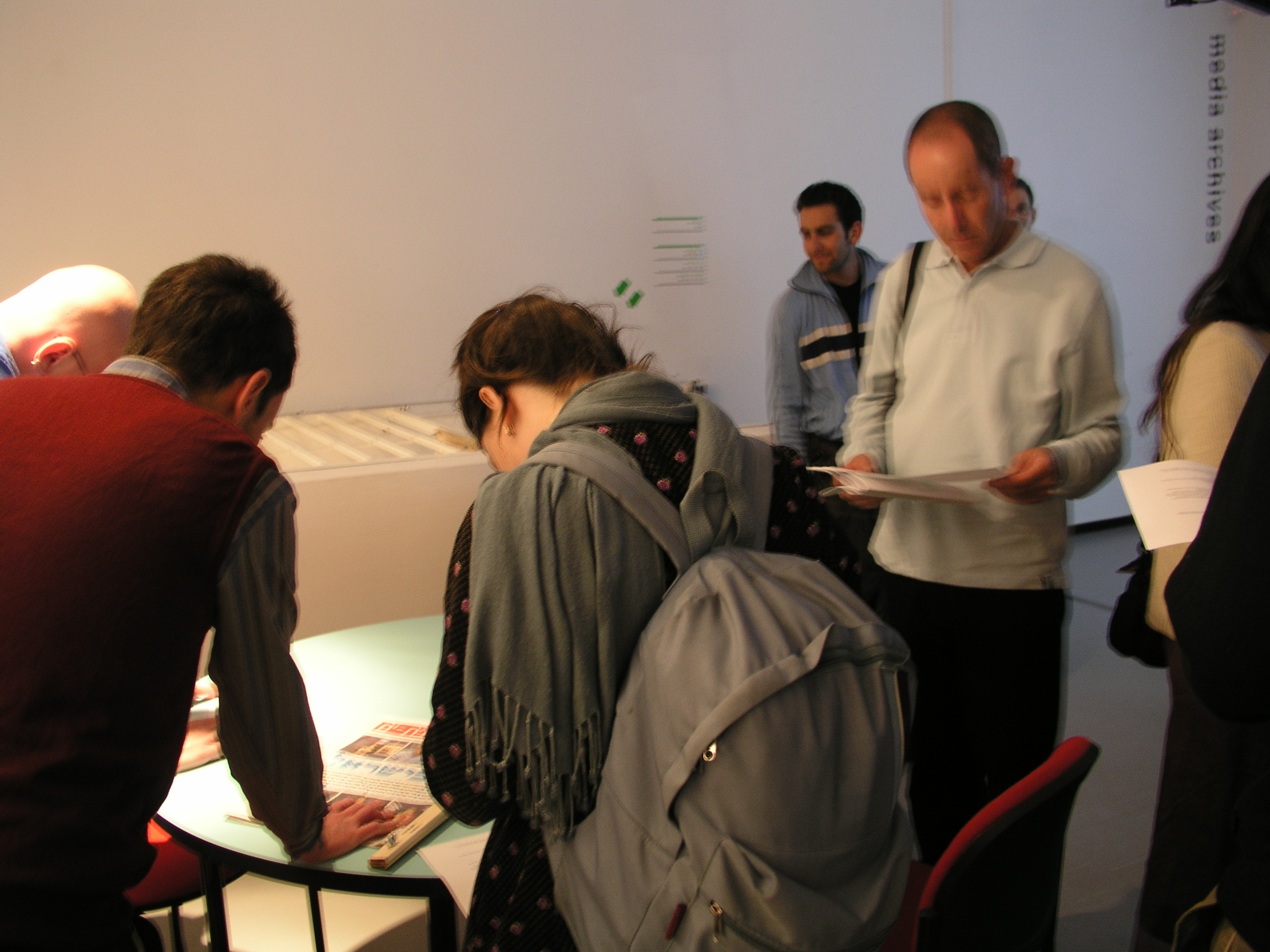
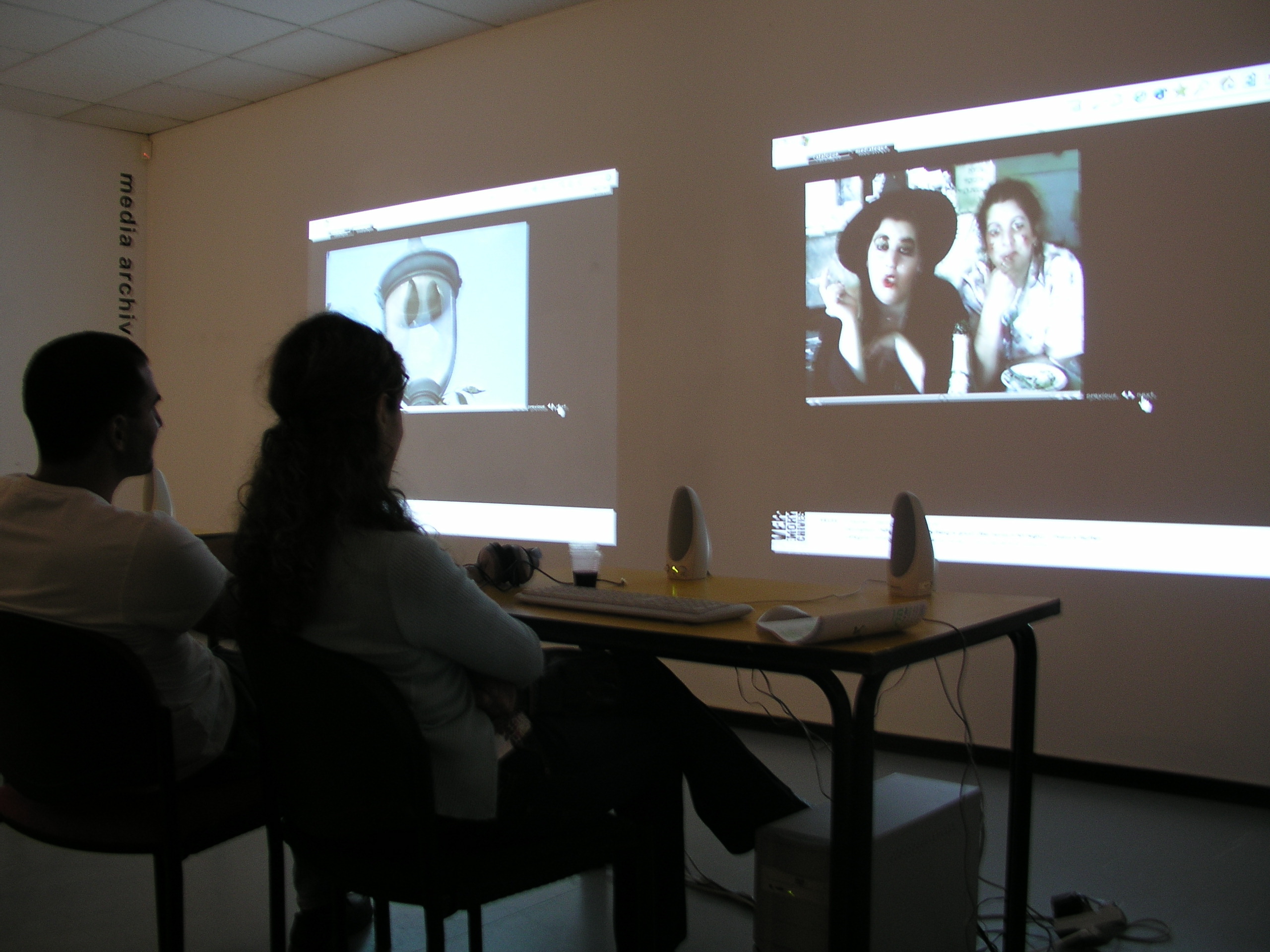
The “Urban Over Memory Archives of Holon” is a project consisting of documenting and cataloguing the Over Memory of the periphery of the Israeli Center for Digital Art, Holon. This project is the second in a series of urban archival works+2. The archives result from a process of cataloguing video, audio and motion items, generally conceived as irrelevant and dull. SALA-MANCA attempts to establish a representation of another memory, different and poetic, pertaining to a geographic-artistic space. Items usually regarded as irrelevant may reveal a different, unofficial aspect, thus complementing the ’relevancy,’ which forever is a relative concept. The “Urban Over Memory Archives of the Periphery of the Israeli Center for Digital Art” are located physically at the center, thus reversing the center-periphery relationship in a poetic and symbolic manner. Another denser, and at the same time broader, version of the archives may be found on the web, a center-less entity, which is to be the future meeting point of the Israeli Urban Over Memory.

OLYMPUS DIGITAL CAMERA  OLYMPUS DIGITAL CAMERA OLYMPUS DIGITAL CAMERA  OLYMPUS DIGITAL CAMERA

In the frame of the exhibition: “Hilchot Shcehnim, Chapter B”, 24.4.2004-24.6.2004

Curators: Galit Eilat, Eyal Danon

http://digitalartlab.org.il/ExhibitionPage.asp?id=54&path=level_1