WordPress database error: [DELETE command denied to user 'sala-manca'@'localhost' for table `sala_manca_net`.`wp_options`]
DELETE FROM `wp_options` WHERE `option_name` = '_site_transient_wp_theme_files_patterns-3e81fb819c0831df69203ee558a709b9'

WordPress database error: [DELETE command denied to user 'sala-manca'@'localhost' for table `sala_manca_net`.`wp_options`]
DELETE FROM `wp_options` WHERE `option_name` = '_site_transient_timeout_wp_theme_files_patterns-3e81fb819c0831df69203ee558a709b9'

WordPress database error: [INSERT, UPDATE command denied to user 'sala-manca'@'localhost' for table `sala_manca_net`.`wp_options`]
INSERT INTO `wp_options` (`option_name`, `option_value`, `autoload`) VALUES ('_site_transient_timeout_wp_theme_files_patterns-3e81fb819c0831df69203ee558a709b9', '1792702873', 'off') ON DUPLICATE KEY UPDATE `option_name` = VALUES(`option_name`), `option_value` = VALUES(`option_value`), `autoload` = VALUES(`autoload`)

WordPress database error: [INSERT, UPDATE command denied to user 'sala-manca'@'localhost' for table `sala_manca_net`.`wp_options`]
INSERT INTO `wp_options` (`option_name`, `option_value`, `autoload`) VALUES ('_site_transient_wp_theme_files_patterns-3e81fb819c0831df69203ee558a709b9', 'a:2:{s:7:\"version\";s:3:\"4.0\";s:8:\"patterns\";a:0:{}}', 'off') ON DUPLICATE KEY UPDATE `option_name` = VALUES(`option_name`), `option_value` = VALUES(`option_value`), `autoload` = VALUES(`autoload`)

WordPress database error: [INSERT, UPDATE command denied to user 'sala-manca'@'localhost' for table `sala_manca_net`.`wp_options`]
INSERT INTO `wp_options` (`option_name`, `option_value`, `autoload`) VALUES ('_transient_doing_cron', '1792701073.9357600212097167968750', 'on') ON DUPLICATE KEY UPDATE `option_name` = VALUES(`option_name`), `option_value` = VALUES(`option_value`), `autoload` = VALUES(`autoload`)

Maya Shleifer – Sala-Manca

Familiar Strangers by Maya Shlefier

Familiar Stranger | Maya Shleifer
Curators: Sala-Manca

Mamuta Art and Research Center
Opening hours: Tues.-Wed.: 10:00-14:00, Thurs: 15:00-19:00, Friday: 11:00-14:00

Home

Passersby, people on the train, women who meet during walks, passengers on the bus – others and strangers are the inspiration for Maya Shleifer’s series of works, which explores the world of familiar strangers as she imagines it.
In the exhibition, Maya’s illustrations gain another dimension through various techniques: from mythological devices that hark back to the early days of cinema like Zoetrope to physical computing. The installations in the exhibition hold a dialogue with the world of pop up books and incorporate projections of moving images and static illustrations in varying degrees of interactivity. The space in which Maya’s images are scattered echo the world of filmmaker Georges Méliès and animator William Kentridge, as well as the world of old children’s books.
Maya is an illustrator and a designer. We worked together for the first time when she was still a student at Bezalel, when she designed the first issue of Hearat Shulayim and devised the journal’s aesthetic line. In the 15 years that have passed since, she designed fascinating children’s books, among them “It’s Not Easy Being a Superhero”, “Princess Zohara,” and “The Bunny Who Wanted to be a Tree,” and was chief designer at TheMarker newspaper. All the while, she continued to create her own personal works.
This exhibition, which is Maya’s first in the art field, brings us back together. In this reunion which also we joined forces with Guy Yitzhaki, Nir Yahalom, Yuval Kedem, Studio Poink, Ofir Gal and Yuri Smertenko creating for Maya’s world of motion a space that is somewhere between an open studio, a laboratory, and a cabinet of curiosities.

Programing: Guy Yitzhaki
The wheel mechanism in ”The World is Round”: Yuval (Galileo) Kedem
Technical supervisor and Zoetrope: Nir Yahalom
Technical assistant: Yuri Smertenko
Sound: Ofir Gal
Animation: Studio Poink
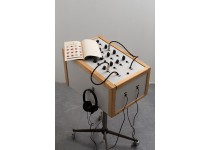
La Máquina de Hacer Pájaros, 2014

Formica and wood box, miniature printed circuit board (PCB), MP3 players, audio sockets and earphones, power supply, metal leg, two sofas from Casa Argentina, Jerusalem Text: João Delgado; music: Yarden Erez; electronic system: Amir Markovitz; programming

Exhibited in the frame of  Recalculating Route at Petach Tikva Museum of Art, in theframe of the 4 Mediations Biennale, Poznan, 2014 | 2.10.2014-24.1.2015

Curator: Drorit Gur Arie

The spirit of João Delgado has been haunting Diego Rotman and Lea Mauas, members of the Jerusalem-based Sala-Manca Group, for fifteen years. A Portuguese poet, writer, playwright, and essayist, Delgado was, in all likelihood, born in Lisbon (date unknown) and disappeared in Argentina in the second half of the 1970s, in the dark years of the Generals’ regime. Like the circumstances of his disappearance, his life was equally shrouded in mystery, and little is known about it. Years later, his post-realist poetry has had a vast impact on late 20th century Latin-American literary avant-garde, but Delgado himself did not live to see it, since the political circumstances—the censorship placed by the military junta in Argentina—and his own choices interfered with the reception of his works by the public at large. His writing was confusing, and he often used fictive aliases which further blurred his identity. In literary terms, Delgado was a modernist who addressed the formal questions of writing (like Georges Perec and the Oulipo group): the author’s identity, the gap between the text and the world, and the illusions of fiction and reality. In this he joined other, more senior, contemporary modernists, from the Argentinean Jorge Luis Borges and Portuguese Fernando Pessoa to the Hungarian Lajos Kassák, whose Cubist poetry from the 1930s and 1940s had influenced Delgado when he lived in Central Europe.

Design: Maya Shleifer

The members of the Sala-Manca Group, in their joint work as artists, curators, and activists, often revisit Delgado’s figure, publishing translations of his work and incorporating excerpts from his unfinished plays into their performances. The return to Delgado, the eternal migrant who wandered until he disappeared, is linked with Rotman’s and Mauas’s personal immigration experiences and the need to discover new territories through language and the act of writing.
The work La Maquina de Hacer Pájaros (‘The Bird-Making Machine,’ as the name of an Argentinean rock band which formed in 1976, in the dictatorship days) is yet another chapter in the quest after the Portuguese-Argentinean writer. The viewer-listener is given the opportunity to wander amid excerpts of text by Delgado and other writers of his alleged circle, such as Juan Mestre, Regina Handeke, Irina Pantalova, and Arturo Maure, who may well have been none other than Delgado himself. This wandering is akin to a journey through the soundtrack of a literary microcosm, comprised of fragments of texts, sounds, and linguistic images. The listener is invited to try to compose the narrative as s/he pleases, to believe the story in whose making s/he took part, or disbelieve it altogether.
One of the legends associated with Delgado maintains that he made his way from Portugal to Argentina with the aid of a map of the Atlantic Ocean which he adopted from a Lewis Carroll book. Whether and how he arrived at his destination—no one knows. João Delgado is, in fact, a fictive entity, a figment of Rotman and Mauas’s imagination; at the same time, like them—who create in-between the splinters of their Latin-American and Israeli identities, in-between the language from there and the one they have adopted in Jerusalem—he is totally real.

Drorit Gur Arie