WordPress database error: [DELETE command denied to user 'sala-manca'@'localhost' for table `sala_manca_net`.`wp_options`]
DELETE FROM `wp_options` WHERE `option_name` = '_site_transient_wp_theme_files_patterns-3e81fb819c0831df69203ee558a709b9'

WordPress database error: [DELETE command denied to user 'sala-manca'@'localhost' for table `sala_manca_net`.`wp_options`]
DELETE FROM `wp_options` WHERE `option_name` = '_site_transient_timeout_wp_theme_files_patterns-3e81fb819c0831df69203ee558a709b9'

WordPress database error: [INSERT, UPDATE command denied to user 'sala-manca'@'localhost' for table `sala_manca_net`.`wp_options`]
INSERT INTO `wp_options` (`option_name`, `option_value`, `autoload`) VALUES ('_site_transient_timeout_wp_theme_files_patterns-3e81fb819c0831df69203ee558a709b9', '1792702868', 'off') ON DUPLICATE KEY UPDATE `option_name` = VALUES(`option_name`), `option_value` = VALUES(`option_value`), `autoload` = VALUES(`autoload`)

WordPress database error: [INSERT, UPDATE command denied to user 'sala-manca'@'localhost' for table `sala_manca_net`.`wp_options`]
INSERT INTO `wp_options` (`option_name`, `option_value`, `autoload`) VALUES ('_site_transient_wp_theme_files_patterns-3e81fb819c0831df69203ee558a709b9', 'a:2:{s:7:\"version\";s:3:\"4.0\";s:8:\"patterns\";a:0:{}}', 'off') ON DUPLICATE KEY UPDATE `option_name` = VALUES(`option_name`), `option_value` = VALUES(`option_value`), `autoload` = VALUES(`autoload`)

WordPress database error: [INSERT, UPDATE command denied to user 'sala-manca'@'localhost' for table `sala_manca_net`.`wp_options`]
INSERT INTO `wp_options` (`option_name`, `option_value`, `autoload`) VALUES ('_transient_doing_cron', '1792701068.2657380104064941406250', 'on') ON DUPLICATE KEY UPDATE `option_name` = VALUES(`option_name`), `option_value` = VALUES(`option_value`), `autoload` = VALUES(`autoload`)

Guy Yitzhaki – Sala-Manca

Paradise

Paradise Inn

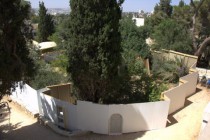
Paradise Inn, Talbiyeh, Jerusalem. A dream for only one person. Infinite stars and a real gate to paradise. Reserve your room at the former Lepers’ home.
Jerusalem, where any piece of land can become your temporary dwelling.

In light of the policy of the city of Jerusalem to develop tourism and to use art and culture as a touristic tool, a group of local artists decided to be part of this new trend. In order to generate a new resource for tourism as well as some independent income for local artists and the Mamuta Art and Media Center, they established the luxurious Paradise Inn on part of the lands of the former Jerusalem Lepers’ Home at Hansen House.
Using a “green” approach to urban design as well as the idea of recycling electronic waste, the artists created a summer hotel for temporary residence, inspired by Bauhaus architecture, temporary techniques of modernist parcelization, and the new school of architecture, Growing Walls.
The artists participated in the design and implementation of all aspects of the hotel, with the goal of giving everyone the possibility of spending a few nights at Paradise Inn. The project synthesizes new visionary ideas for a modern Jerusalem: a hotel for only one person, a personal paradise built in the exquisite Hansen House gardens.
Image“Paradise Inn is an island surrounded by the walls of the former Jerusalem Lepers’ Home. A metaphor of differentiation and exclusivity. Paradise Inn is a luxurious paradise that originates from a public institution that was historically used to protect society from lepers and lepers from society. Paradise Inn dwells in the spirit of gentrification, inviting an artist to reside for free in the paradise for a month and a half. In return, the artist is expected to produce artwork for the comfort of future residents.” (From I Love Jerusalem Magazine)

In the year 2018, the utopia that Boris Schatz wrote about in his novella “The Rebuilt Jerusalem: A Daydream” (1923), is supposed to be fulfilled. A Utopian Jerusalem in which paradise exists; harmonious coexistence with nature and with the Arab residents of the city, and building of the Third Temple, which will serve as a museum, with the consent of the Arab minority.

Three years prior, in the year 2015, at the Hansen House gardens, Paradise is built – a haven in the middle of the city, a white façade bounding a garden that has been expropriated from the public. In Paradise, only one human being at a time can experience the ideal and modern natural living, leaving the public with a sense of longing, allowing a sneak peek into a free and peaceful world, at an affordable price.
The entrepreneurs of Paradise Inn have invited an artist to live and create for a month and a half in this daydream – an infinite-star hotel for one, a slice of nature in the middle of Jerusalem, in the historical garden of the former Lepers’ House.

From the middle of September, Paradise’s sole room will be available for rent at an outrageous rate for all interested.
Please visit us and reserve your nights: www.paradisehotel.co

Concept: Sala-manca
Architects: Sala-manca and Nir Yahaom
Interior Desing: Itamar Mendes-Flohr
Paradise Inn art collection: OZ Malul, Guy Yitzhaki, Itamar Mendes-Flohr, Sala-manca, Shaul Zemach.
Souvenirs: Silent Room 1, Chen Cohen | Room-Kit, Pessi Komar | A letter for you, Shiri Zinger, Elevator to Paradise, Lior Pinski
Avantgarde workers: Yuval Galili, Diego Rotman, Yeshaiahu Rabinowitz, Rotem Zuta, Ayala Shamir, Ktura Manor, Lea Mauas, Chen Cohen, Galia Lulko, Nahuel & Ayu
Paradise Inn website: www.paradisehotel.co
Observation post to Paradise: Conrad Shick


Press:

http://www.haaretz.co.il/gallery/art/artreview/.premium-1.2732894

http://old.sala-manca.net/wordpress/wp-content/uploads/2015/08/almost-paradise.png
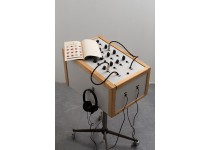
 

La Máquina de Hacer Pájaros, 2014

Formica and wood box, miniature printed circuit board (PCB), MP3 players, audio sockets and earphones, power supply, metal leg, two sofas from Casa Argentina, Jerusalem Text: João Delgado; music: Yarden Erez; electronic system: Amir Markovitz; programming

Exhibited in the frame of  Recalculating Route at Petach Tikva Museum of Art, in theframe of the 4 Mediations Biennale, Poznan, 2014 | 2.10.2014-24.1.2015

Curator: Drorit Gur Arie

The spirit of João Delgado has been haunting Diego Rotman and Lea Mauas, members of the Jerusalem-based Sala-Manca Group, for fifteen years. A Portuguese poet, writer, playwright, and essayist, Delgado was, in all likelihood, born in Lisbon (date unknown) and disappeared in Argentina in the second half of the 1970s, in the dark years of the Generals’ regime. Like the circumstances of his disappearance, his life was equally shrouded in mystery, and little is known about it. Years later, his post-realist poetry has had a vast impact on late 20th century Latin-American literary avant-garde, but Delgado himself did not live to see it, since the political circumstances—the censorship placed by the military junta in Argentina—and his own choices interfered with the reception of his works by the public at large. His writing was confusing, and he often used fictive aliases which further blurred his identity. In literary terms, Delgado was a modernist who addressed the formal questions of writing (like Georges Perec and the Oulipo group): the author’s identity, the gap between the text and the world, and the illusions of fiction and reality. In this he joined other, more senior, contemporary modernists, from the Argentinean Jorge Luis Borges and Portuguese Fernando Pessoa to the Hungarian Lajos Kassák, whose Cubist poetry from the 1930s and 1940s had influenced Delgado when he lived in Central Europe.

Design: Maya Shleifer

The members of the Sala-Manca Group, in their joint work as artists, curators, and activists, often revisit Delgado’s figure, publishing translations of his work and incorporating excerpts from his unfinished plays into their performances. The return to Delgado, the eternal migrant who wandered until he disappeared, is linked with Rotman’s and Mauas’s personal immigration experiences and the need to discover new territories through language and the act of writing.
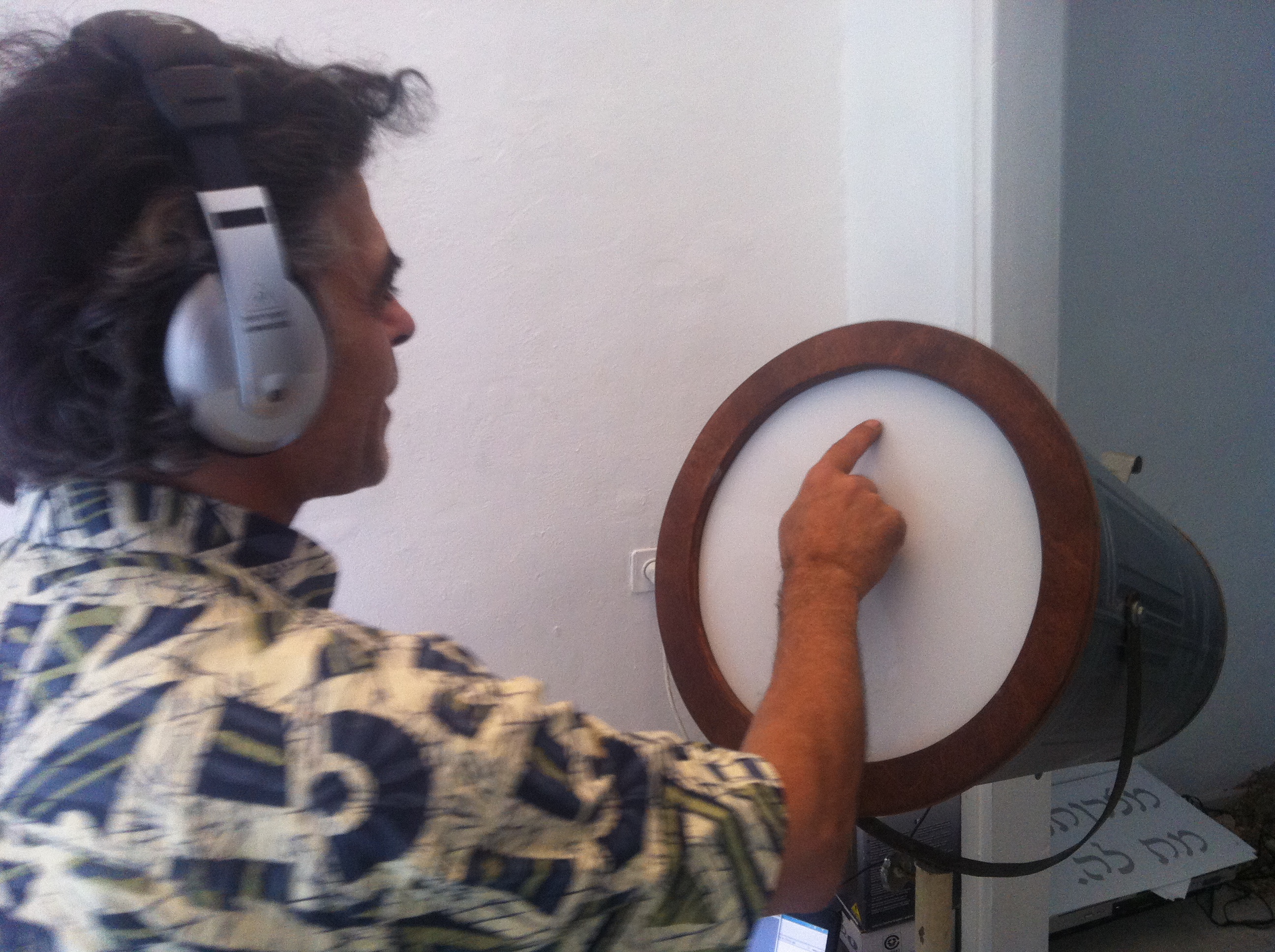
The work La Maquina de Hacer Pájaros (‘The Bird-Making Machine,’ as the name of an Argentinean rock band which formed in 1976, in the dictatorship days) is yet another chapter in the quest after the Portuguese-Argentinean writer. The viewer-listener is given the opportunity to wander amid excerpts of text by Delgado and other writers of his alleged circle, such as Juan Mestre, Regina Handeke, Irina Pantalova, and Arturo Maure, who may well have been none other than Delgado himself. This wandering is akin to a journey through the soundtrack of a literary microcosm, comprised of fragments of texts, sounds, and linguistic images. The listener is invited to try to compose the narrative as s/he pleases, to believe the story in whose making s/he took part, or disbelieve it altogether.
One of the legends associated with Delgado maintains that he made his way from Portugal to Argentina with the aid of a map of the Atlantic Ocean which he adopted from a Lewis Carroll book. Whether and how he arrived at his destination—no one knows. João Delgado is, in fact, a fictive entity, a figment of Rotman and Mauas’s imagination; at the same time, like them—who create in-between the splinters of their Latin-American and Israeli identities, in-between the language from there and the one they have adopted in Jerusalem—he is totally real.

Drorit Gur Arie


Borderline, 2013

Borderline – Two performance events in the frame of Rashamim (drawing biennale) and with the collaboration of Daat HaMakom

Participating artists: adi kaplan and shahar carmel together with Dudu Carmel and invited musicians, shira legmann together with musica nova consort, hadas ophrat, lezli rubin-kunda, josef sprinzak.
Invited artists: Guy Yitzhaki and Dafi Sapunar, Yonatan Amir and Ronen Eidelman

Curators: Sala-manca.

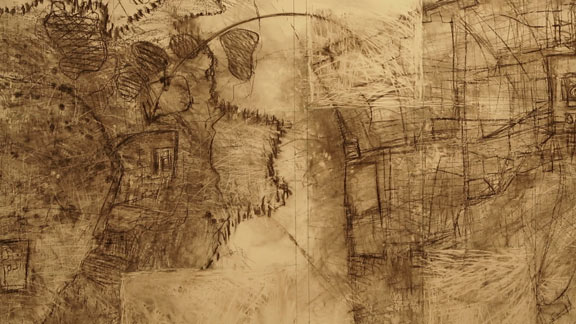
“Borderline” is the title of two performance events featuring new works that address the space of the former Hansen leper house, and engage with cartography, mapping, and drawing in space.

Lezli-Rubin-Kunda-2Cartography, as a field of knowledge that encodes the space and delineates the connections between space and identity, employs the language of drawing in order to express political, economic, and social worldviews, all the while preserving and founding perceptions of identity. The works in “Borderline” will offer a different mapping of the space, whether through a revised reading of existing maps or the creation of alternative poetic maps.

The wall of Hansen House – which marked the separation between normal life and abnormal life – serves as the borderline, the initial point of departure for some of the works. The Hansen wall, residue of the outside self-defense against the inside, marks the space of a ghetto, of exile within the city, and serves as an architectural metaphor that echoes other walls. The works in the series of performances engage with the conceptual and concrete notion of the borderline: its delineation, erasure, or blurring. The borderline appears in the works as a formal or metaphorical line that separates and unifies its two sides, produces situations of passage, blockage, schism, or destination, and materializes in the encounter with agents that indicate its existence: customs, police, border crossing, conflict between different interests.Hadas-ofrat-3

The aspiration towards a utopian borderless space, a plan for a space without lines, was the dream of architect Rodriguez (the pseudonym of João Delgado), who had signed his business card “Arch. Rodriguez – Plans without Lines: an architect on a tightrope”.

http://traces.art.org.il/5/venues/mamuta?en

Living in a Film, 2014

Mamuta at Hansen | January-February 2013

Artists: Asya Lukin, Itamar Mendes-Flohr, Guy Yitzhaki, Hagar Goren, Hadassa Goldvitch, Zemer Sat, Yarden Erez, Einat Amir and Sala-Manca

Curators: Sala-manca

The project, which incorporates art, cinema and performance, will feature eight artists who were artists-in-residence at Mamuta in Ein Karem. The entrance to “Living in a Film” is every full hour. The viewers are led by a movie usher named Esther, a girl born to a Jewish Orthodox family, who left religion and fell in love with the usher of the Lisbon Cinema, which operated in the cellars of the leppers’ house in the city of Lisbon in Portugal between 1963 and 1973 (the era of Salazar’s dictatorship – and managed to serve as the underground nerve center of freedom fighters, right under the regime’s nose). In the wake of her love to the usher she also fell in love with the art of cinema, and because of that love was banished from her home.

images from the exhibition

FFINAL-Poster-Live-in-a-Film (1)

The  Exhibition is supported by the Ostrovsky Family Fund and the Ministry of Culture