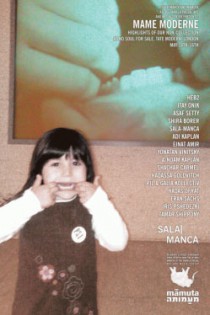
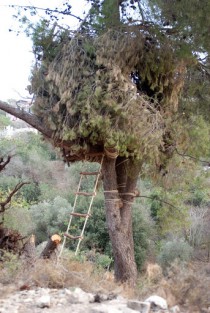
What’s Hidden Behind the Pastoral? is an art project in which more than thirty artists present installations, performances, tours, and shows dealing with the past, present, and future of Ein Karem. The project explores the history of the village from biblical times, through its epoch as a Palestinian village, and until its present day as a Jewish neighborhood of West Jerusalem and a primary object of desire for big real-state projects. These are the central themes that the artists deal with at the project. This series of actions examines the place of the pastoral in Israeli art in general and its implications on Ein Karem specifically. The event is also the formal opening to the public of the Mamuta at the Daniela Passal Art and Media Center, which has been operating since February 2009 in the house of the late artist Daniela Passal, thanks to her generosity. Mamuta is a joint project of the Jerusalem Foundation and the Sala-manca group.
Works and projects that will be held and presented at the event:
1 – The presentation of some twenty five actions, media installations, and performances by different artists
2 – Open Source Souvenir Shop Project (OSSS). At the Shop, the public will be able to create souvenirs of the event and of Ein Karem, with free access to some of the images of the artists’ works.
3 – Audio tours of Ein Karem will be offered, creating a new and multi-layered narrative of the village: the visitors are invited to go set out on a hike with a map and an MP3 of guided tours made up of different voices that present the history of Ein Karem from different points of view.
4 – Throughout the event and in real time, three groups—each comprised of a poet, a photographer, a theoretician, an editor, and a graphic designer—will head out on a safari with a personal guide, to collect and create materials. Each group will produce and design its own catalogue for the event. The catalogues will be printed on the site and the public will have the opportunity to choose between the different catalogues—different records of the same event
5 -Friday October 16, from 9:30 to 13:00: Symposium on the curation and creation of art in contested spaces, with the participation of Galit Eilat, Charles Esche and Danna Tagar.
6 – Saturday October 17, from 11:00 to 14:00: Bridge tournament between the local ladies’ team and guests of the event.
Background
The Center’s location demands in our view a treatment of the historical and ideological complexity of the loaded landscape: the landscape of the village of Ein Karem and the village of Ein Karem as landscape.
The central project that guides us at Mamuta, and which gives this lecture its title, is: “What’s Hidden Behind the Pastoral?”
One of Mamuta’s main challenges is its location and history and the need to observe and confront that very same spatial pastorality, which is essentially a window into understanding Israeli reality in the broadest sense. Through “What’s Hidden Behind the Pastoral?” we take a critical look at the geographic and historical space of Ein Karem; we deal with the representation of the landscape and the relationship of the landscape with notions of power and nation; and we explore the connection between art, media, and technology, and the Israeli landscape as an arena for events and critical artistic production in general and in the representation of Israeliness in particular.
According to jewish the tradition, Ein Karem is the ancient Beit HaKarem as recorded in the Bible (Jeremiah 6:1, Nehemia 3:14).According to the Christian tradition, Ein Karem is the birthplace of John the Baptist. In the Byzantine era, churches were built there that are connected to the name of John the Baptist and his family, and to this day Ein Karem is considered a holy place for Christianity and a site of pilgrimage.
In the thirteenth century, the village was conquered by the arabs forces of Omar al-Khatav ,. In the nineteenth century, the village, home to both Christians and Muslims, developed into a site of pilgrimage for Christians from around the world and also a site for the cultivation of olives and the production of olive oil.
In the 1948 war—which ended with Independence for Israel, and catastrophe, or Nakba, for the Palestinians—the village was conquered by Israeli army forces. Most of the residents of the village fled before the army came in, following attacks on neighboring villages . After the property was confiscated, the State began to settle the village with Jewish refugees and immigrants from various countries. A youth agricultural school was established there over the years , and in the 1980s Ein Karem became a central tourist spot in Jerusalem, bringing about a rise in real estate prices and an influx of wealthy residents.
Ein Karem is one of the few Arab villages that was not destroyed by the Israeli army during or after the 1948 war, and it amazingly preserves the pre-1948 architecture of the village.
The history of the village, the history of the representation of the landscape in Israeli art and a criticism on the dominant pastoral perspective in the area in which the Center is located are the central subjects of the long-term project that will occupy us and the center for the coming years,. This project will be comprised of a series of actions, events, exhibits, and performances dealing with the present, the past, and the future of Ein Karem. The project will take place, will be produced and presented at Mamuta and its environs through collaboration with different institutions and neighbors. It is a project in stages, with different stops in which its opening date is known (this October 15-17) but its completion date is unknown.