WordPress database error: [DELETE command denied to user 'sala-manca'@'localhost' for table `sala_manca_net`.`wp_options`]
DELETE FROM `wp_options` WHERE `option_name` = '_site_transient_wp_theme_files_patterns-3e81fb819c0831df69203ee558a709b9'

WordPress database error: [DELETE command denied to user 'sala-manca'@'localhost' for table `sala_manca_net`.`wp_options`]
DELETE FROM `wp_options` WHERE `option_name` = '_site_transient_timeout_wp_theme_files_patterns-3e81fb819c0831df69203ee558a709b9'

WordPress database error: [INSERT, UPDATE command denied to user 'sala-manca'@'localhost' for table `sala_manca_net`.`wp_options`]
INSERT INTO `wp_options` (`option_name`, `option_value`, `autoload`) VALUES ('_site_transient_timeout_wp_theme_files_patterns-3e81fb819c0831df69203ee558a709b9', '1792702852', 'off') ON DUPLICATE KEY UPDATE `option_name` = VALUES(`option_name`), `option_value` = VALUES(`option_value`), `autoload` = VALUES(`autoload`)

WordPress database error: [INSERT, UPDATE command denied to user 'sala-manca'@'localhost' for table `sala_manca_net`.`wp_options`]
INSERT INTO `wp_options` (`option_name`, `option_value`, `autoload`) VALUES ('_site_transient_wp_theme_files_patterns-3e81fb819c0831df69203ee558a709b9', 'a:2:{s:7:\"version\";s:3:\"4.0\";s:8:\"patterns\";a:0:{}}', 'off') ON DUPLICATE KEY UPDATE `option_name` = VALUES(`option_name`), `option_value` = VALUES(`option_value`), `autoload` = VALUES(`autoload`)

WordPress database error: [INSERT, UPDATE command denied to user 'sala-manca'@'localhost' for table `sala_manca_net`.`wp_options`]
INSERT INTO `wp_options` (`option_name`, `option_value`, `autoload`) VALUES ('_transient_doing_cron', '1792701052.8445110321044921875000', 'on') ON DUPLICATE KEY UPDATE `option_name` = VALUES(`option_name`), `option_value` = VALUES(`option_value`), `autoload` = VALUES(`autoload`)

Installation & Media Based (selected) – Page 2 – Sala-Manca

Paradise

Paradise Inn

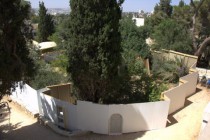
Paradise Inn, Talbiyeh, Jerusalem. A dream for only one person. Infinite stars and a real gate to paradise. Reserve your room at the former Lepers’ home.
Jerusalem, where any piece of land can become your temporary dwelling.

In light of the policy of the city of Jerusalem to develop tourism and to use art and culture as a touristic tool, a group of local artists decided to be part of this new trend. In order to generate a new resource for tourism as well as some independent income for local artists and the Mamuta Art and Media Center, they established the luxurious Paradise Inn on part of the lands of the former Jerusalem Lepers’ Home at Hansen House.
Using a “green” approach to urban design as well as the idea of recycling electronic waste, the artists created a summer hotel for temporary residence, inspired by Bauhaus architecture, temporary techniques of modernist parcelization, and the new school of architecture, Growing Walls.
The artists participated in the design and implementation of all aspects of the hotel, with the goal of giving everyone the possibility of spending a few nights at Paradise Inn. The project synthesizes new visionary ideas for a modern Jerusalem: a hotel for only one person, a personal paradise built in the exquisite Hansen House gardens.
Image“Paradise Inn is an island surrounded by the walls of the former Jerusalem Lepers’ Home. A metaphor of differentiation and exclusivity. Paradise Inn is a luxurious paradise that originates from a public institution that was historically used to protect society from lepers and lepers from society. Paradise Inn dwells in the spirit of gentrification, inviting an artist to reside for free in the paradise for a month and a half. In return, the artist is expected to produce artwork for the comfort of future residents.” (From I Love Jerusalem Magazine)

In the year 2018, the utopia that Boris Schatz wrote about in his novella “The Rebuilt Jerusalem: A Daydream” (1923), is supposed to be fulfilled. A Utopian Jerusalem in which paradise exists; harmonious coexistence with nature and with the Arab residents of the city, and building of the Third Temple, which will serve as a museum, with the consent of the Arab minority.

Three years prior, in the year 2015, at the Hansen House gardens, Paradise is built – a haven in the middle of the city, a white façade bounding a garden that has been expropriated from the public. In Paradise, only one human being at a time can experience the ideal and modern natural living, leaving the public with a sense of longing, allowing a sneak peek into a free and peaceful world, at an affordable price.
The entrepreneurs of Paradise Inn have invited an artist to live and create for a month and a half in this daydream – an infinite-star hotel for one, a slice of nature in the middle of Jerusalem, in the historical garden of the former Lepers’ House.

From the middle of September, Paradise’s sole room will be available for rent at an outrageous rate for all interested.
Please visit us and reserve your nights: www.paradisehotel.co

Concept: Sala-manca
Architects: Sala-manca and Nir Yahaom
Interior Desing: Itamar Mendes-Flohr
Paradise Inn art collection: OZ Malul, Guy Yitzhaki, Itamar Mendes-Flohr, Sala-manca, Shaul Zemach.
Souvenirs: Silent Room 1, Chen Cohen | Room-Kit, Pessi Komar | A letter for you, Shiri Zinger, Elevator to Paradise, Lior Pinski
Avantgarde workers: Yuval Galili, Diego Rotman, Yeshaiahu Rabinowitz, Rotem Zuta, Ayala Shamir, Ktura Manor, Lea Mauas, Chen Cohen, Galia Lulko, Nahuel & Ayu
Paradise Inn website: www.paradisehotel.co
Observation post to Paradise: Conrad Shick


Press:

http://www.haaretz.co.il/gallery/art/artreview/.premium-1.2732894

http://old.sala-manca.net/wordpress/wp-content/uploads/2015/08/almost-paradise.png
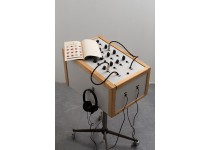
 

La Máquina de Hacer Pájaros, 2014

Formica and wood box, miniature printed circuit board (PCB), MP3 players, audio sockets and earphones, power supply, metal leg, two sofas from Casa Argentina, Jerusalem Text: João Delgado; music: Yarden Erez; electronic system: Amir Markovitz; programming

Exhibited in the frame of  Recalculating Route at Petach Tikva Museum of Art, in theframe of the 4 Mediations Biennale, Poznan, 2014 | 2.10.2014-24.1.2015

Curator: Drorit Gur Arie

The spirit of João Delgado has been haunting Diego Rotman and Lea Mauas, members of the Jerusalem-based Sala-Manca Group, for fifteen years. A Portuguese poet, writer, playwright, and essayist, Delgado was, in all likelihood, born in Lisbon (date unknown) and disappeared in Argentina in the second half of the 1970s, in the dark years of the Generals’ regime. Like the circumstances of his disappearance, his life was equally shrouded in mystery, and little is known about it. Years later, his post-realist poetry has had a vast impact on late 20th century Latin-American literary avant-garde, but Delgado himself did not live to see it, since the political circumstances—the censorship placed by the military junta in Argentina—and his own choices interfered with the reception of his works by the public at large. His writing was confusing, and he often used fictive aliases which further blurred his identity. In literary terms, Delgado was a modernist who addressed the formal questions of writing (like Georges Perec and the Oulipo group): the author’s identity, the gap between the text and the world, and the illusions of fiction and reality. In this he joined other, more senior, contemporary modernists, from the Argentinean Jorge Luis Borges and Portuguese Fernando Pessoa to the Hungarian Lajos Kassák, whose Cubist poetry from the 1930s and 1940s had influenced Delgado when he lived in Central Europe.

Design: Maya Shleifer

The members of the Sala-Manca Group, in their joint work as artists, curators, and activists, often revisit Delgado’s figure, publishing translations of his work and incorporating excerpts from his unfinished plays into their performances. The return to Delgado, the eternal migrant who wandered until he disappeared, is linked with Rotman’s and Mauas’s personal immigration experiences and the need to discover new territories through language and the act of writing.
The work La Maquina de Hacer Pájaros (‘The Bird-Making Machine,’ as the name of an Argentinean rock band which formed in 1976, in the dictatorship days) is yet another chapter in the quest after the Portuguese-Argentinean writer. The viewer-listener is given the opportunity to wander amid excerpts of text by Delgado and other writers of his alleged circle, such as Juan Mestre, Regina Handeke, Irina Pantalova, and Arturo Maure, who may well have been none other than Delgado himself. This wandering is akin to a journey through the soundtrack of a literary microcosm, comprised of fragments of texts, sounds, and linguistic images. The listener is invited to try to compose the narrative as s/he pleases, to believe the story in whose making s/he took part, or disbelieve it altogether.
One of the legends associated with Delgado maintains that he made his way from Portugal to Argentina with the aid of a map of the Atlantic Ocean which he adopted from a Lewis Carroll book. Whether and how he arrived at his destination—no one knows. João Delgado is, in fact, a fictive entity, a figment of Rotman and Mauas’s imagination; at the same time, like them—who create in-between the splinters of their Latin-American and Israeli identities, in-between the language from there and the one they have adopted in Jerusalem—he is totally real.

Drorit Gur Arie


Israeli Time, 2015

Interactive installation and questionnaire

Exhibited at The Ethnographic Department, 2015

Concept: Sala-manca | Programmer: Guy Yitzhaki

10920942_998108806869211_8464947476147197867_n

“Real time” is an interactive machine that makes part of the sounds shaping Israeli time and pacing conduct according to one’s awareness of the sanctity and meaning of time on the Sabbath, Memorial Day, Holocaust Memorial Day and in times of emergency and war.”

This work is a sound archive that requires the visitor to pay for its function. The price of working the siren is set according to a criteria hierarchy, moving between 5 and 12 NIS.

Towards an updated ethnographic questionnaire (following S. An-ski) 

28 First Questions

10361972_998108886869203_458225386582237166_n

  • How does one tell a Sabbath siren from an emergency or war alarm siren?
  • What do you feel upon hearing a real emergency siren?
  • What do you feel while hearing the Memorial Day siren?
  • What do you feel while hearing the Holocaust Memorial Day siren?
  • What do you feel while hearing the Sabbath siren?
  • When did you last hear an alarm or other siren?
  • What did you do when you heard it?
  • Do you know stories, jokes, or sayings about sirens – alarm or other types? Tell us.
  • What do you tell your child in case of a real alarm siren
  • What do you tell your child in case of a Memorial Day siren?What is his/her answer or question?
  • Do you make sure to hear or find out about a certain situation such as the Sabbath, Memorial Day, Holocaust Memorial Day and war through other means as well? Please elaborate.
  • Could you perform the siren yourself?
  • Do you recall the first time you heard it? What are your recollections of that time?
  •  What happens to the body and mind at the moment of the following types of sirens: Sabbath, Memorial Day, Holocaust Memorial Day, emergency or war.
  • Were we to hear a siren right now, what would you do? What would you do if you were outdoors? In the bathroom?
  • What does the sound of a siren symbolize for you, or remind you of?
  • Have you ever heard similar sounds in other countries? What did you feel then?
  • Do you know the myth of Odysseus relating to the Siren? Please elaborate.
  • Do you need sirens? If so, which? Please explain why.
  • How do you tell them different kinds of sirens apart?
  • What do you think of the effects that sirens have upon Palestinians? Work immigrants? Israeli Jews? Non-Israeli Jews? Foreign tourists? Animals? Children? Politicians? Clergymen? Policemen? Soldiers?
  • Is there a difference in behavior of men and women at the sound of the sirens? Please elaborate.
  • On Memorial Day, upon hearing the siren do you stand? If some people around you do not, what do you think of them or of the State?
  • On Holocaust Memorial Day, upon hearing the siren do you stand? If some people around you do not, what do you think of them or of the State?
  • Upon hearing the Sabbath siren, what are your bodily actions?
  • Upon hearing a real alarm siren, what are your bodily actions?
  • Do you think that the price-hierarchy set for alarms at the ethnographic museum is proper? If not, elaborate.
  • What was the artists’ intention?


Total Investment, 2013

IMG_6256 IMG_6258 IMG_6261969508_652127261467369_1815255362_n

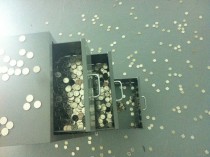
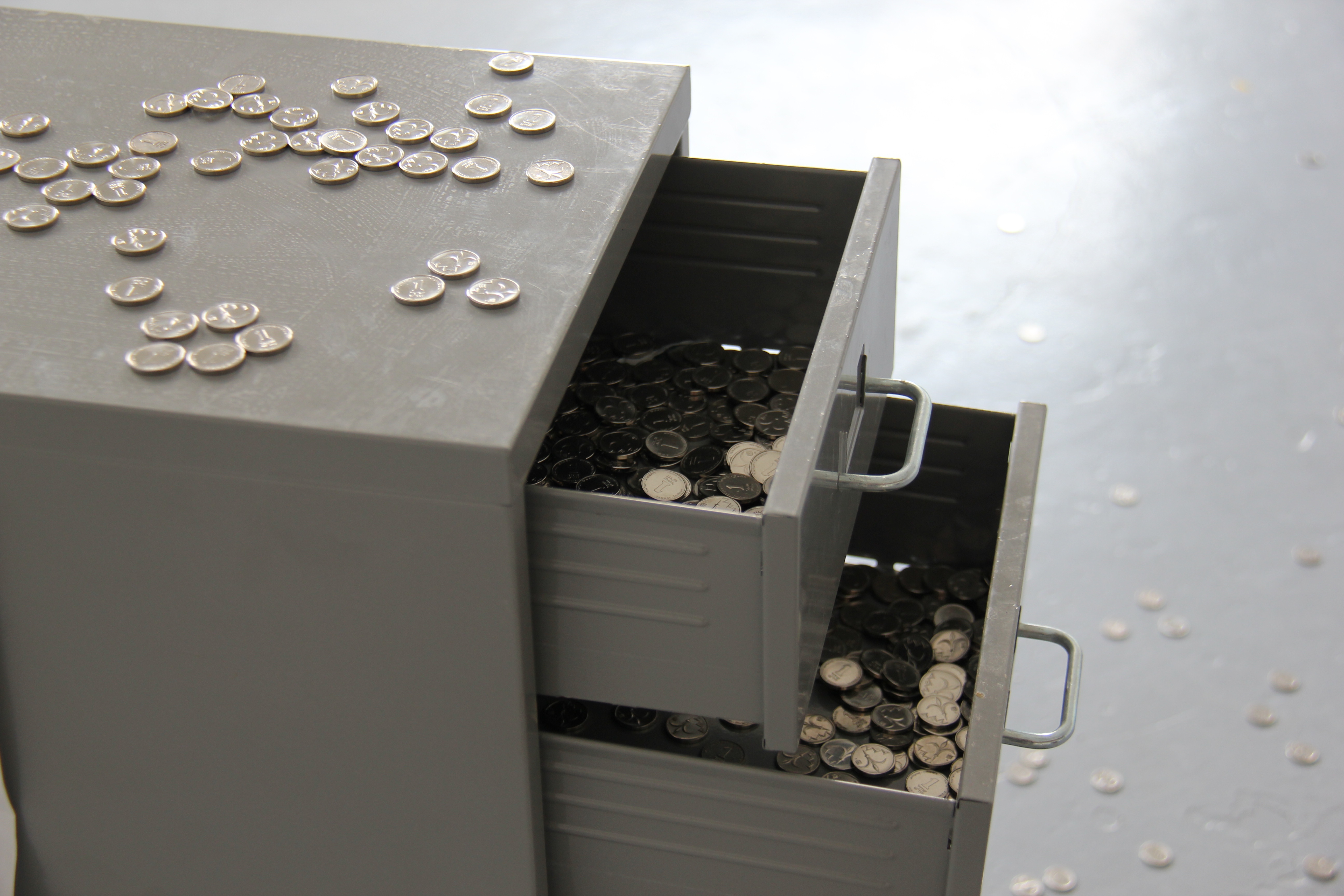
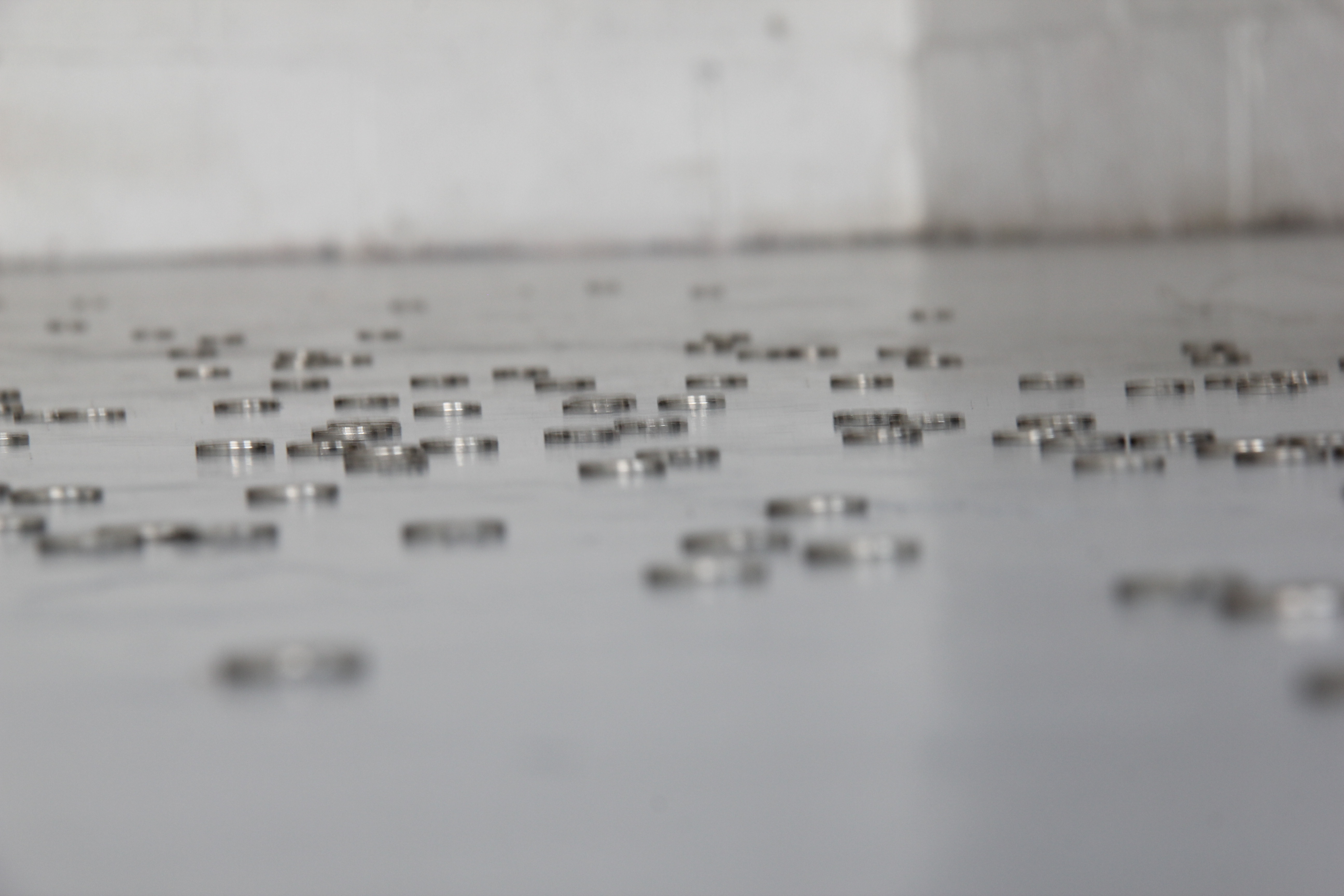
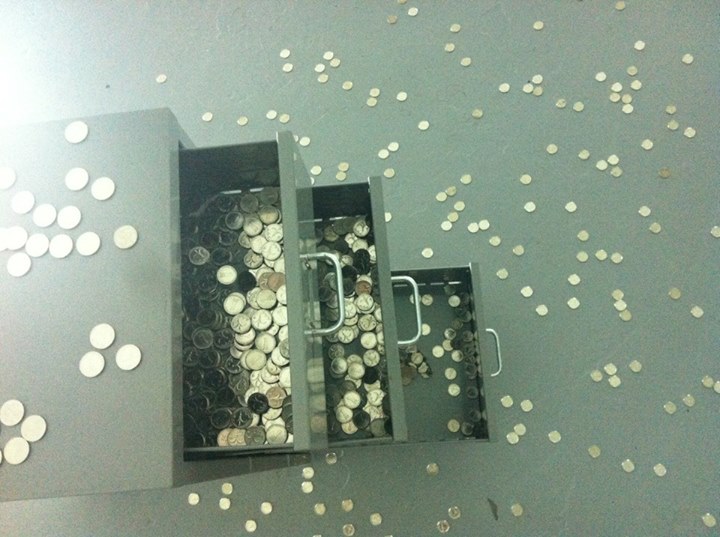
The project budget for the work was 1000 nis. The work is a sculpture  comprised of 1000 – shekel coins, the artists’ fee including expenses.

The sculpture is for sale. the price is 8000 shekel.

Performa 0:2 Festival / School of Visual Theater/ Curator: Guy Gutman 

Background

In 1972, the Portuguese-Argentinian Joao Delgado decided to expose the support mechanisms of the fringe theater he managed in Argentina. In the first act of his first play, on stage, he signed a contract with an urban producer stipulating the conditions and budget of the production itself. In the second act he took it back, and signed with the largest fund in the city that gives the smallest grants. In the third act he built a tower out of 2500 one-peso coins, comprising the meager budget of the entire show.

In the fourth act, to everyone’s surprise, the money vanished from the stage.

Play was performed only once and was a critical response to the ruling economic and political policy in Argentina at the time, when both foreign and local foundations and organizations attempted to dictate an alien cultural agenda, by force of their wealth. In this work, called “Total Investment”, Delgado preceded his time in a brilliant critical act and continued to work independently until his disappearance during the military dictatorship in Argentina.

photos: hilla spector

The Church of Criticism, 2012

Installation, in the frame of The Museum of the Contemporary, Mamuta in Ein Karem

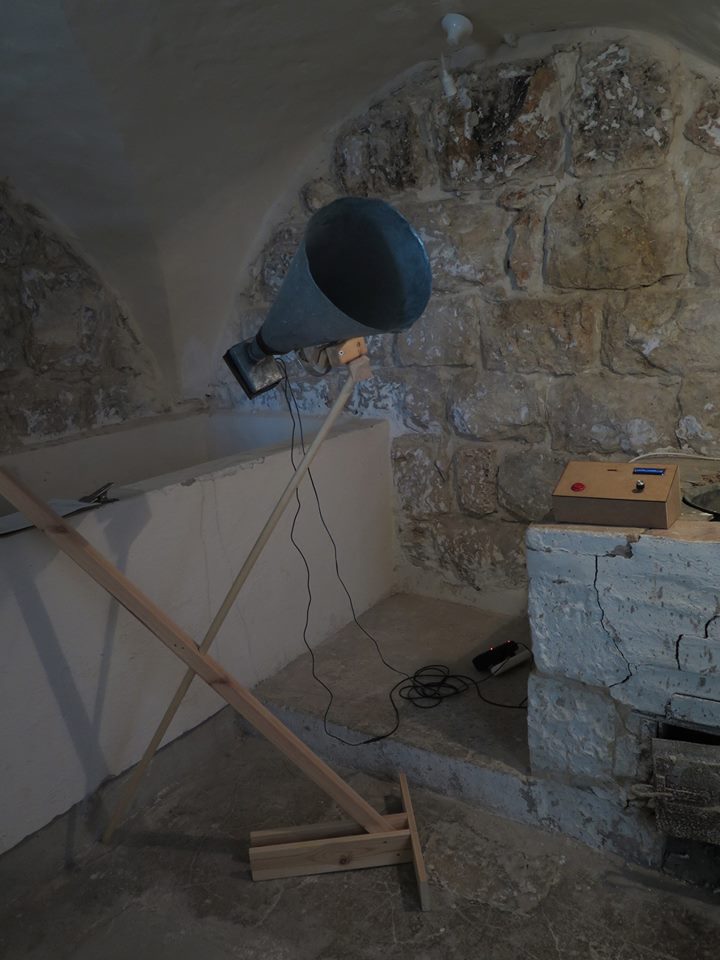
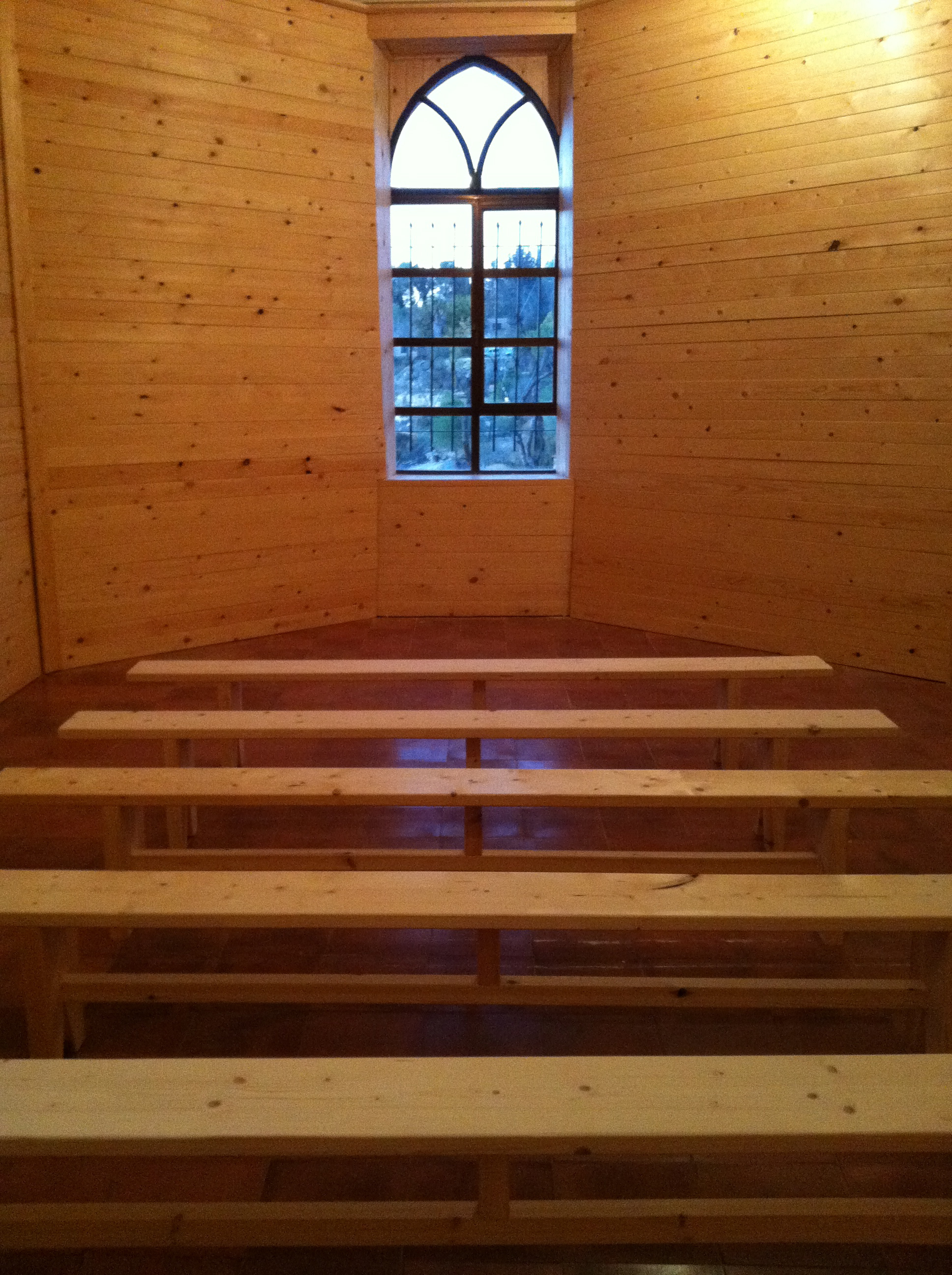
Another stop along the tourists’ route, where art becomes the decoration of a private school-trip experience. The museum is a modern secular church and the performance executed in the Church is a combination of a mass, sermon and poetry reading. A reference to the unique geographic site of the Museum of the Contemporary, midway through the pilgrimage route to the Church of Visitation. A sculptural object, duplication of an Eastern European church to the Arab village; another comment on the process of converting the house’s original identity, “halfway” between the architectural tradition of a Norwegian church and a zimmer in northern Israel. The Church of Criticism features and quotes Western philosophers as icons of the Church’s outlook.

[*Knesiat Habikoret, a play on the Hebrew name of Church of Visitation]

Pine wood, stained glass, projector, mixer, computer, music machine, microphones, metal megaphone, camera obscura :pierced black wallpaper, tracing paper

IMG_1844


Sound of the Installation: Yarden Erez, “The Temple of Contemporary”


Short doc of the video installation at the church:

Private View, 2012

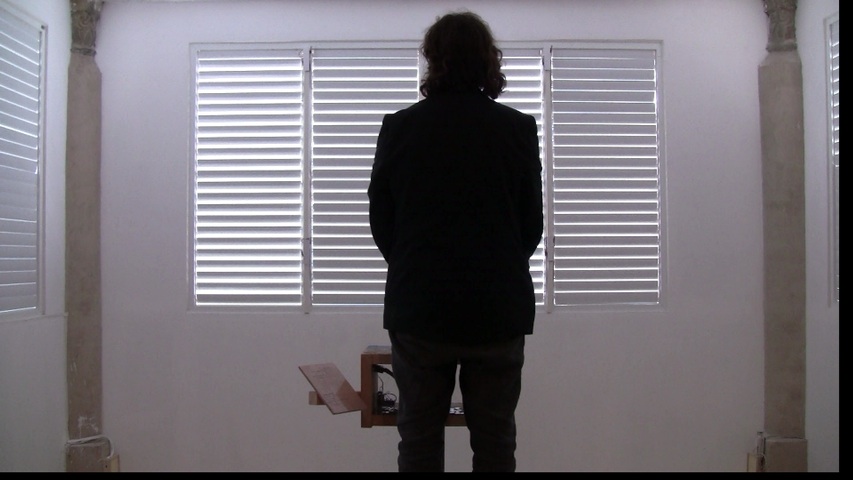
Plastic blinds, plaster, metal frame, PVC sheet, wood. Box: perspex, wood, metal brackets. Electronic mechanism: servo engines, arduino, cables, batteries.
Sala-Manca in collaboration with Mamuta collective
Programming: Amir Markovitz
Mechanics: Yuval Kedem (Galileo)
trisim
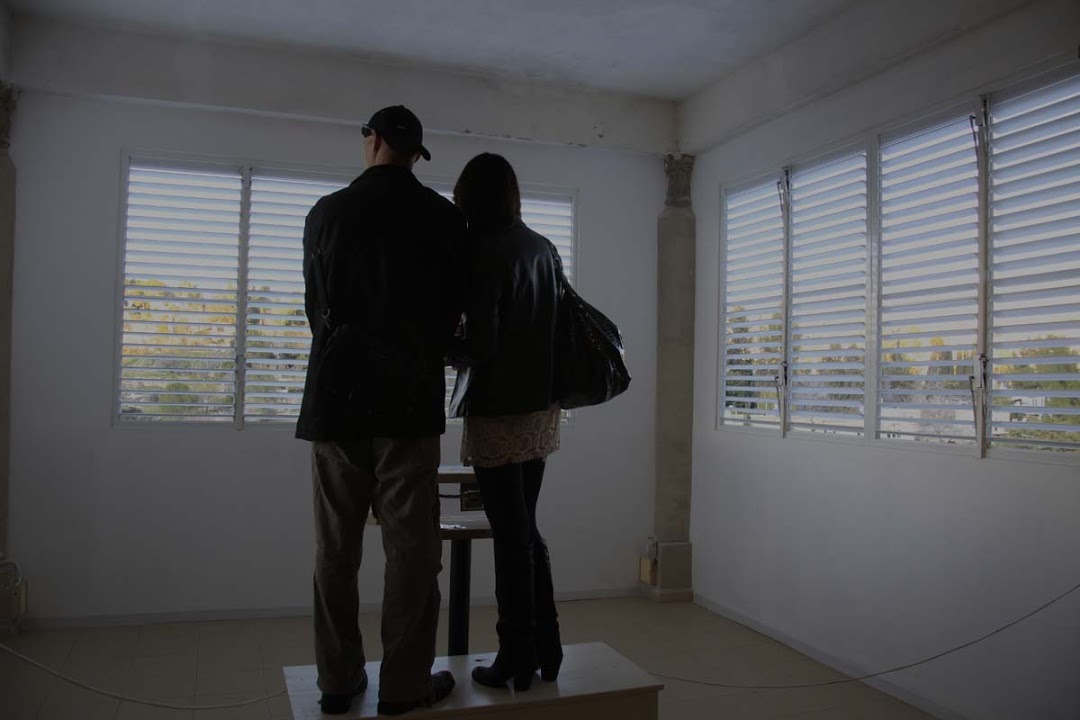
A sculptural interactive work exploring the tension between pastoral Ein Karem and the privatization processes taking over the landscape. The view is framed and rented by means of installing typical “Tel Aviv” plastic shutters in the balcony of the house and barring them. For 3 nis the blinds will open alltogether for 8 seconds, a private view for profit.

_MG_7275
Shown in the frame of the Museum of the Contemporay, Mamuta, Ein Karem, 2012

Eternal Shabes, 2009-2014

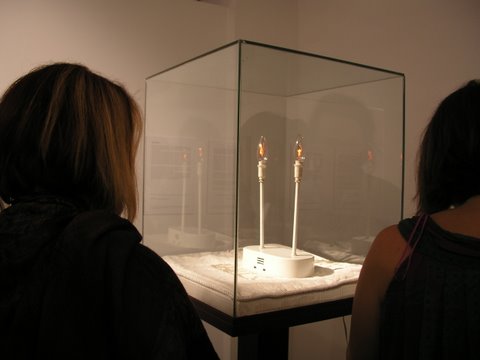
Ready made, base with white lacquer, two candlesticks, two light bulbs, white electrical cord, short black electrical cord, electrical plug, white insulation tape

Candlesticks created for Osher and Malka Rotman, parents of the artist in Buenos Aires in 1990. The nanny Cristina used to light the candles every Sabbath Eve. It was never clear who and how blew them out, if at all. In 1995 the candlesticks returned to Samuel Rotman’s home and in 2009 they were brought to Israel.

Exhibited at “Drama of Identities” curated by Irena Gordon, in Beth Hatfutsot MuseumElectric Sabbath is a work by Samuel Rotman; at the Museum of the Contemporary, Ein Karem; The Ethnographic Department, Hansen House

“Lea Mauas and Diego Rotman, the Sala-Manca group, persistently deal with the modes of formation of Jewish cultural identity through various acts of translation and through the creation of alternative, fictional histories that hold up Diaspora culture as a critical and emotional mirror to Israeli culture.

Samuel Rotman
Samuel Rotman

IMG_0280They create performative video and sound installations alongside cinematic and theatrical works, whose nature is ironic and full of parody though always centered on the particular human subject. At the center of “Eternal Sabbath,” the installation prepared especially for this exhibition, are electric candles—a family heirloom. The story surrounding them poses questions about Jewish and Socialist traditions.” (Irena Gordon)
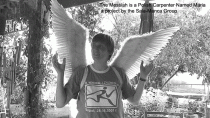
 

The Messiah is a Polish Carpenter Named Maria, 2008

Action/Video Documentation

“Chosen” | Wyspa Art Institut, Gdansk, Poland & Digital Art LAb Holon | Curators: Aneta Szylak, Galit Eilat

Foreshadowing the Past | ARTISTERIUM in Tibilisi, Georgia | 2010 |Curator: Eyal Danon

In one way or the other, most of the works of Israeli artists in this exhibition deal with the coming of the Messiah or with inducing his arrival. In “The Messiah is a Polish carpenter named Maria”, the group Sala-manca traveled from Jerusalem to Gdansk to hold auditions for a “Messiah”. The group published a want-ad in Polish stating that they are searching for a “Messiah” and that the “chosen” candidate will go to Israel as part of the project. Seven people, men and women of different backgrounds, arrived at the auditions, and were tested for the part. They were asked to read aloud “messianic” Hebrew texts by Jacob Frank, Theodor Herzl, Uri Zvi Greenberg, Yona Wallach and others, texts that were sent to them previously via email, to allow them to prepare for the audition. Finally the “Messiah” part was given to Maria Sahajko, whose visit to Israel took place in August 2008. The exhibition will present photos from a film documenting the “Messiahs” visit to Israel and her initial encounter with Israelis.

Interview with Eytan Buganim, Time Out

Seara/Storm, 2006-2007

vers 2.0 presented @ Hapzura Series, Digital Art Lab Holon | curator: Eran Sachs & Heara 10 | The Science Museum | curator: Sala-manca

Seara/Storm *

In 1950 during a party on the roof of Marian Loop, celebrating the 100 anniversary of Tomas Robinson’s invention of the wind meter, Regina Handke, Marian Loop and Joao Delgado decided to build a wind meter as a quotation to Robinson’s original machine.

OLYMPUS DIGITAL CAMERA Regina Handke, the Hungarian-Yiddish poet, who began in those days to learn Hebrew, told her friends that in Modern Hebrew there are two meanings to the word “seara”: hair and storm**. Delgado and Loop got excited from the linguistic discovery, and decided to build a wind meter based on a hair.

In 1955 the machine was brought to Israel and activated in a symbolic and nationalistic act, using David Ben Gurion’s hair. This experiment made Ben Gurion very disappointed from his hair quality, who sent the machine away.

In 2005 the machine was exhibit for the first time in fifty years in the frame of the Jerusalem Film Festival. In 2006 the machine is exhibited again , this time not only the wind meter has been repaired but also the sound-wind visual meter.

* This machine is part of sala-manca’s collection of Joao Delgado’s works.


** She was not aware that although the pronunciation is the same, “seara” for hair and “seara” for storm have a different Hebrew spelling.

vers. 1.0 – presented at the Intersection – Jerusalem Film Festival 2005, Heara 10-The Science Museum, Jerusalem, February 2006

Studies on New Israeli Landscapes, 2005-2008

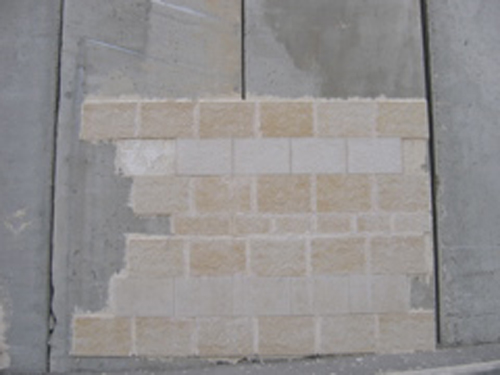
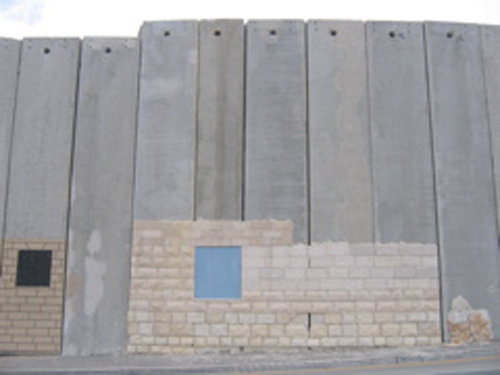
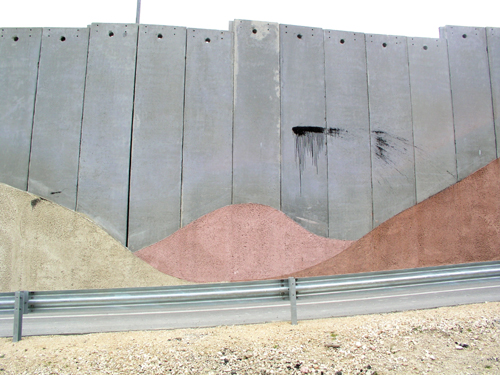
From the beginning of the 20th century, Zionism visually represented ideologically charged Eretz Israel (Palestine), showing the local landscape as an idealized continuation of the biblical landscape. Until around 1970, Jewish Israeli art constructed an ideological representation of  “the own territory”, “the own landscape” where the Palestinian population was not represented at all, or became literally a part of  the landscape. Since 2002 with the beginning of the construction of the separation wall by the Israel government, a new border is being defined and a new landscape is being created.

1348 1338 1358 3

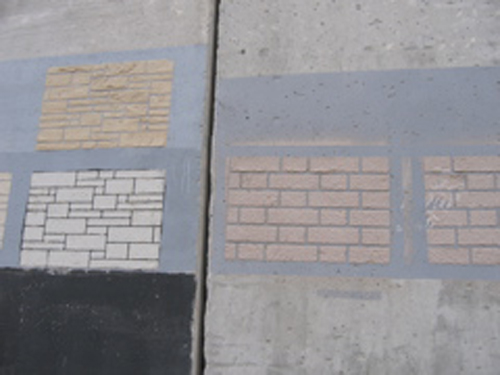
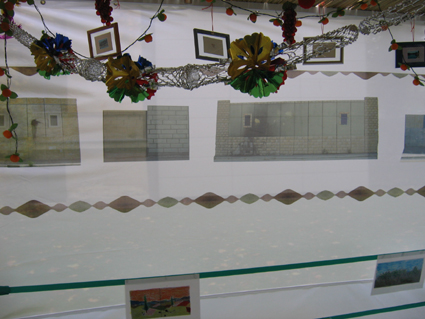
The construction of a new form of landscape, which has the aim of hiding the view of the separation wall, is being tested in Maavar Hazeitim (The Pass of the Olives), situated in Al-Azaria area, near Mount Scopus, Jerusalem. A pastoral and “natural” name is intended to conceal the fact that a weird terminal serves as a check-point. In this part of the wall the construction of a façade, of a Potemkin Village1, is being tested along the “border”, in order to prevent the Israeli citizens from seeing the wall. But the use of landscape construction, through painting and reliefs, is not only intended in this case to create the idea of a peaceful wall, but to make the wall disappear. You can see mountains, flowers, pastoral images, and also the facades of Jerusalem stone houses with windows which do not overlook any where.

In this project Sala-Manca deals with the use of political created landscapes, with these new forms of art-ificial or art-official and naïves landscapes, created in a very non-naïve platform. The platform is the message, and the naïve landscapes the decadence of an official aesthetics of colonialism. The first steps of a new fake as a way of living proposed by the Israeli state to its citizens.

Prof. G. Vakulinchuk


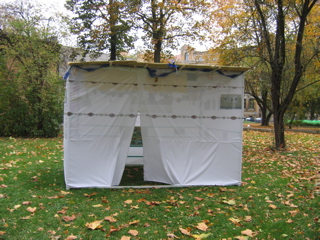
Sukkat Nezach (Eternal Tabernacle 1)

Produced in the frame of Liminal Spaces project curated by Galit Eilat, Reem Fadda, Eyal Danon and Phil Misselwitz. Exhibited at GFZK, Leipzig, Germany, 10.2006-1.2007

IMG_4645-1

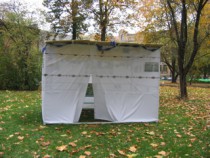
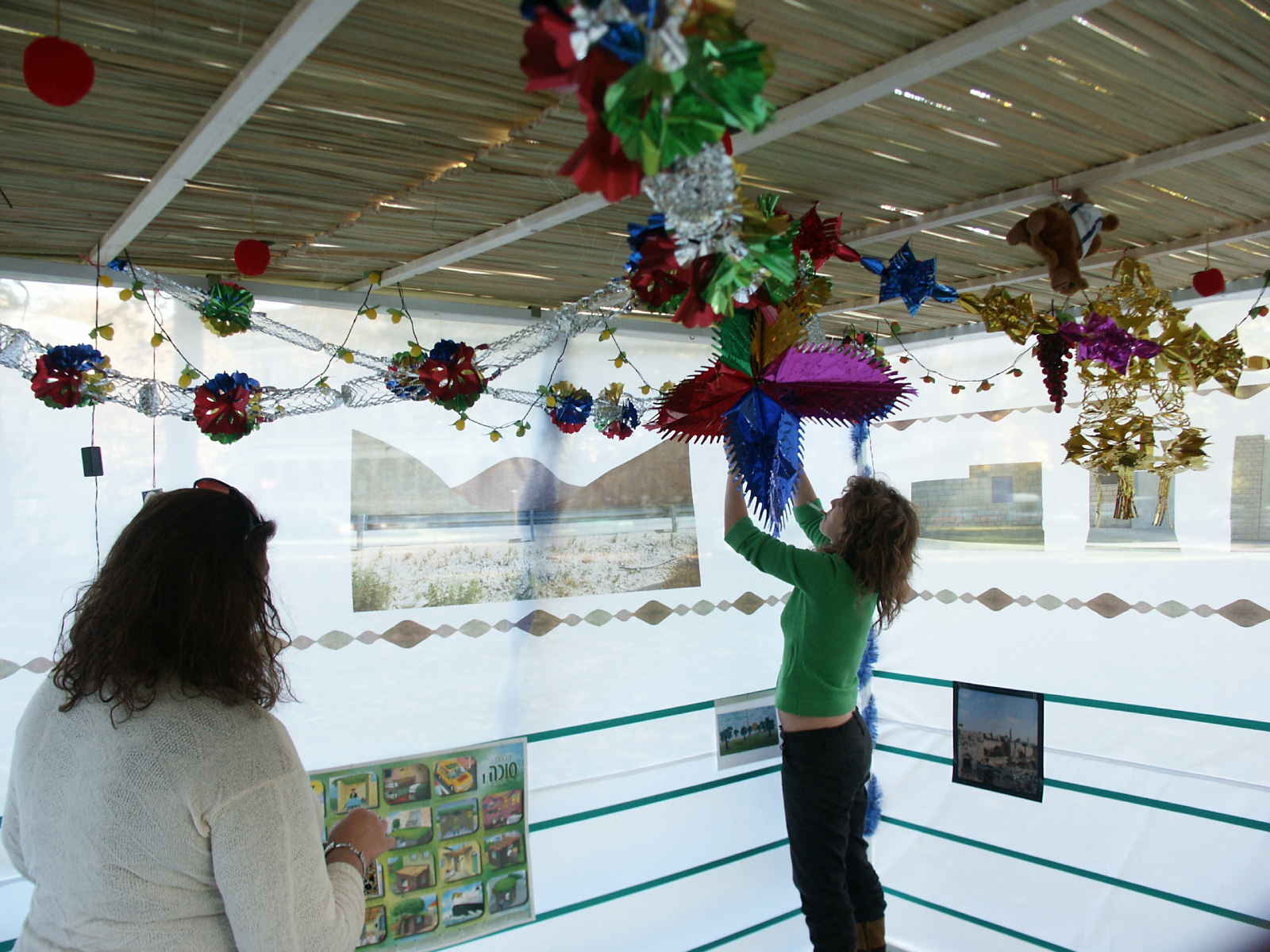
The holiday of Sukkot is one of the three holidays mentioned in the Torah on which it was customary to go on pilgrimage to Jerusalem during the period of the First and Second Temple. The name of the holiday comes from the word Sukkah – the name of the huts in which the Israelites encamped in the desert during their exodus from Egypt (Exodus 33:6). 1 The holiday’s relation to Jerusalem acquires additional meanings in the Bible when several of the prophets refer to the city using the term “Sukkah” – see, for instance, Isaiah (1:8) and Amos (9:11). 2 The holiday commemorates the exodus from Egypt by means of the commandment to build sukkot (Leviticus 23:42) – temporary structures topped by a covering of branches or fronds. During the holiday, one’s house become a “temporary residence”, while the sukkah becomes a “permanent residence”. During the holiday, Jews are commanded to sit in the sukkah, and to eat, study and even sleep in it during the seven days of the holiday. One of the central customs related to the holiday is the decoration of the sukkah; these decorations lend it a festive air and are a means of expressing the identity and ideological outlook of its builders. In the ultra orthodox community, dominant motifs include DCF 1.0 sukahrabbinical figures; the seven ushpizin, or exalted guests, who are symbolically invited to the sukkah; and various religious symbols. Members of the national-religious community adorn their sukkahs with decorations that have a national character, such as images of the local landscape, its fauna and flora, and the Israeli declaration of independence. Jerusalem and related symbols are always central motifs in sukkah decoration. The sukkah symbolizes the tension between a permanent residence and a temporary residence – between “the ancient ideal of wandering referred to by the symbols of the holiday and the ideal of permanent residence, which is at the core of Zionism”. 3 Eternal Tabernacle4 is composed of materials typically used to construct a sukkah in Jerusalem: an aluminum framework that is easy to construct and to dismantle, a prefabricated covering and other do-it-yourself-style paraphernalia. The cloth walls surrounding the sukkah are made of water-resistant material, which is frequently used to surround the modern sukkah. In many sukkahs, symbols and motifs related to Jerusalem are imprinted upon this cloth. The motifs we used for the walls of Eternal Tabernacle are taken from an area of the separation wall in Jerusalem. This area, which is called the “Olive Pass” was decorated by Akerstein Industries. The decoration of the wall was commissioned by the Ministry of Defense, in an a?empt to explore the possibility of artificially “beautifying” the separation wall and thus dissimulating its presence on the Israeli side. Thanks to Itay Weiser, David Mauas, Mery Goldwaser, Hagar Goren

1 The place name Sukkot is first mentioned in the Torah when Esau and Jacob go their separate ways; Jacob built a hut, or Sukkah, and named the place a?er it.
2 See G. Hasan-Rokem, 1997.
3 Ibid.
4 Eternal Tabernacle is a paradoxical name that expresses the tension between temporary and permanent residences. It is the name of one of the companies that builds and dismantles sukkahs.
Sources:
1. G. Hasan-Rokem, “Representation and Dialogue in Folklore Research: The Poetics
and Politics of an Unperformed Festival,” Jerusalem Studies in Jewish Folklore,
19–20, 1997–1998.
2. G. Vakulinchuk, “Studies on New Israeli Landscapes – Notes for a Project by Sala-
Manca (Jerusalem),” unpublished manuscript.
3.www.wikipedia. org

 New Territories

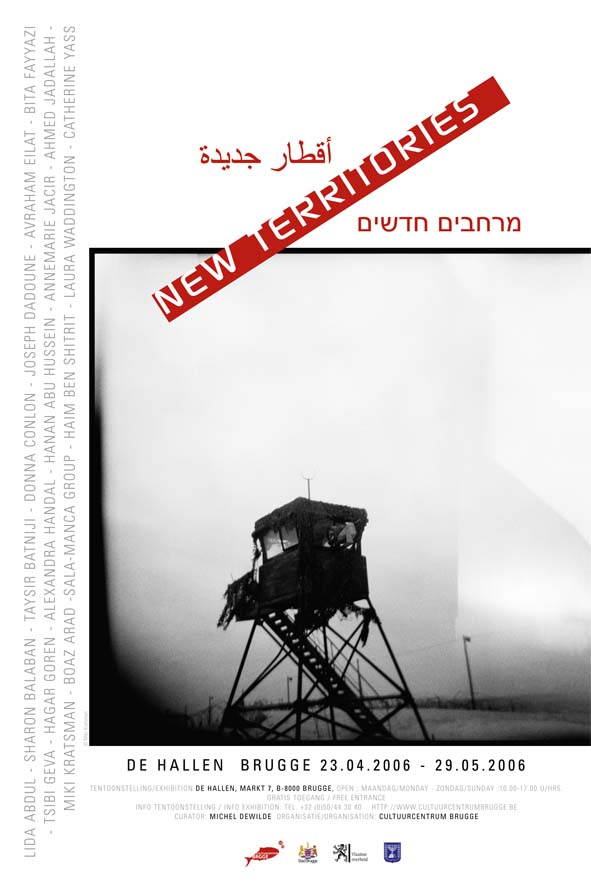
Ephemeral Territores at “New Territories” | De Hallen, Brugge – Belgium | Curator:  Michel DeWilde

Faxworks

OLYMPUS DIGITAL CAMERA OLYMPUS DIGITAL CAMERA OLYMPUS DIGITAL CAMERA OLYMPUS DIGITAL CAMERA OLYMPUS DIGITAL CAMERA

Babylon Poems, 2006-2007

Translation, text, and sound works

Exhibited in the frame of “Free Radicals”, Digital Art Lab Holon, 24.2.2007-28.04.2007 | Curator: Eyal Danon

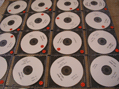
Hebrew to Hebrew translation of ten poems from the 2006-2007 matriculation exam list for Israeli high school students. The poems were translated using Babylon automatic machine translation software, passing through 14 different languages (from Hebrew to German, German to Dutch, Dutch to Spanish, Spanish to French, French to Italian, Italian to Portuguese, Portuguese to Japanese, Japanese to Chinese, Chinese to Arabic, Arabic to Korean, Korean to Turkish, Turkish to Russian, Russian to Polish, Polish to English, and from English back to Hebrew).
Babylon Poems
Poets: Haim Nachman Bialik, Nathan Alterman, Shaul Tchernichovsky, Uri Zvi Grinberg, Rachel, Dahlia Ravikovitch, Leah Goldberg, Natan Zach, David Avidan, Yehuda Amichai

The poems were read by Ilana Zuckerman, sound and radio artist, founder and director of the Metula Poetry Festival


Natan Zach

Uri Zvi Grinberg

Rachel

Chaym Nachman Bialik

Shown first as part of the project: “The Right to Copy”, 2006, Confederation House, Jerusalem

Elephants in the Nights of Metula (2005-2010)

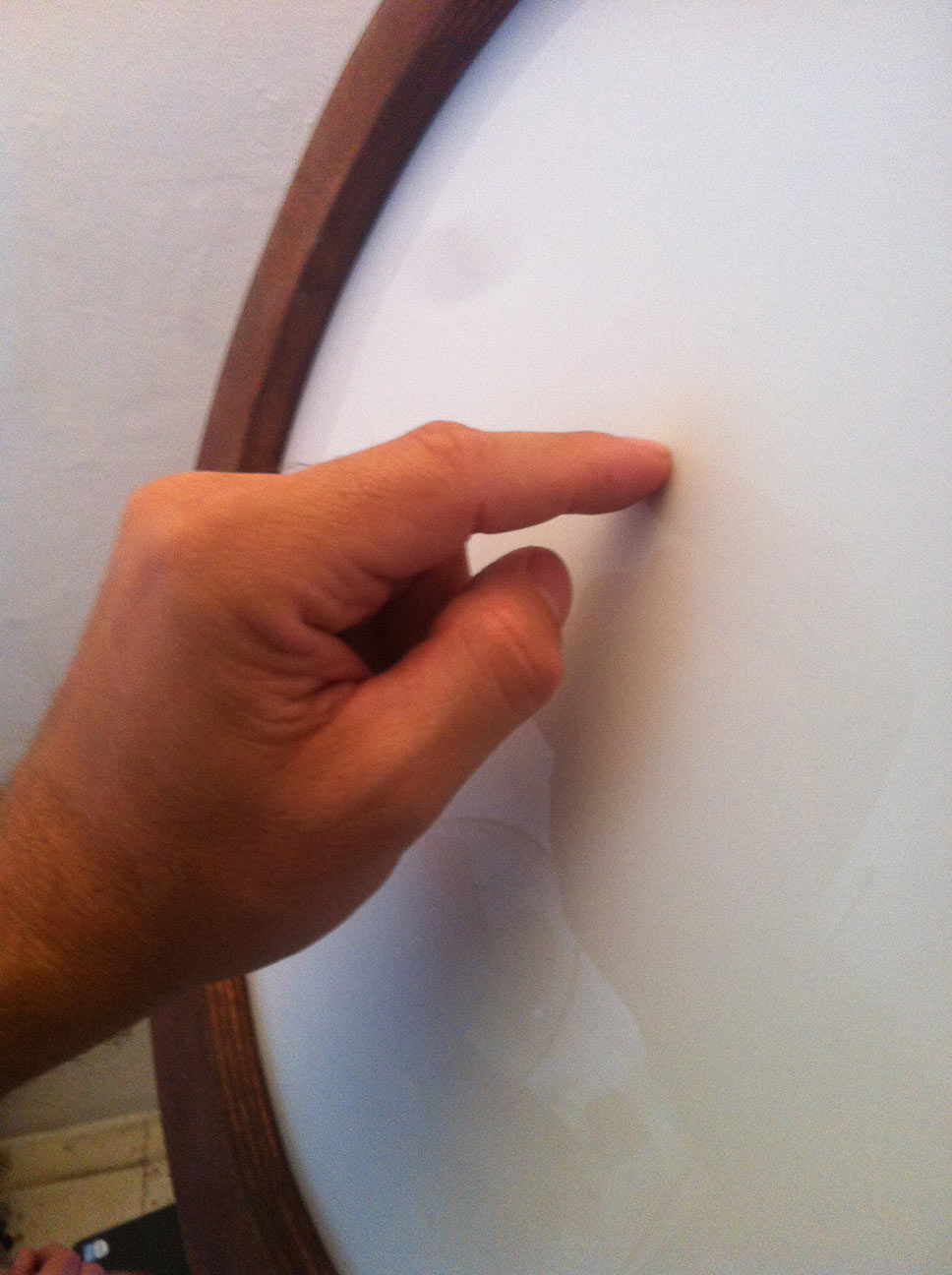
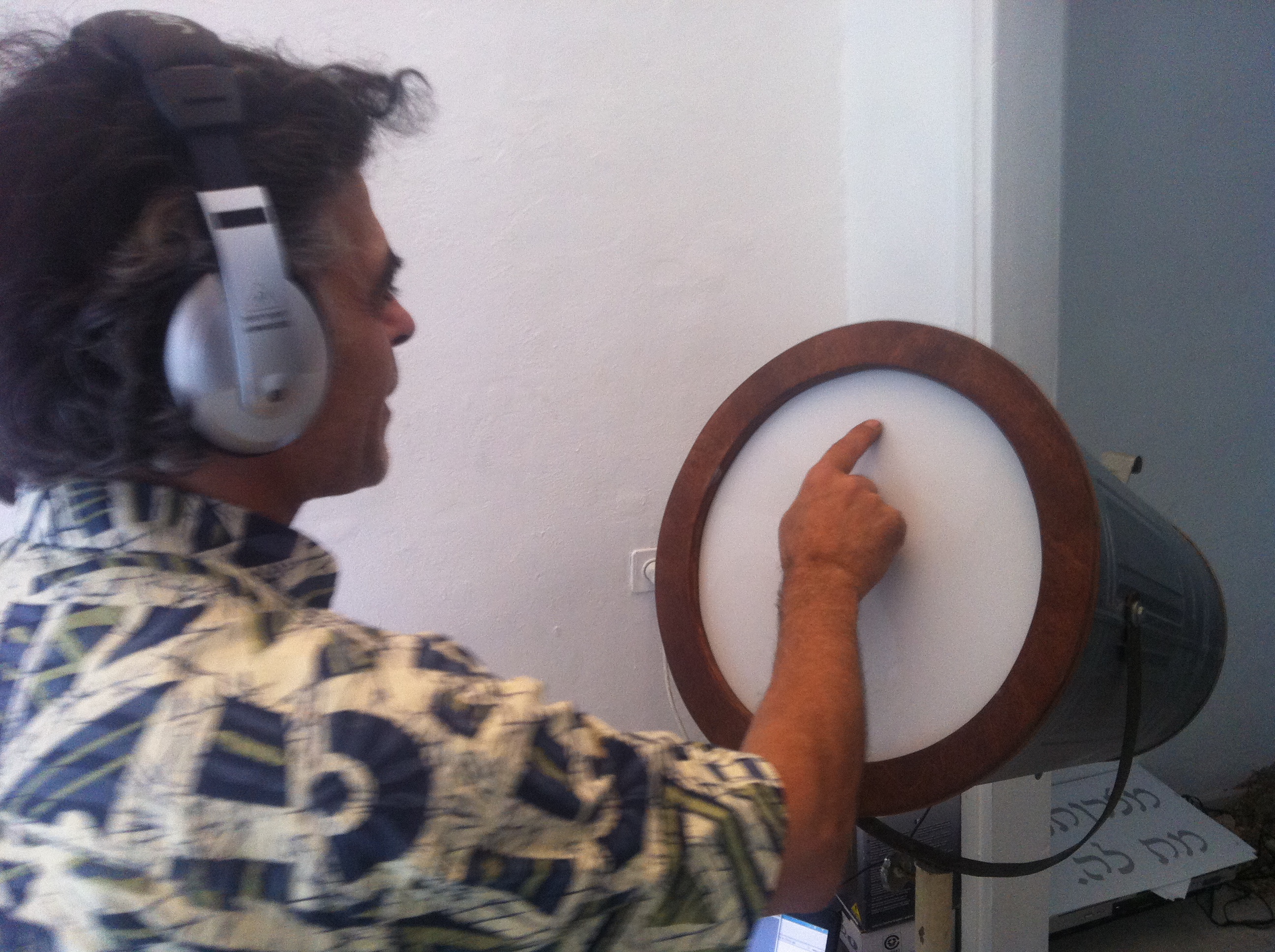
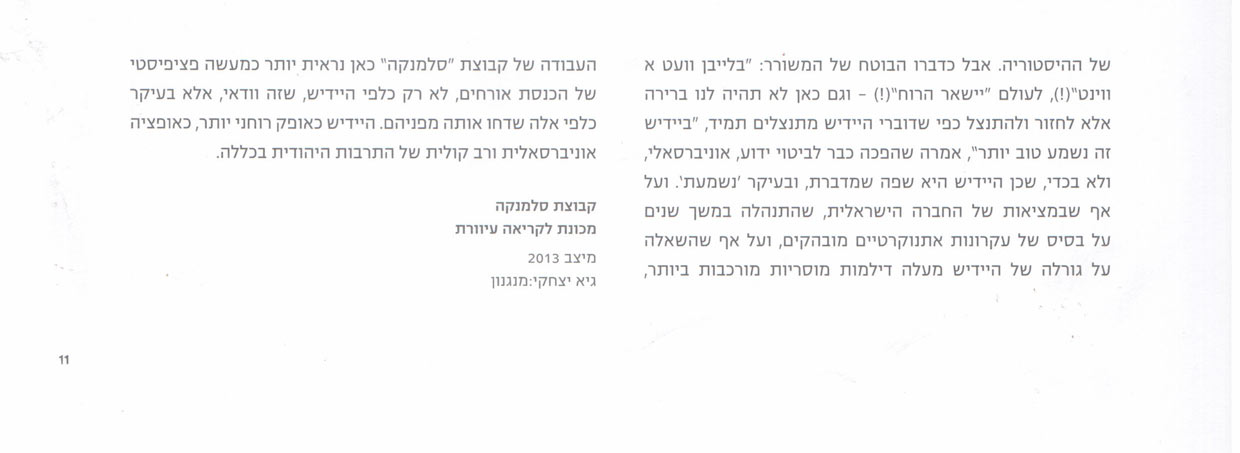
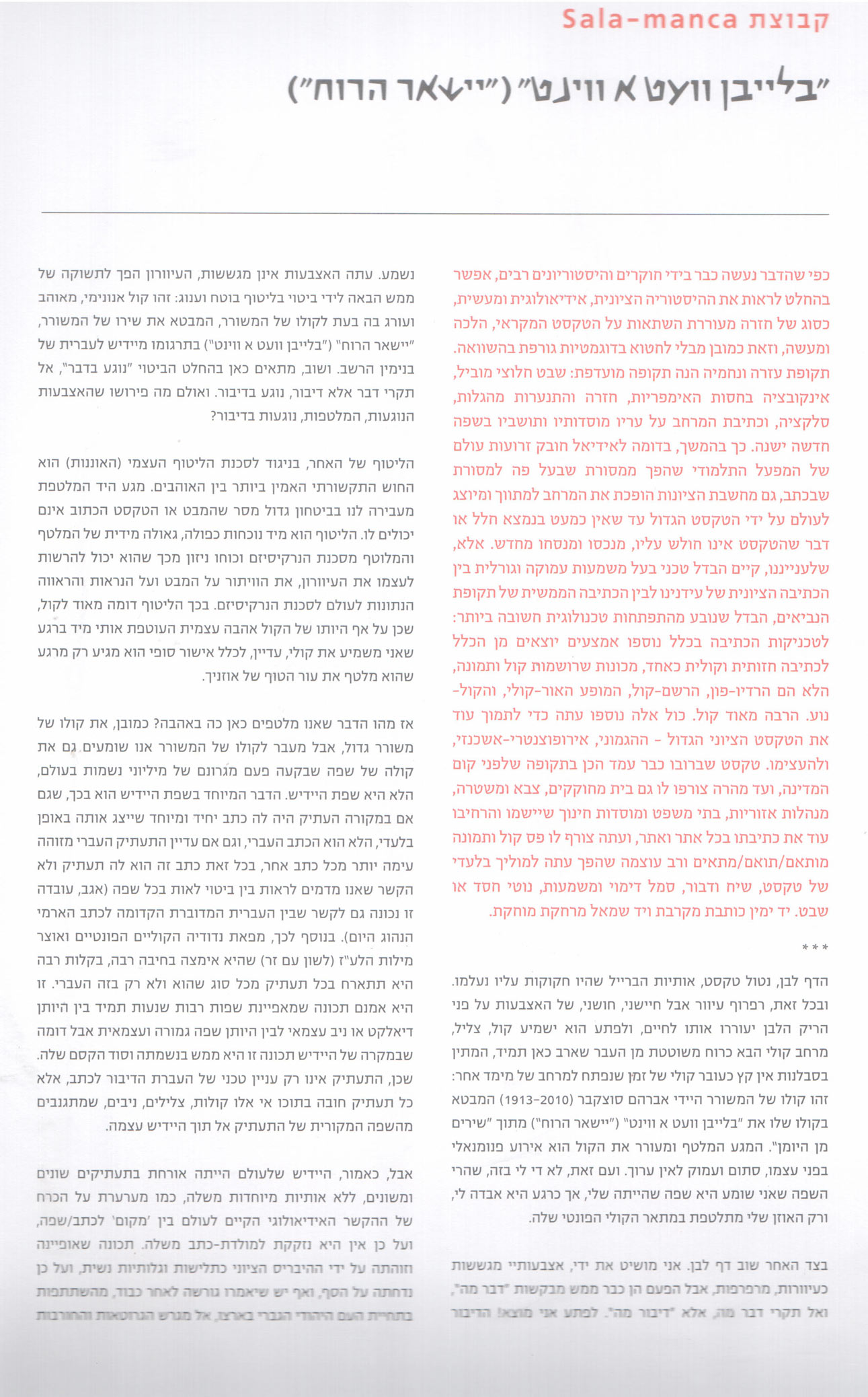
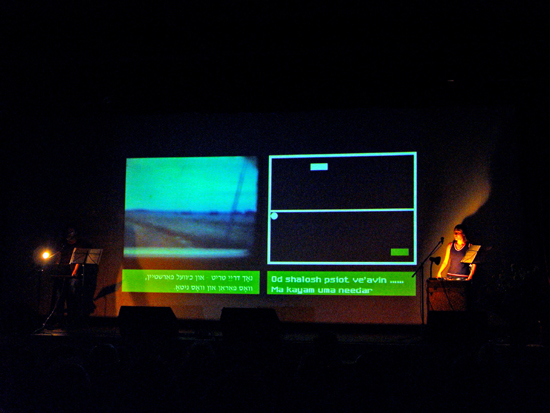
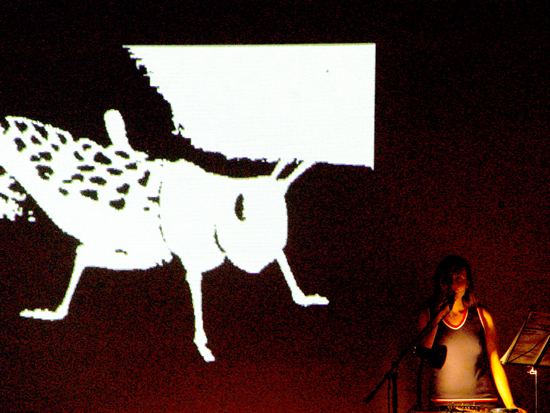
Performance (Yiddish/English/Polish/Hebrew)Presented at The Neighbour Next Door Festival (Sasiedzi dla Sasiadów – edycia V), Warsaw, Poland / Jewish Film Festival, Jerusalem /   Belfast Exposed – Interface – Ullster University, Belfast,-24.5.06 / CCA – Tel-AVIV/   ForumStadtPark, Graz, Austria – In the frame of Under_Ctrl Project, curated by Basak Senova – 31.3-2..4.06/ NYU, New York, February, 2006/ The Upgrade International, Eybeam, New York, September, 2005 / Blurrr 5- Bienniale of Performance Art, November, 2005/ Jewish Film Festival, Jerusalem Cinematec, December 2005/ 8 Metula’s Poetry Festival; Metula, June 2005 /DSC06631As an installation was presented as part of “Eclipsed Voices”, OpenSpace, Vienna | Curator: Basak SenovaElephants in the Nights of Metula is an performance and installation that includes video, digital slides, film, animation, and dual audio in Yiddish and English. The performance is based on the texts of the Yiddish poet Avrom Sutzkever (1913-2010), re-contextualizing his poetry in the historiography of Israeli literature from a contemporary perspective.

The story told in the installation deals with the harsh Israeli cultural control policies with respect to the Jewish diaspora cultures existing in the 50’s, and which in its turn represented a process of hegemonization of resulting in a new Hebrew culture.DSC06633

This project is a continuation of our performance work dealing with texts and poetry. The piece also relates to our research on the gap between the written letter (the text), its voiced expression, the body and the icon, and visual, cultural and sound translations.

Avrom Suzkever, who passed away last January at the age of 96 years, was indeed one of the greatest poets in the Yiddish language, and was also recognized as of the most prominent poets of the 20th Century. Despite his talent and originality, Since his writings were in Yiddish; he remained almost unknown in Israel.

DSC06618The poems in this booklet are in 4 different writings:
– Yiddish
– Yiddish (transliteration in Latin letters)
– English written through truespel transliteration, a phonetic system for English writing
– English translation in Braile (graphic)

[“Elephants in the Nights of Metula” text by Sala-Manca]

download Elephants in the Nights of Metula
PDF

ECLIPSED VOICES

The “off-the-record” narratives have the potential to generate voids in the vortex of registered histories. As an ever-changing representation of the past, “memory” constructs new patterns to read history. Collective memories alter their content with social, political, and economical changes in time. Thus, individual memory develops in interaction with the diverse realities of social inputs. Our memory shapes our lifestyles, political and ideological positions. Yet, in the process of remembering, each time, we reconstruct a memory by adding or changing details.  Therefore, memories are never stable. At the same time, the acts of confrontation, integration, and adaptation are possible only through these ephemeral and fragmented memories since they indicate the construction of defence mechanisms for us to cope with life.

eclipsed

In any case of political and economical imposition and repression, identities have systematically been lost and fragmented. At personal levels, identities are re-constructed with fragmentation of the narrations -as memory extracts- and the disconnected temporality of multiple realities.

eclipsed

With each work, we clearly witness such narratives in different verbal and visual levels –in every possible layer: political, territorial, spatial, psychological, economical, social –in every possible layer: political, territorial, spatial, psychological, economical, social– in each work. This collection of works touches upon the issues of the control of the memory as each work clearly manifests how individual stories about the past interact with existing narratives and other forms of remembrance. It is inevitable that these memories will continue to change, once there is no one alive to tell the tale from their own experience. For this project, this fact activates the motivation behind the obsessive attempt to document personal narratives as eclipsed voices.

Text by Basak Senova

Over Memory- Jaffa, 2004

Jaffa‘s Over Memory/Archives & Invisible Performance | Blurrr, The 4th Biennial for Performance Art, Jaffa, November, 2004 | Curator: Sergio Edelstein

Documentation as a “flea.” Memory as an item. Memory creation as a purpose in itself – dialogue with the overflow of documentation (in art, tourism, family events). Documentation instead of performance. Archive as a quotation of a city. The artistic act (city documentation) is completed before the action (the biennial) begins, and only its memory (caarchives4talog-diary) and the spectator’s action remain: watching the action memory as reconstruction of the city and the artistic action. Documentation of seemingly irrelevant aspects of history and constructing place memory, in an attempt to create poetics of the city’s Over Memory*.
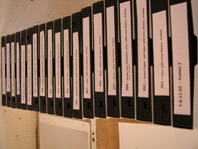
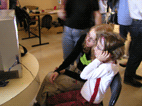
* The concept Over Memory, coined by the Portuguese scholar Joao Delgado, refers to areas in individual and collective memory that are conceived as meaningless and purposeless even though they are central to pertinent mapping. See: Maure, A., “Paradigma de la memoria y sobrememoria – Bocetos para una arqueologia del olvido”, Ruptura Nro. 123, 1993, pp. 23-28

archives2archives3archives1

Archives at the Bienniale
of Performance Art
The Over Memory Archive of Jaffa is the outcome of our (namely: external artists) efforts to document and catalog the city. We set to catalog the irrelevant, “marginal,” as it were, aspects of the city (cross-documentation), in an attempt to construct other, different, poetic representation and memory, believing that what we conceive as irrelevant might unveil an additional facet of the city and thus complement the relevant which is always relative.
In the context of the biennial, we wanted to create an action that would not take place in front of an art audience (the biennial spectators), but rather chose to act vis-a-vis the city inhabitants. The artistic act was an ambivalent act of encounter and estrangement: day in, day out, for about a week, city inhabitants were exposed to the documentation of, inter alia, locks, vegetation, sky, zebra crossings, cars passing by, walking rhythm, urban air-conditioning sounds, street names, graffitis.
In place of the action, we chose to present the documentation to the biennial audience, believing that sometimes the documentation – the material on-, the discourse about- – is more meaningful than the actual artistic act. And since we had decided at the beginning of our field-work not to document the “artistic act” itself, we brought with us a catalog (along with documentation items) qua action memories, travel journal (including times, dates, locations and descriptions), activity log, that allowed us to reconstruct the artistic act by tracing our movement in the city and simultaneously revisit the city and our encounters with it as we were watching over memory items.

How to Use the Archive
The archival material is cataloged thematically (Category), chronologically (Date), temporally (Time), geographically (Address), and descriptively (Description), as well as providing the original location of the item (Master) and its place in the catalog (Shelf). In addition, each item has a catalogic entry that includes information about the respective media: P – stills, V – video clips, S – soundtracks.
One can search and arrange the items according to the divisions in the librarians’ catalog, or look for them in the printed edition according to date and category.
In addition, there are maps that map the documentation activity according to date and theme, see: Atlas.
(It is worth mentioning that the catalogic items were not edited or elaborated in any way.)


Jaffa – Over Memory: Project Schedule

a. November 5-14, 2003
Documentation in stills, video and sound of seemingly irrelevant aspects of Jaffa.

b. November 15-19, 2003
Classification and cataloging the material within a catalog that refers readers chronologically and thematically to the documentation, and provides them with information about the media.
Inviting the general public to use the archive during the festival. The exercise’s aim: writing and creating material for electronic book: Over Memory ñ I – Outlines for an Over Historiography of Jaffa.

c. November 20-22, 2003
Founding Jaffa’s Over Memory Archive. The archive was open to the general public, researchers, artists, intellectuals, tourists and inquisitive people.
Closing the archive – locking the archival material with an index. The archive would be destroyed along with the publication of the electronic book (stage d).

d. November 23 to December 31, 2003
Preparing the electronic book.

e. January 1, 2004 (tentative date), without time limit
Publication of Over Memory ñ I – Outlines for an Over Historiography of Jaffa (various authors), and its dissemination in libraries throughoutIsrael, and in research institutions dedicated to the study of Jaffa.

Minute Box Machine, 2004-2008

Exhibited in the frame of “Speed of Light”, Digital Art Lab, Holon | Curators: Galit Eilat, Eyal Danon | VideoZone 2008


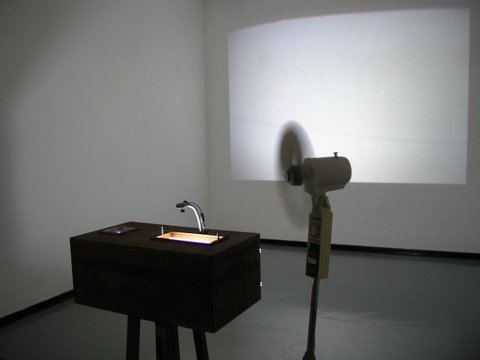
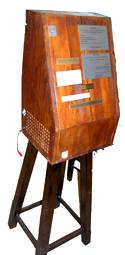
Minute Box Machine: A Reconstruction of Marian Loop’s Time Machine enables viewers to play with time. The Minute Box Machine invites the public to acquire a product—in this case, one minute. Inserting a one Shekel coin into the machine activates a clock inside the Box for 60 seconds. The clock is being filmed in real time by a surveillance camera, and the footage is projected from inside the Minute Box Machine onto a central wall at the open space, showing the minute running. After 60 seconds the purchased time is finished, and the clock stops. Time stops until another coin is inserted into the machine. The projection of the clock for 60 seconds becomes a visual representation of the economic transaction (the purchased minute), concurrently converting the private minute into a public one. At the same time, since the clock in not activated continuously, a gap is generated between the ”real” time and the time of the clock, ”degenerating” the local time where the Minute Box is installed. The backside of the box, from where the projection is screened, is transparent, showing the dark side of time generation to the curious public, juxtaposing the old-looking wooden machine with the electronic devices suggesting a homemade bomb. The Minute Box is an attempt to reconstruct Marian Loop’s (1920-1985) machine destroyed.

Electronics: Amir Marcovich

Stretching the Memorial, 2004

Site specific installation, in the frame of “Heara 5”, Sergey Courtyard, Jeursalemstretching2   

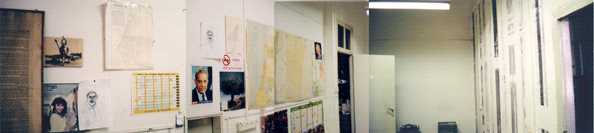
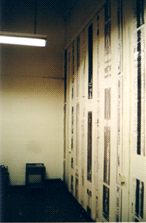
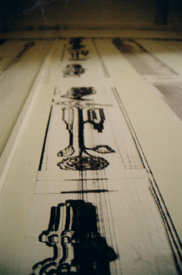
Stretching the Memorial is a fax installation done in a state burocratic office which was abandoned in year 2000 remaining untoched till today. The whole wall designed by the clerk (posters of politicians, drawings, maps…) was copyed by fax stretching the original.stretching4

A new wall, a memorial of thstretching1e office was built. A memorial which was – because of the nature of the thermal paper – destined to dissapear before the original clerk’s office.
Urban Overmemory Archives 2 – The Periphery of the Center -Holon, 2004

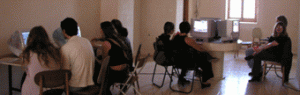
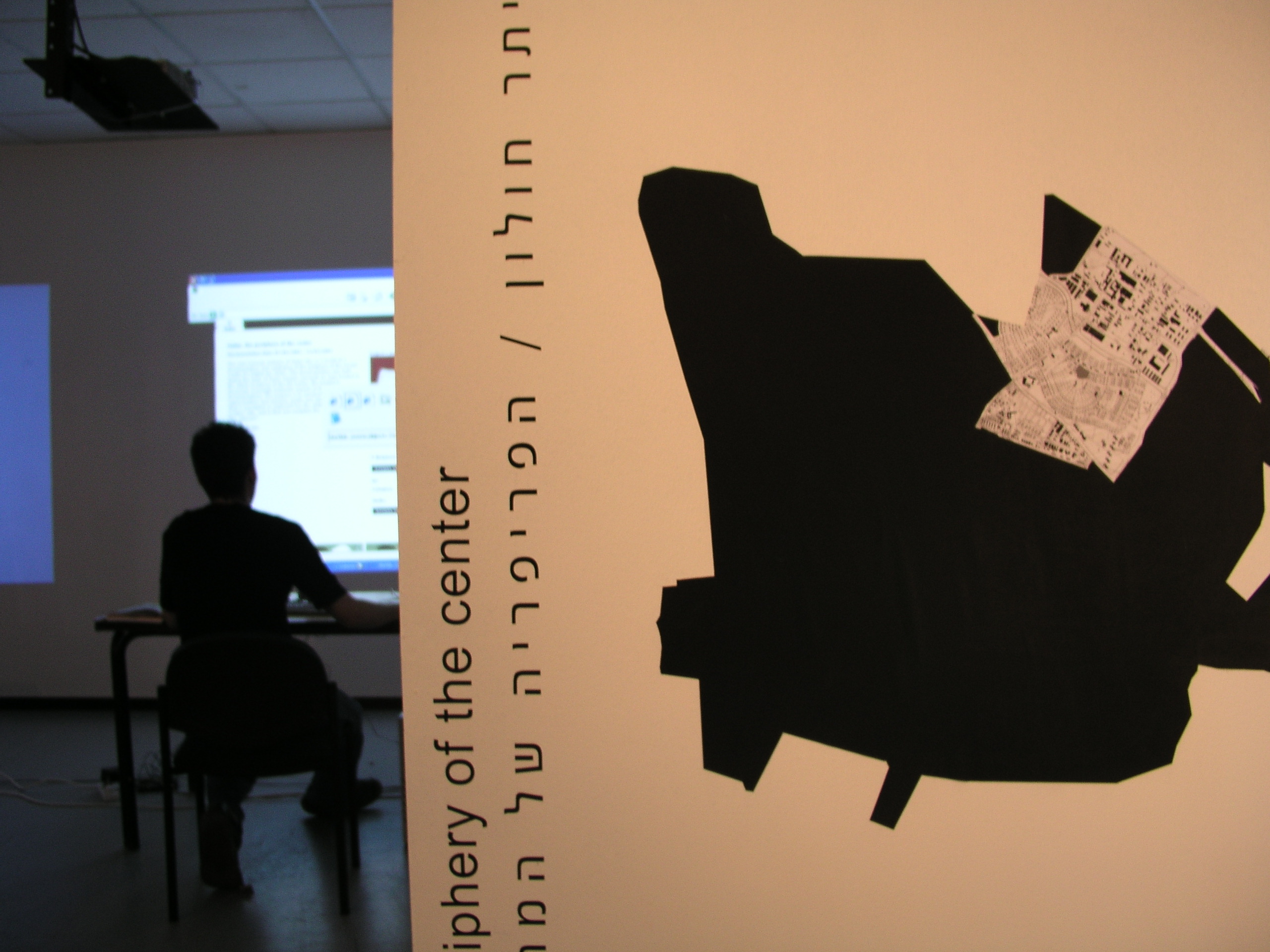
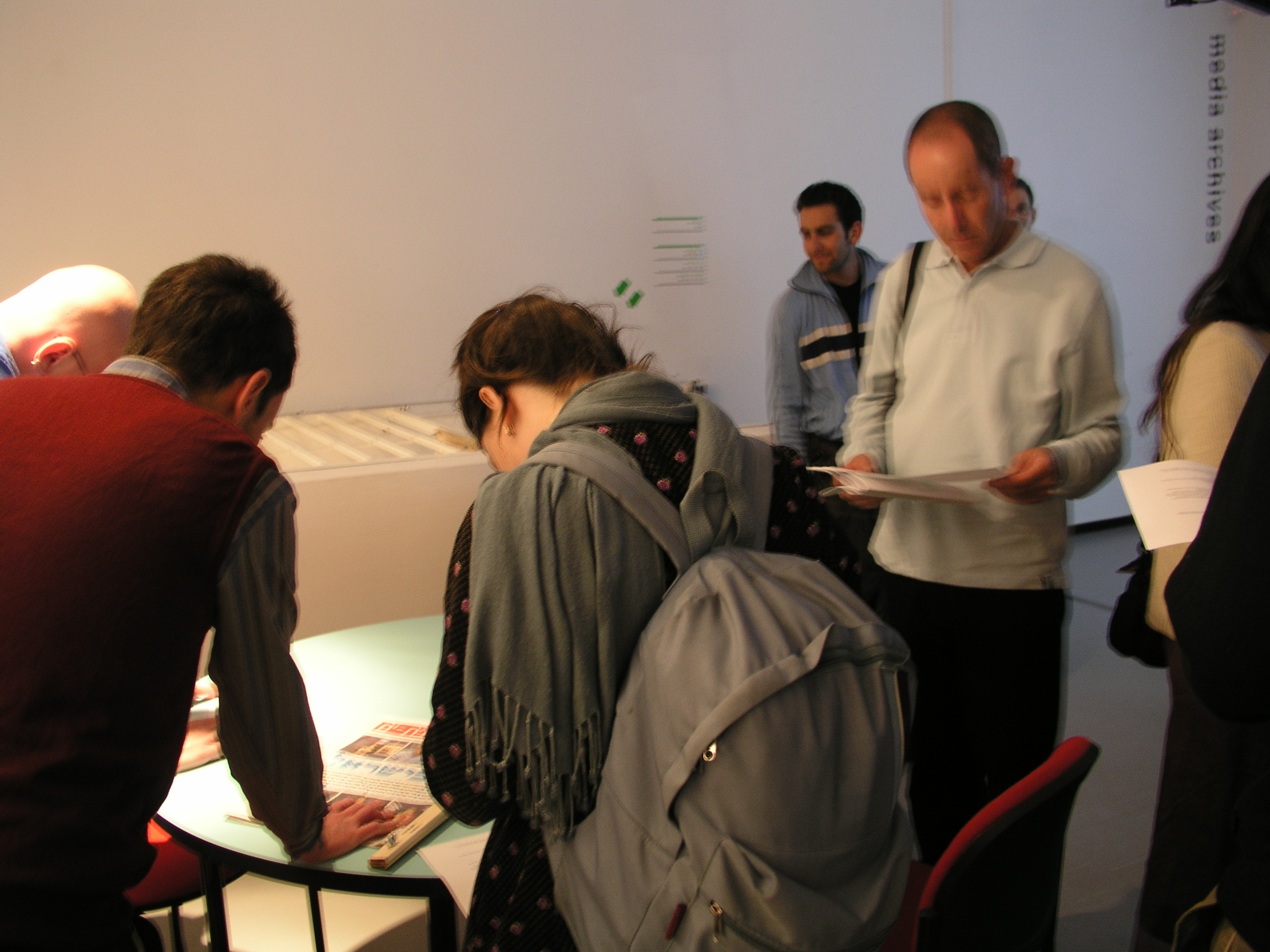
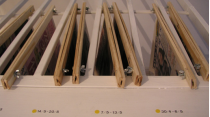
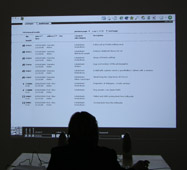
The “Urban Over Memory Archives of Holon” is a project consisting of documenting and cataloguing the Over Memory of the periphery of the Israeli Center for Digital Art, Holon. This project is the second in a series of urban archival works+2. The archives result from a process of cataloguing video, audio and motion items, generally conceived as irrelevant and dull. SALA-MANCA attempts to establish a representation of another memory, different and poetic, pertaining to a geographic-artistic space. Items usually regarded as irrelevant may reveal a different, unofficial aspect, thus complementing the ’relevancy,’ which forever is a relative concept. The “Urban Over Memory Archives of the Periphery of the Israeli Center for Digital Art” are located physically at the center, thus reversing the center-periphery relationship in a poetic and symbolic manner. Another denser, and at the same time broader, version of the archives may be found on the web, a center-less entity, which is to be the future meeting point of the Israeli Urban Over Memory.

OLYMPUS DIGITAL CAMERA  OLYMPUS DIGITAL CAMERA OLYMPUS DIGITAL CAMERA  OLYMPUS DIGITAL CAMERA

In the frame of the exhibition: “Hilchot Shcehnim, Chapter B”, 24.4.2004-24.6.2004

Curators: Galit Eilat, Eyal Danon

http://digitalartlab.org.il/ExhibitionPage.asp?id=54&path=level_1

To Live her Life, 2002

Video, 3′

Shown at: VideoZone – 1st Biennial of Video, Tel Aviv, November 2002; Homemade (curatorby Liliana Kadichevski) II Festival Dialogu Czterech Kultur, Lodz, Poland, September 2003; Local Time 7, Tel Aviv, Jerusalem 2004; Living in a Film, Mamuta in Hansen, Curator: Sala-manca

3 4 2

Underground photography. quote. an excerpt from a film by Dreyer within a film by JLG. to live her life. from cinema to video. one shot.


Ephemeral Works, 2002

Hazira, Jerusalem, 2002. Curator: Hadas Ophrat

Modern Lovers Exhibition, Three Colts Gallery – London | Curators: Pil and Galia Kollectiv

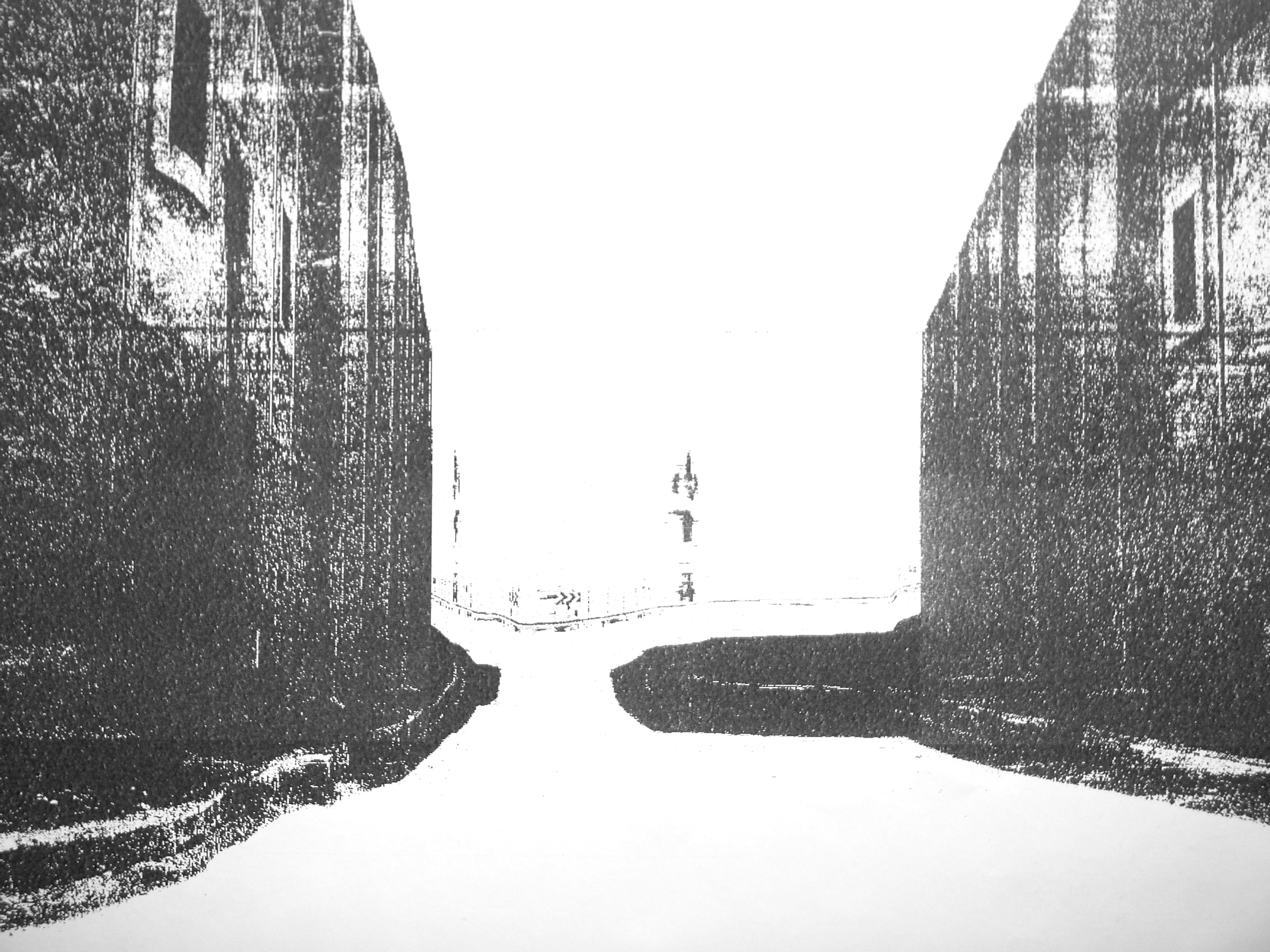
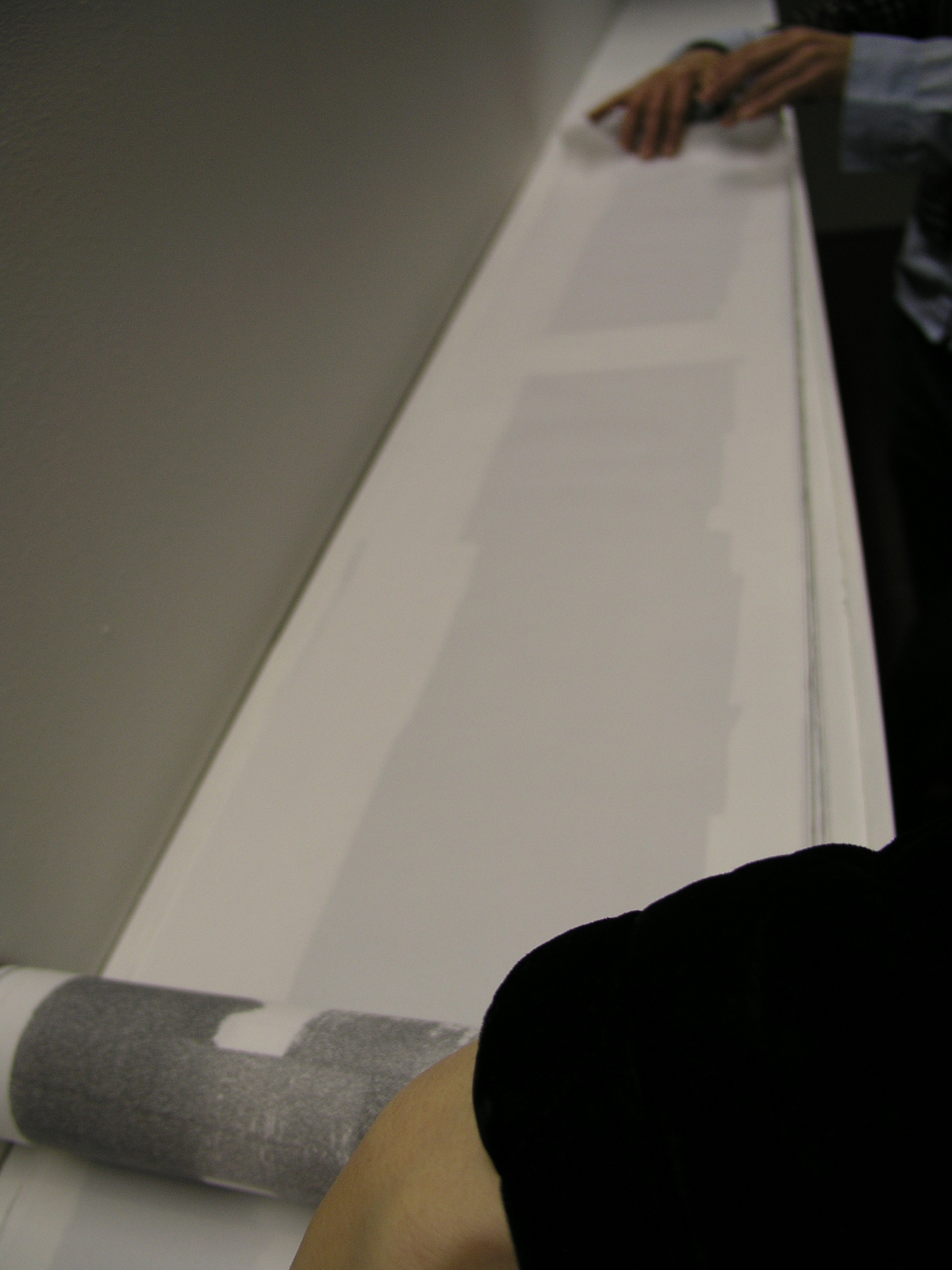
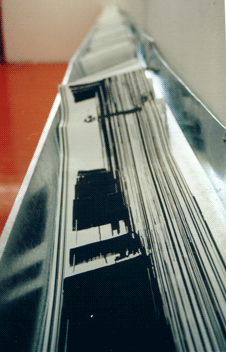
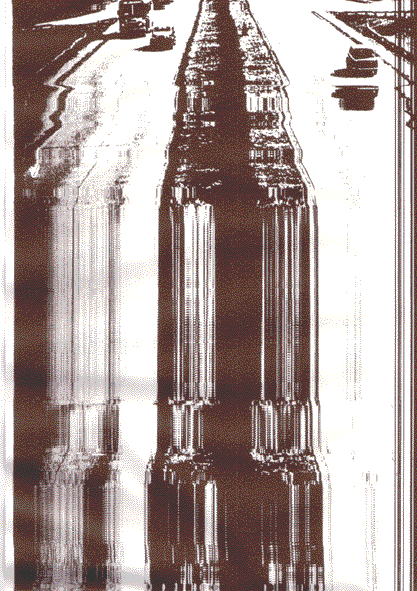
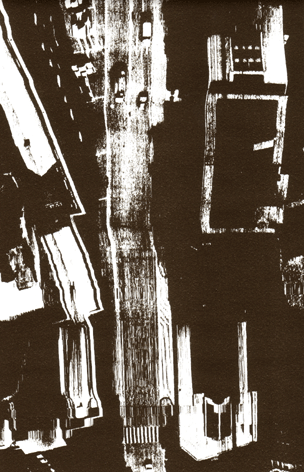
In the installation were exposed 80 works made of fax paper (thermal paper), which nature will lead them to disappear. Different series of works (maps, citizens, portraits, towns and objects) are exposed, all of which went through a process of “faximilisation”. This technique of manipulation of the picture passing through the fax, thus creating a new image, permits to blur the border between the original and the copy. When the fax work (the “coeph2py”) turns out to be the original, the gap is created . The subversive potential of the fax machine is not solely fulfilled by this technique, but also by the change, by the individual, of the genuine function of the machine (instrument used to the transmission of information and to communication) and mostly, by the combination of the both: sending “fax works” through the machine.

eph3 The nature of the works, the space of the exhibition – the foyer of the “Interdisciplinary Arena” theater – a place where the visitors
are not coming in the aim of seeing exhibitions, and the way of displaying (works rolled up on the side, so that the observer is required to get closer and to open the works in order to look at them), raise interrogations about the canonical place of the artistic creation, and its cultural and commercial status.

ROUTE-2 Untitled-Scanned-01

Sound of the Installation (stretched tape of a recorded fax machine by Sala-manca)


atarw2  atarw3 atarw5  atarw4

Click to enlarge