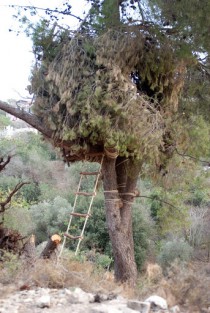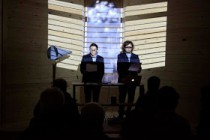
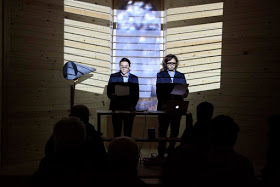
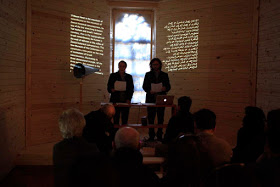
Performance in the frame of the Museum of the Contemporary
WordPress database error: [DELETE command denied to user 'sala-manca'@'localhost' for table `sala_manca_net`.`wp_options`]DELETE FROM `wp_options` WHERE `option_name` = '_site_transient_wp_theme_files_patterns-3e81fb819c0831df69203ee558a709b9'
WordPress database error: [DELETE command denied to user 'sala-manca'@'localhost' for table `sala_manca_net`.`wp_options`]DELETE FROM `wp_options` WHERE `option_name` = '_site_transient_timeout_wp_theme_files_patterns-3e81fb819c0831df69203ee558a709b9'
WordPress database error: [INSERT, UPDATE command denied to user 'sala-manca'@'localhost' for table `sala_manca_net`.`wp_options`]INSERT INTO `wp_options` (`option_name`, `option_value`, `autoload`) VALUES ('_site_transient_timeout_wp_theme_files_patterns-3e81fb819c0831df69203ee558a709b9', '1792709211', 'off') ON DUPLICATE KEY UPDATE `option_name` = VALUES(`option_name`), `option_value` = VALUES(`option_value`), `autoload` = VALUES(`autoload`)
WordPress database error: [INSERT, UPDATE command denied to user 'sala-manca'@'localhost' for table `sala_manca_net`.`wp_options`]INSERT INTO `wp_options` (`option_name`, `option_value`, `autoload`) VALUES ('_site_transient_wp_theme_files_patterns-3e81fb819c0831df69203ee558a709b9', 'a:2:{s:7:\"version\";s:3:\"4.0\";s:8:\"patterns\";a:0:{}}', 'off') ON DUPLICATE KEY UPDATE `option_name` = VALUES(`option_name`), `option_value` = VALUES(`option_value`), `autoload` = VALUES(`autoload`)
WordPress database error: [INSERT, UPDATE command denied to user 'sala-manca'@'localhost' for table `sala_manca_net`.`wp_options`]INSERT INTO `wp_options` (`option_name`, `option_value`, `autoload`) VALUES ('_transient_doing_cron', '1792707411.4978818893432617187500', 'on') ON DUPLICATE KEY UPDATE `option_name` = VALUES(`option_name`), `option_value` = VALUES(`option_value`), `autoload` = VALUES(`autoload`)
Performance in the frame of the Museum of the Contemporary
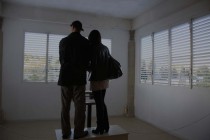
Plastic blinds, plaster, metal frame, PVC sheet, wood. Box: perspex, wood, metal brackets. Electronic mechanism: servo engines, arduino, cables, batteries.
Sala-Manca in collaboration with Mamuta collective
Programming: Amir Markovitz
Mechanics: Yuval Kedem (Galileo)
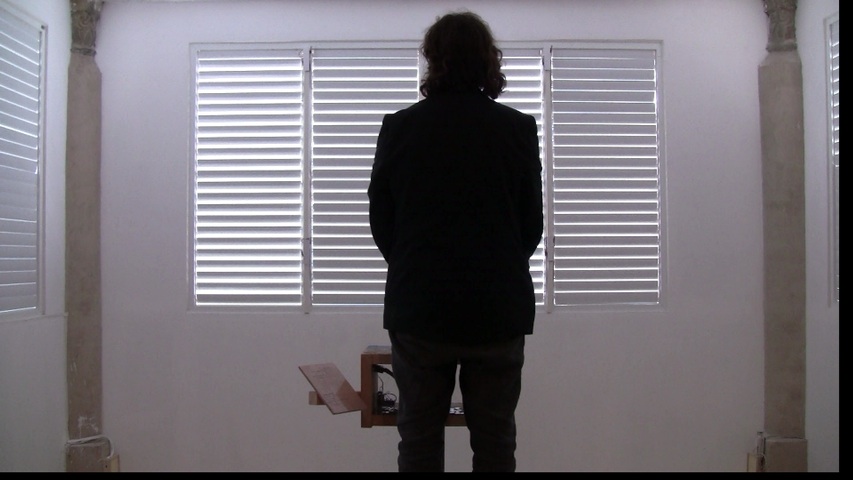
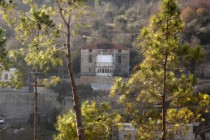
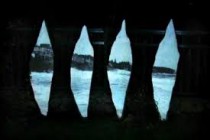
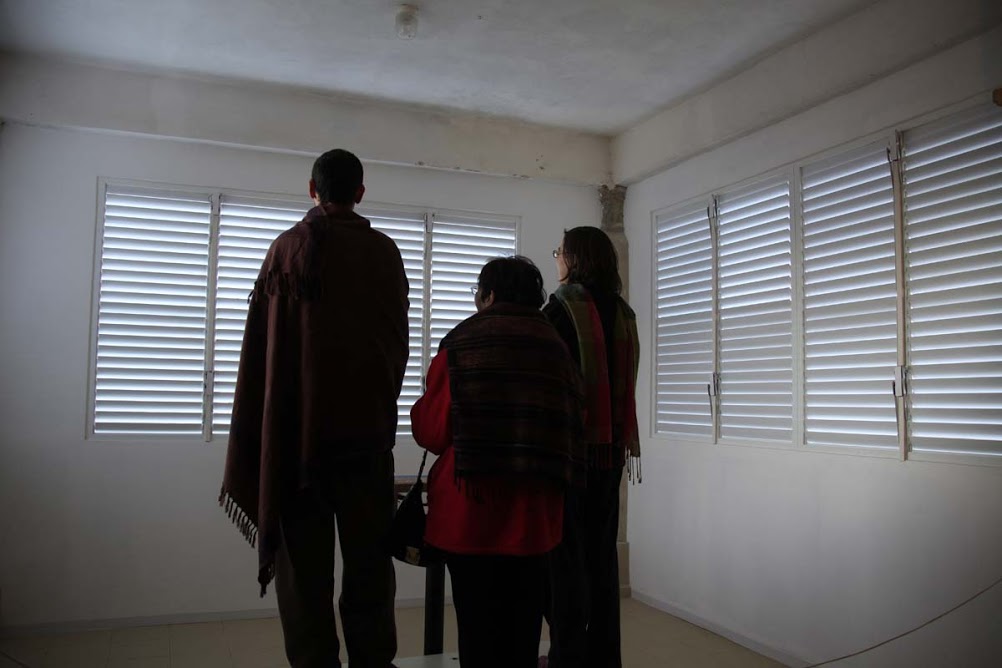
A sculptural interactive work exploring the tension between pastoral Ein Karem and the privatization processes taking over the landscape. The view is framed and rented by means of installing typical “Tel Aviv” plastic shutters in the balcony of the house and barring them. For 3 nis the blinds will open alltogether for 8 seconds, a private view for profit.
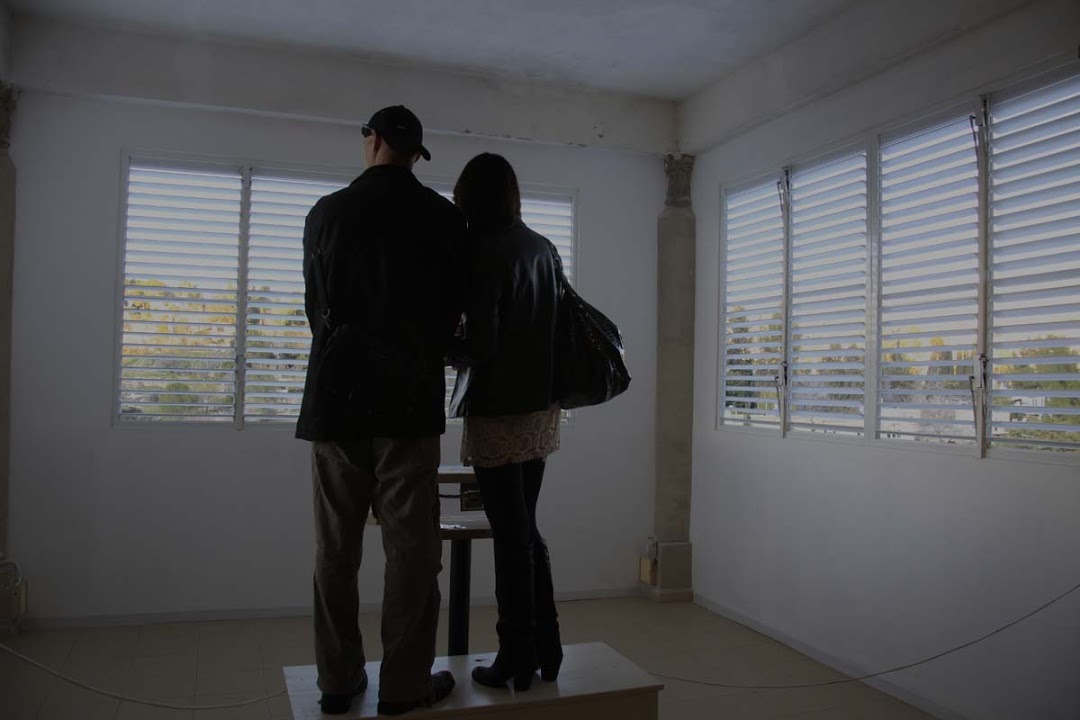
Shown in the frame of the Museum of the Contemporay, Mamuta, Ein Karem, 2012
Aritsts: Sala-manca
Invited Artists: Hadas Ophrat, Wanja Schaub. Invited Performance: Uri Katzenstein
“If Mount Herzl is the mountain of remembrance or the mountain of Zionist historical consciousness, by way of the line stretching between Yad Vashem and Israel’s national cemetery, then in the topography of Israeli remembrance, Ein Karem is the wadi of oblivion or the valley of Zionist historical subconscious. The New Museum of the Contempora
ry constitutes a new point on the map of institutions of Israeli consciousness, illustrating its three-dimensional triangle. Of the three points, the museum is the deepest point.” (Rodriguez, from the curatorial text of the museum’s inaugural exhibition)
 The first exhibition produced at the Museum of the Contemporary’s physical space is an exhibition of Sala-Manca group. This is the group’s first exhibition since 2006. The exhibition wi
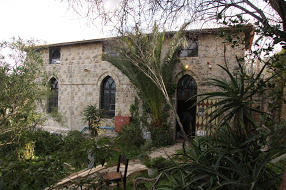
 ll feature new sculptures, sound works and performances created especially for the exhibition, in conjunction with works created in collaboration with Hadas Ophrat, Wanja Shaub and Mamuta collective. The exhibited works serve as a comment on local history, urban politics and the architectural structure in which the exhibition is held – an Arab house in Ein Karem located midway along the pilgrimage trail to the Church of the Visitation. The building was declared absentee property by the State of Israel in 1948 and purchased by the artist Daniela Passal in 1972 who later donated it towards the establishment of an art centre – the Mamuta at the Daniela Passal Art and Media Centre, which have been operating on site since October 2009.
The Collection – The Storage Room
The collection features complete exhibitions that are available for download, which underwent a process of digitalization so as to gain their full quality after they have been downloaded in their respective formats (video, sound, photography, text etc.). After they have been downloaded, the exhibitions could then be displayed in the venu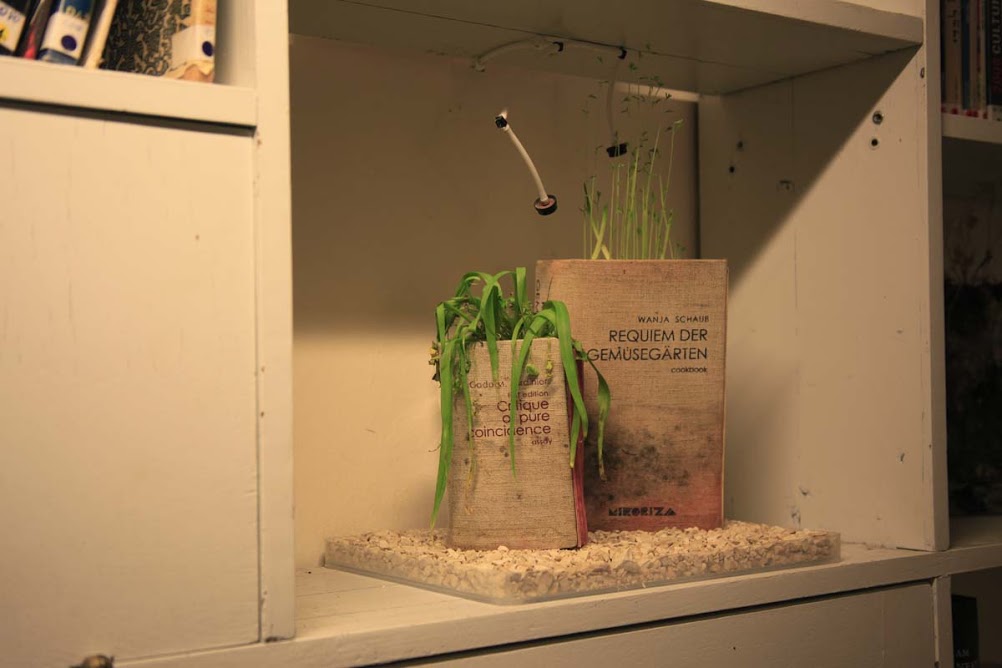 es available to the secondary curators (those who chose to download the exhibitions) and the conditions they have at their disposal. The same exhibition could be displayed simultaneously by agents of completely dissimilar nature and financial means: as the exhibition will be displayed differently, and convey cultural and curatorial perceptions that reflect not only the perception of the exhibition’s curators, but also those of the secondary curators displaying it.
 Press and Articles
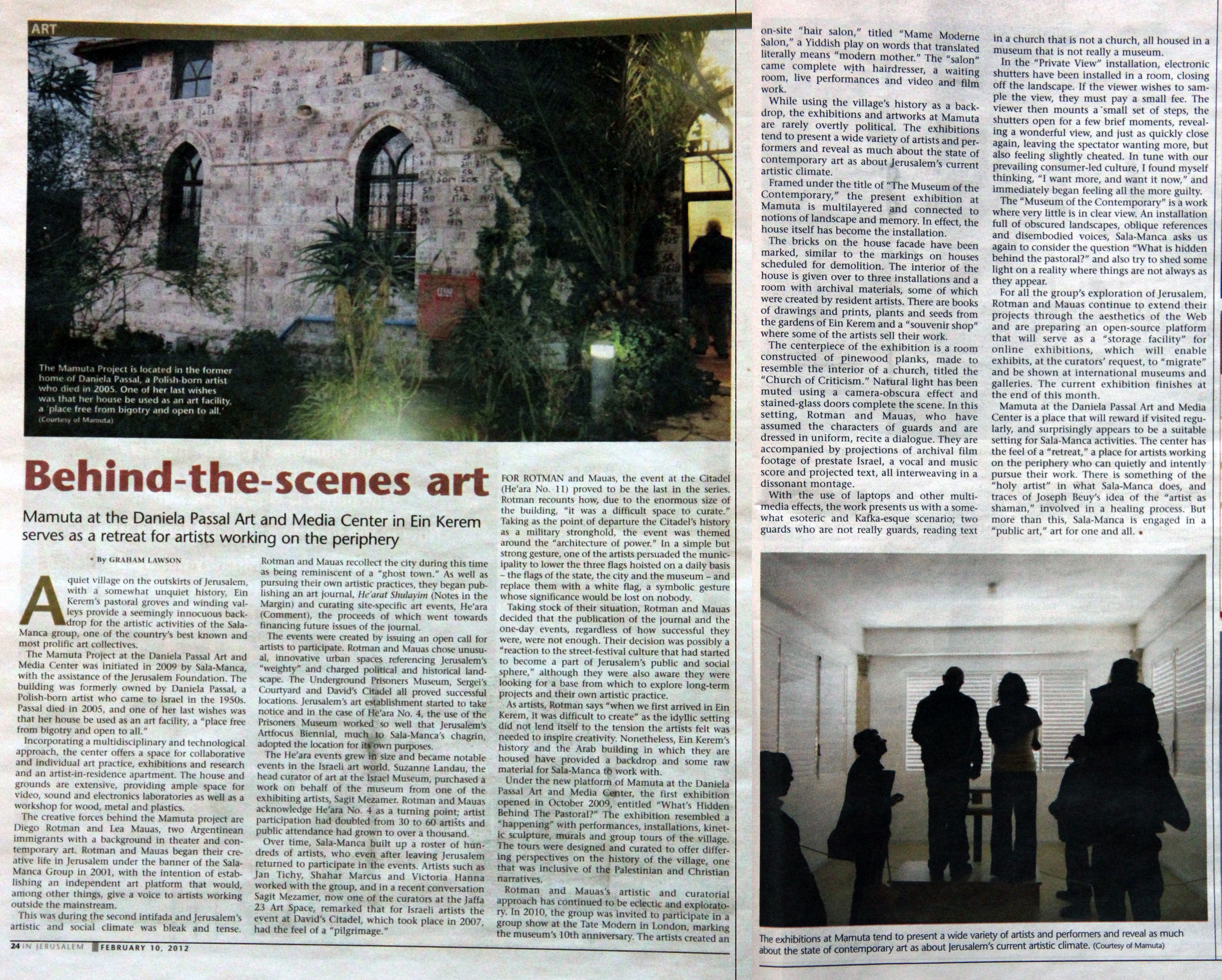
Graham Lawson, The Jerusalem Post
Chaim Noy, Narratives and Counter-Narratives: Contesting a Tourist Site in Jerusalem
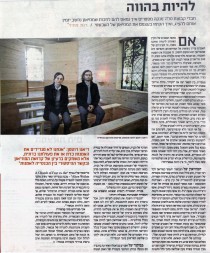
Rut Patir, To Be in the Present (in Hebrew)
Pics
 Comments Off
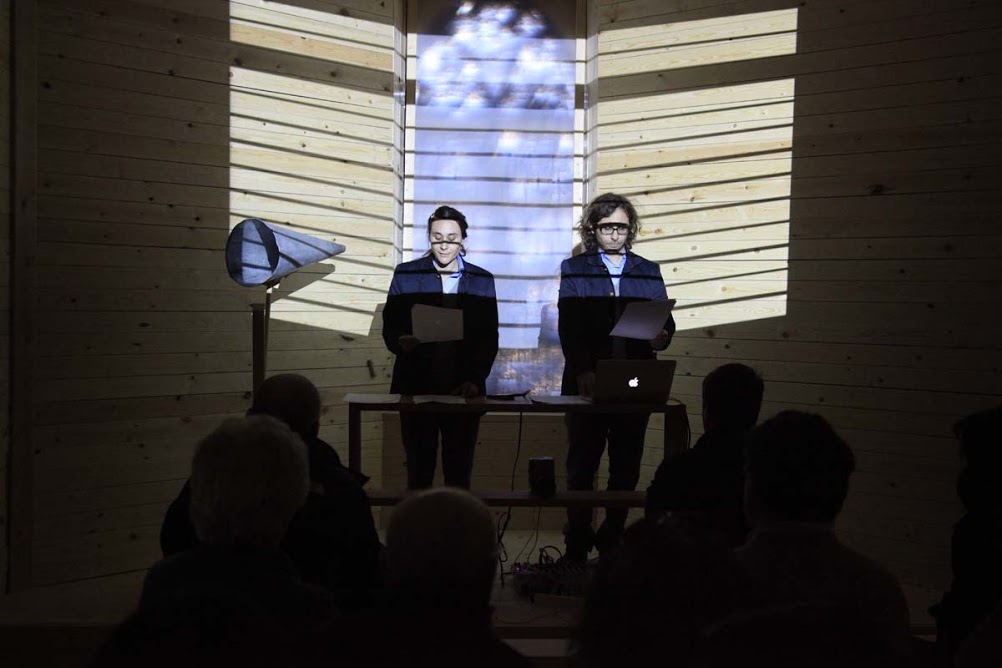
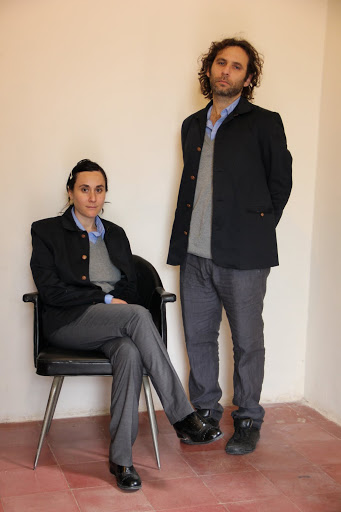
The Sala-manca group work as museum guards of the MOFC (Museum of the Contemporary). It was a comment on their multitask works as artists, curators, directors of Mamuta and exhibition guards. Suddenly, one of the guards would speak: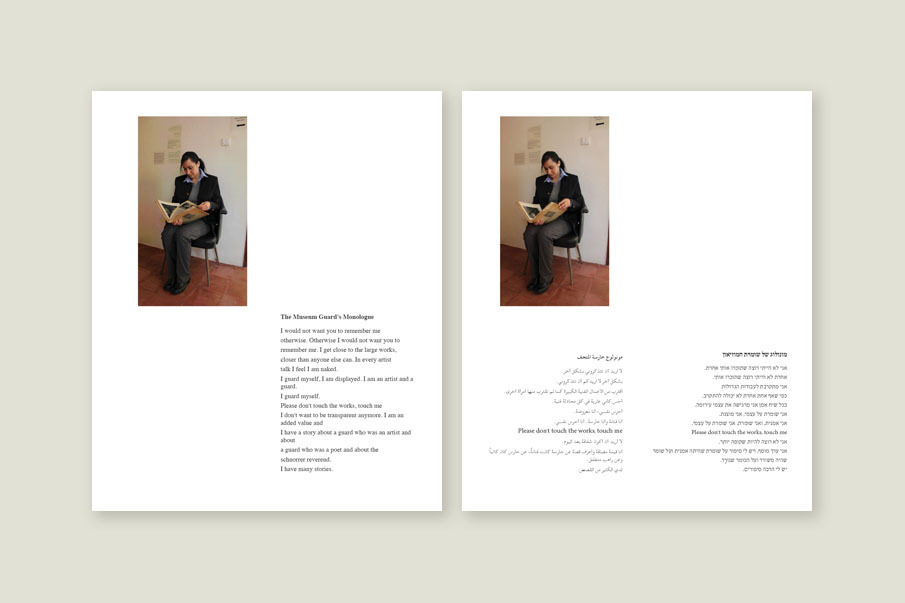
The Museum Guard‘s Monologue
“I would not want you to remember me otherwise. Otherwise I would not want you to remember me.
I get close to the large works, closer than anyone else can. In every artist talk I feel I am naked. I guardmyself, I am displayed. I am an artist and a guard. I guard myself.
Please don’t touch the works, touch me
I don’t want to be transparent anymore. I am an added value and I have a story about a guard who was an artist and about a guard who was a poet and about the reverend shnorrer. I have many stories.”
To Be in the Present, Rut Pativ, Maariv, 12.2011
click to enlarge
Mamuta at Daniela Passal House, Ein Karem
Curators: sala-manca
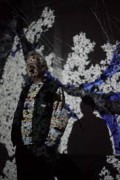
The living room is wall-papered with drawings. A projection
onto the drawings creates a hybrid image. In the space
between the projection and the drawing, strings diverge and
converge, transforming into a three-dimensional image that
changes with the projection. Elsewhere, on the living-room
floor, a projected drawing is thickened by drops of water.
The scenery changes as in a nighttime stroll through the
forest out of a Japanese animated film.
In the library, a book of sketches by Einat and Guy converses
with Illuminated Manuscripts by David Small. As the
spectator browses through the book, the drawings projected
onto it change. They are like memories of digital sketches
from a different place—a combination of the manual craft
and the digital craft. The exhibit is rounded out by Einat’s
drawings, hung in the living-room of the house.
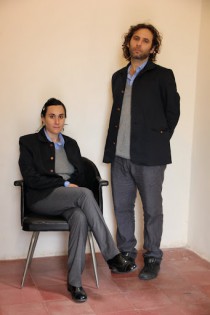
The joint exhibition, Line, was commissioned by Mamuta in
order to bring to fruition the potential of dialogue between
the two artists, which began about two years ago when they
began their residencies in the Center’s shared studio space, and continued with various projects (see the interview with Jan Tichy). It was a successful realization of Mamuta’s choice not to place walls between the studio spaces. Their dialogue
stemmed from Einat’s curiosity about new media and from her desire to penetrate the world of programming and the projected image, which is Guy’s artistic world. Einat feels that with these media she will be able to deepen the investigation of the dimension of time in her own work. For his part, Guy believes that the encounter with the materiality of Einat’s works can broaden his own experimental style—
which entails the creation and projection of images through algorithms that react to physical structures. Their collaboration creates a unique language, combining
two different semiotic systems—that of drawing, craft, and text, and that of the digital image. Thanks to its precision, the connection is fascinating, poetic, and challenging.
The exhibit is the culmination of a year and a half of work at Mamuta, in which the two artists began to develop their common language. Line is the first closing of a circle. This point is only a beginning.
Lea and Diego (Sala-Manca group)
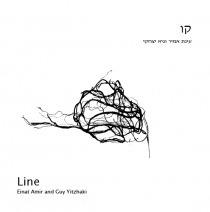
Catalogue of Guy Yitzhaki and Einat Amir joint exhibition at Mamuta in Ein Karem. Curators: Sala-manca
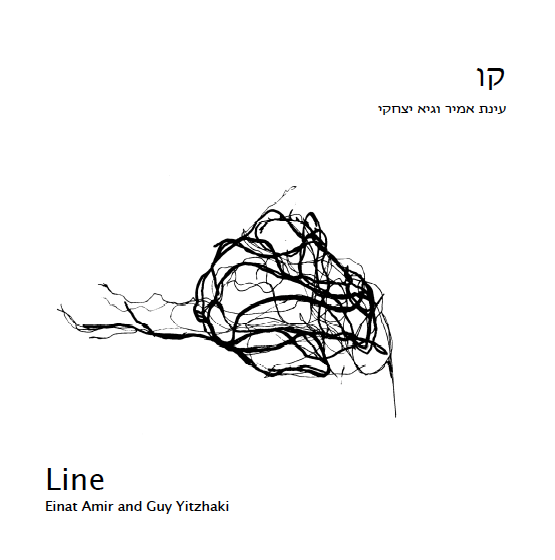
Click to read the catalogue: KAV’s texts_Final for print
אורה לב-רון, הזיקה הלשונית של סלמנקה בפולין
במרכז לאמנות עכשווית בְּוורשה פגשתי את קבוצת סלמנקה, זוג האמנים הישראלים המדוייק והאוונגרדי, שהשתתפו ב- EPAF (פסטיבל אמנות המיצג הבינלאומי).
מיד נכנסתי לכוננות לשונית: לסלמנקה יש היכולת הנדירה לזלול את הלשונות ולהשתמש בהן כחומרי אמנות, או בלשון החביבה על מבקרים הם מבצעים תהליך פירוק והרכבה, מה שהיה פונטי בשפה אחת מופיע כחומר האזנה בקונטקסט של שפה אחרת, והכל משמש כאלמנטים ביצירת מולטי מדיה. היצירה המורכבת החדשה מעוררת תחושה של ולד שהגיע כדרך הטבע, כמעט מבלי משים, בלי עקבות התפרים של ההכנה.
עבודה קודמת שהציגו במרכז לאמנות דיגיטלית בחולון היתה שלובה עמוק בלשון. זה היה תרגום אוטומטי של שירים מעברית לשורה של שפות, ולבסוף חזרה לעברית, והצגת השיר המוגמר שאיבד בתהליך את רוח המשורר, וכך הדגיש אותה, כמו לסמן היכן מונחת הנפש בגוף.
ועכשיו ורשה, שפה נוספת על סדר היום. היתכן שלא ישלבו אותה במיצג? ואם כן, איך? ומה הפירוש?
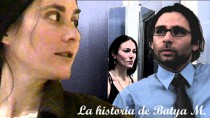
בְּוַרשה הציגה קבוצת סלמנקה את “La Historia de Batia M.” . זהו מיצג המשלב הקרנת טלנובלה עם מופע דיבוב חי ובליווי מוסיקה חיה. על המסך מוקרנת עבודה מקורית המהווה את הפרק האחרון (והיחיד!) של הטלנובלה הספרדית. כמו בז’אנר הפופולארי בארץ ובעולם הוא צולם בבואנוס איירס, בתוספת שוטים סוגרים בבת-ים. לקראת סיום, ולאחר סימון מדוייק של כיס הדמעות והאושר שמציע הז’אנר, זוכה הצופה ל”עדויות מקצועיות” הדנות בסיכוייו של הד”ר-הדרום-אמריקאי-הלא-יהודי בישראל, והטון הענייני מעמיד את הדרמה בהקשר אירוני וכמו-עיוני.
וכמובן, השניים מלהטטים בלשון. שפת השחקנים מתחלפת, והתרגום, המופיע בכתוביות ובדיבוב-חי משתנה אף הוא, מזגזג בין השפות, בין רמות אמינות שונות, ובין הקונבנציות.
הכותרת La Historia de Batia M היא דוגמא מצויינת לתפישת השפה של סלמנקה: מאחר והעבודה נוצרה להצגה בביאנלה של בת-ים, משמשתBatia M
כשם אנושי, אבל היא גם תעתיק פונטי של שם העיר בת-ים. ניתוק של העיצור הסופי מן השם כולו יכול לעלות רק בדעת מי שיכול לפרק את הטקסט לקול וצורה במנותק ממשמעותו.
כששאלתי את דייגו ולאה (= קבוצת סלמנקה) איך היו רושמים בעברית, האם בתיה מ. או בתיה ם.?
הם השיבו יחד ללא היסוס שתי תשובות שונות.
כאילו מדובר בחומרי אמנות הניתנים בכל רגע לעיבוד נוסף.
http://www.jff.org.il/?CategoryID=534&ArticleID=545
האם בוורשה יסתפקו בספרדית, עברית, אנגלית? לא סלמנקה. השְחלות מדוייקות של פולנית הוסיפו חיבור לקהל המקומי ונדבך לעבודה המורכבת. התוצאה: פרק יחיד, אך משתנה ממקום למקום, מפעם לפעם, של טלנובלה, שמטשטש את הגבול בין תעשיית התרבות הטלוויזיונית לבין אמנות אוונגרד מטא-לשונית.
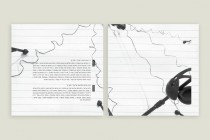
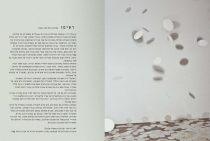
The End of the Landscape, Ilana Zukerman & Sala-manca, CD + Booklet | Sound works by Ilana Zukerman and Sala-manca together with Ilana Zukerman | Desing: Anat Vaknin
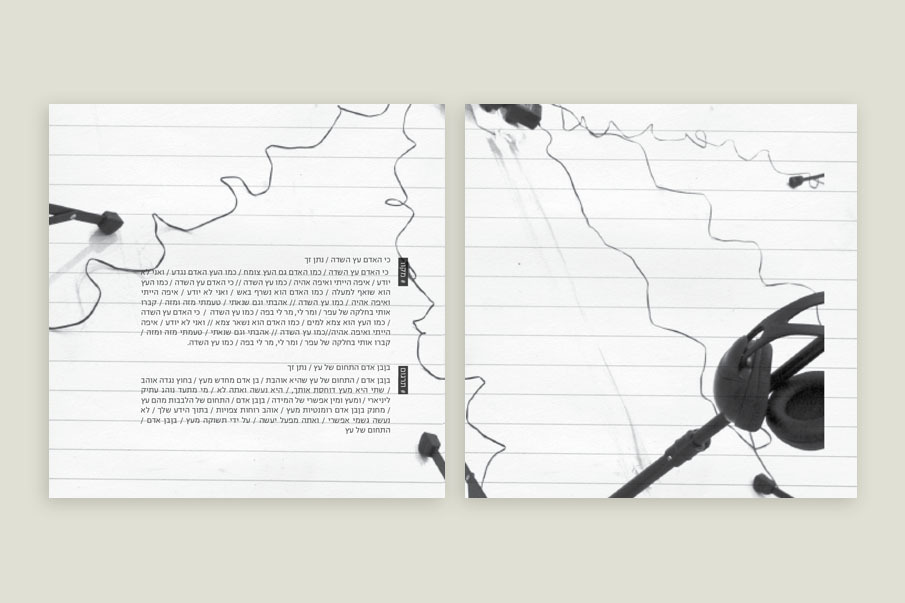
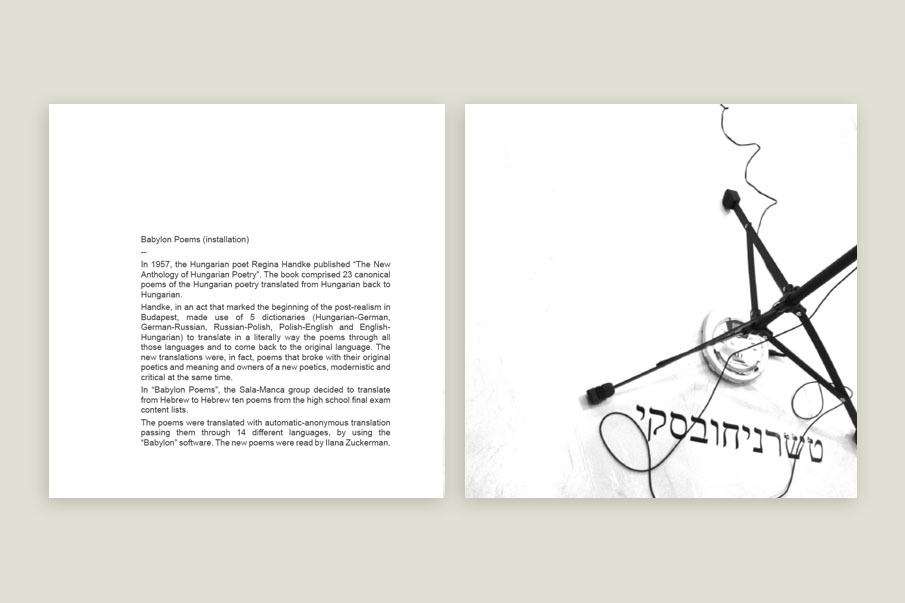
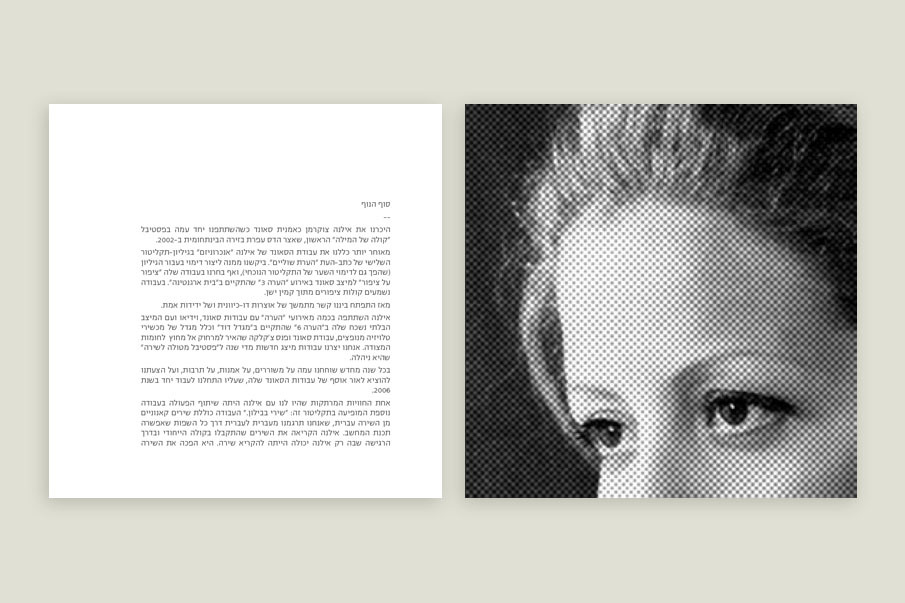
The CD is available at mamuta.org [booklet]
Catalogue of Tamar Shippony’s exhibition “Reshimu” | Curators: Sala-manca | Design: Anat Vaknin
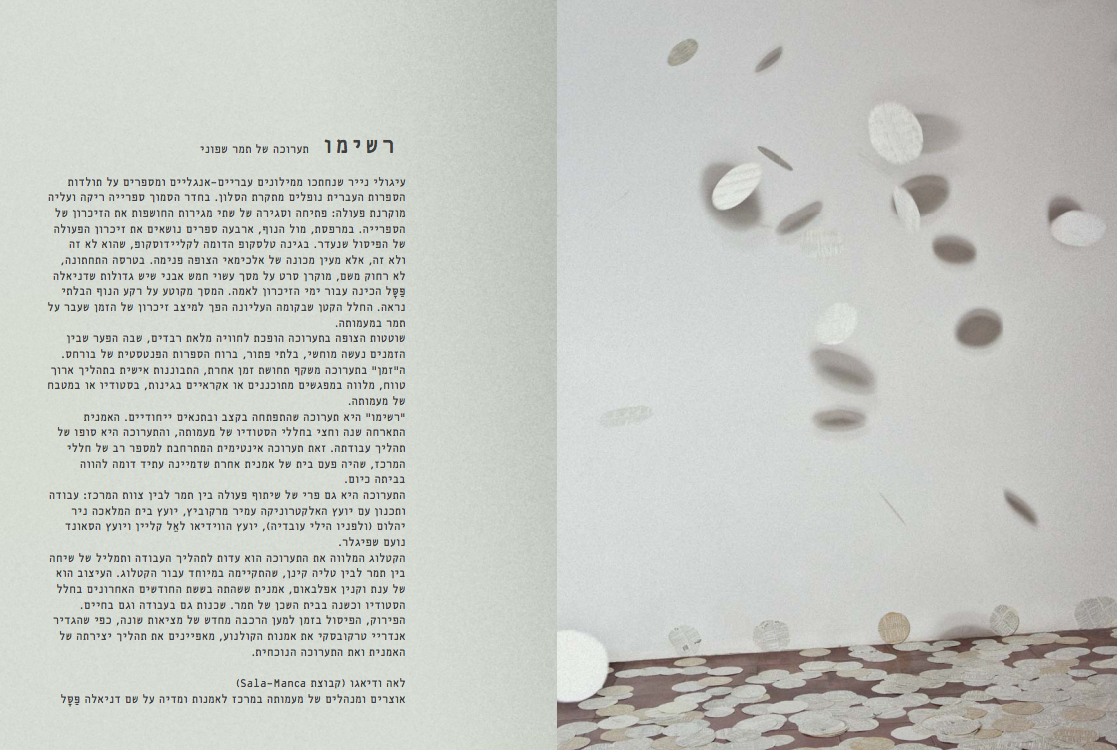
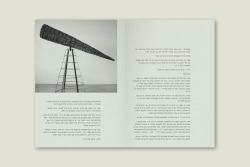
Reshimu is Tamar Shippony’s first solo exhibit, the product of a year and a half of work as a resident artist in the spaces of Mamuta. The exhibit is comprised of sculptural and textual works, a telescope-like sculptural installation in which the viewer becomes viewed, a kinetic installation in which the contents and remains of the books that Shippony sculpted create a new work, and video installations dealing with disassembled time and memory.
The viewer’s experience, strolling in one of the most fascinating houses in Ein Karem, turns into a multi-layered experience, where the time-gap becomes palpable, unresolved, and inviting for more visits.
Curators: Sala-Manca Group
Link to the catalogue (pdf version)
Conversation between Tamar Shippony and Talia Keynan (from Reshimu’s catalogue) [click here]
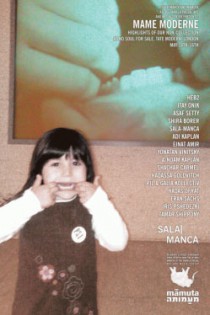
MAME Moderne at No Soul For Sale, Tate Modern
Highlights from our non-collection
Curators: Sala-Manca Collective
Mame Moderne (“Modern Mother” in Yiddish) is the name of the TATE Modern translated literaly and genderly to the Yiddish language (Tate means “Father” in Yiddish). In this salon we show a series of works which don’t belong to us—non-collectors of this non-collection. Maybe a reflection on art habits and rituals, maybe a negative of Museum, maybe a gallery in the local barber shop (or maybe not).
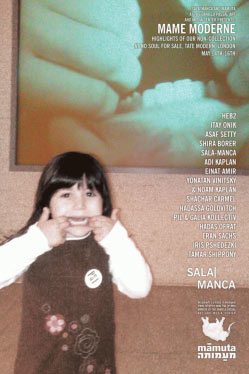
In our 25m2 of Tate Modern we present the Mame Moderne Salon, with its waiting room composed of works presented in different projects curated by Sala-Manca since 2000, dealing (or not) with the topic of Identity Change.
While awaiting the hairdresser to hairdress you watching the process you are passing through in someone else (performance by Shira Borer), you can watch a TV film of a “patriotic” recreation of the myths of the Golem (video by Adi Kaplan, Shahar Carmel, Yonatan Vinitsky, Noam Kaplan, and Etai Onik), hear the story of a Palestinian refugee from Ein Kerem told in the voice of a Jewish-Israeli artist (sound work and performance by Hadas Ofrat), watch a live streaming of barber shops and transformed urban areas in the conflicted Hebron (Heb2-live steaming), see a futuristic film about a post-IKEA society (Pil&Galia Kollectiv) and a still-video work about a sound researcher (Asaf Setty), observe a reflection on cultural treasures and ownership in a video of a film as a metaphor for cultural re-appropriation (Iris Pshedezki) and a woman and a tree that became one and stand alone (Tamar Shipony), hear classical English poetry translated from English into English through Babylon software (Sala-Manca) and foreign workers in Tel Aviv speaking the “holy language” (Eran Sachs) , or buy MAME Moderne t-shirts designed by Einat Amir (einat amir)
On Sunday May 16 at 11:30, a live performance of a love story between an orthodox Jew and a secret agent of the Mossad (Sala-Manca’s live performance at the main stage 2010).
Israelis will Perform at Tate Modern, Eli Armon Azoulay, Haaretz, 3.2010
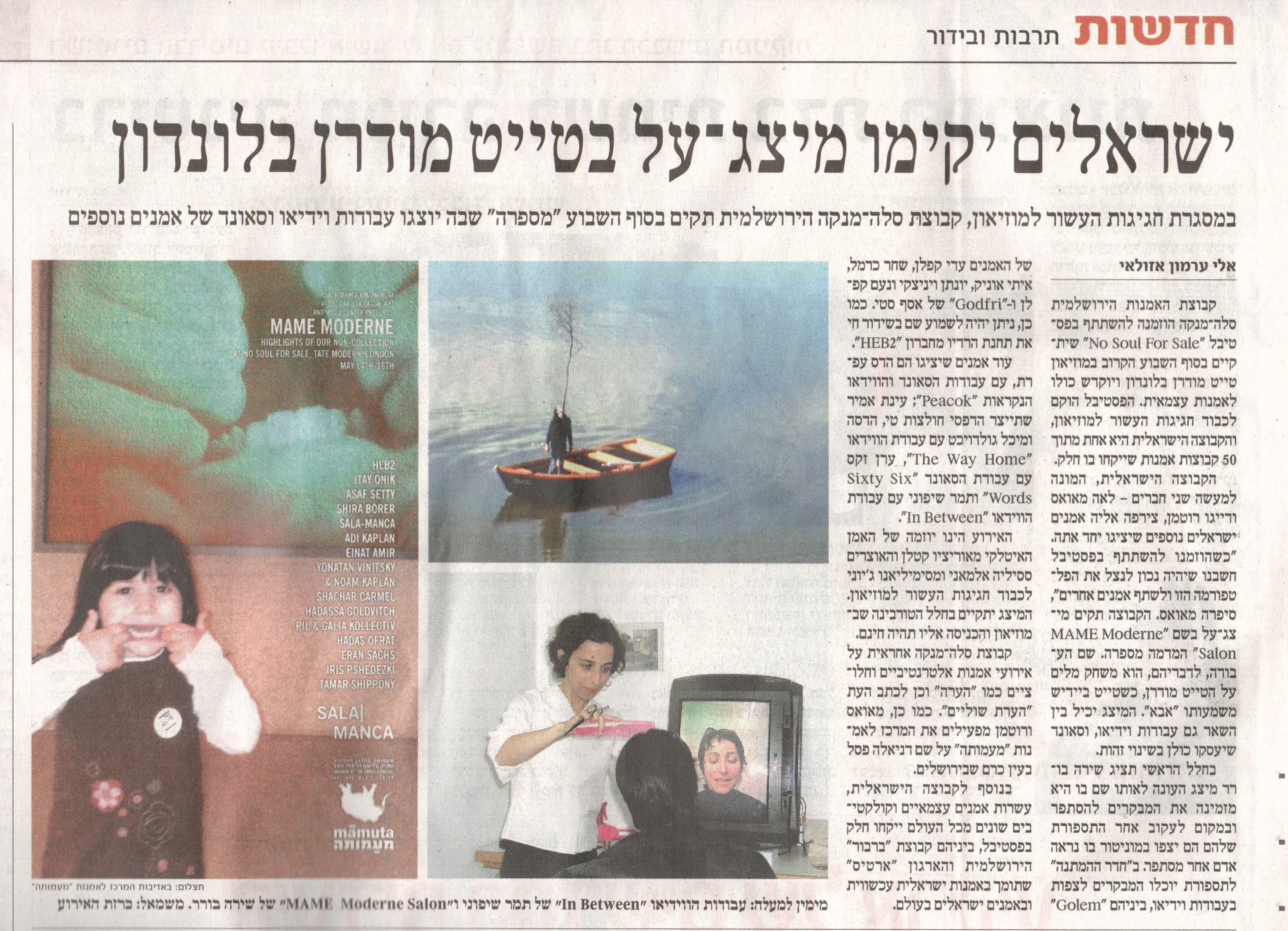
Click to enlarge
Counter-pilgrimage, Yoanatan Amir, Kol Hair, 2.2010
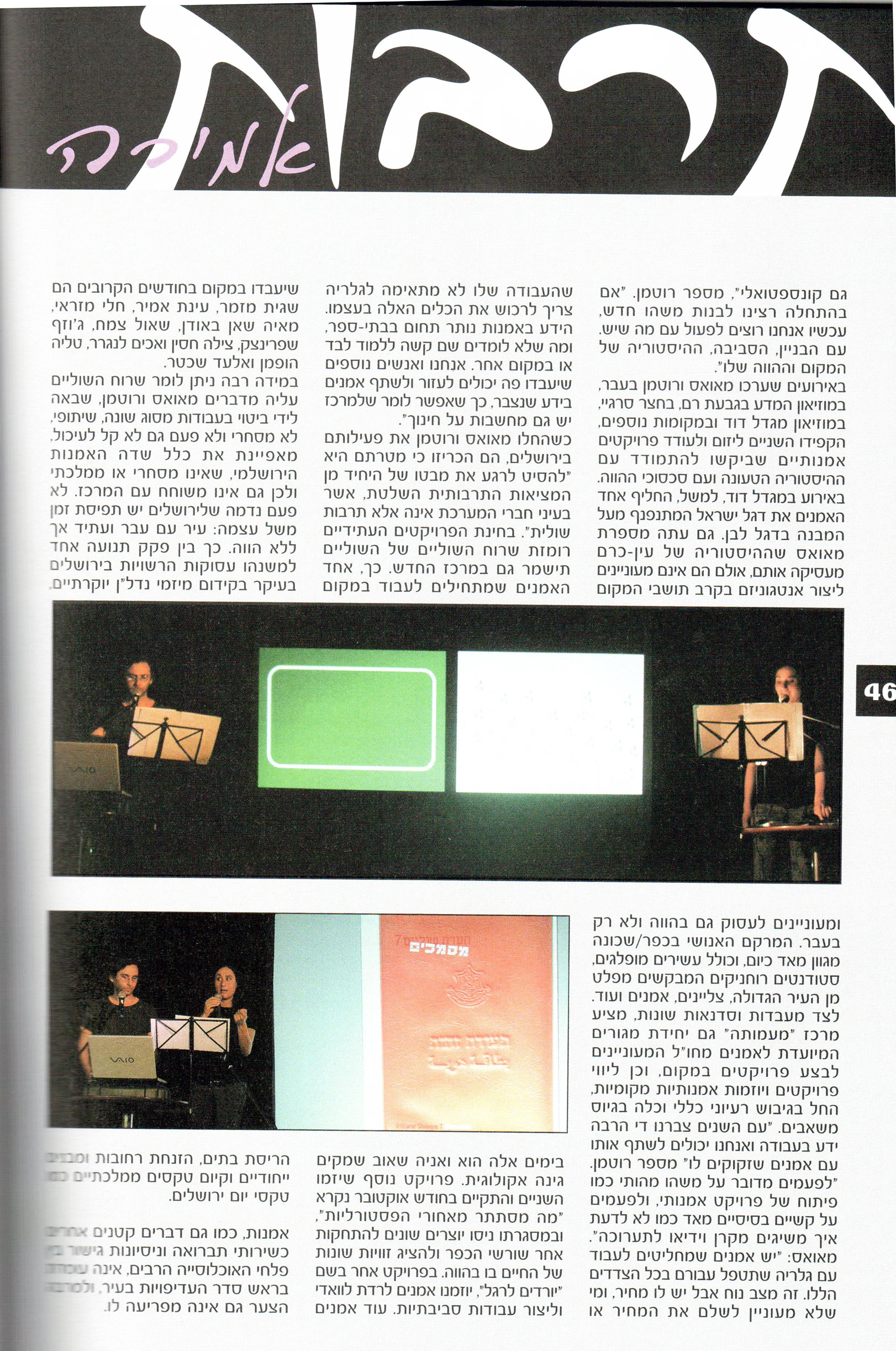
Click the images to enlarge
Diego Rotman, Między Wschodem a Zachodem. Jidysz i performens, CWISZN, 2010
About Yiddish Contemporary Performance, published in Polish in Cwiszn
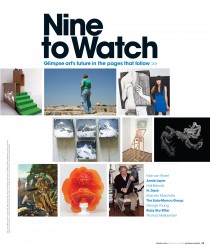
Nine to Watch -A selection of art’s most exciting new talents, Modern Painters, Sarah Douglas, 2009
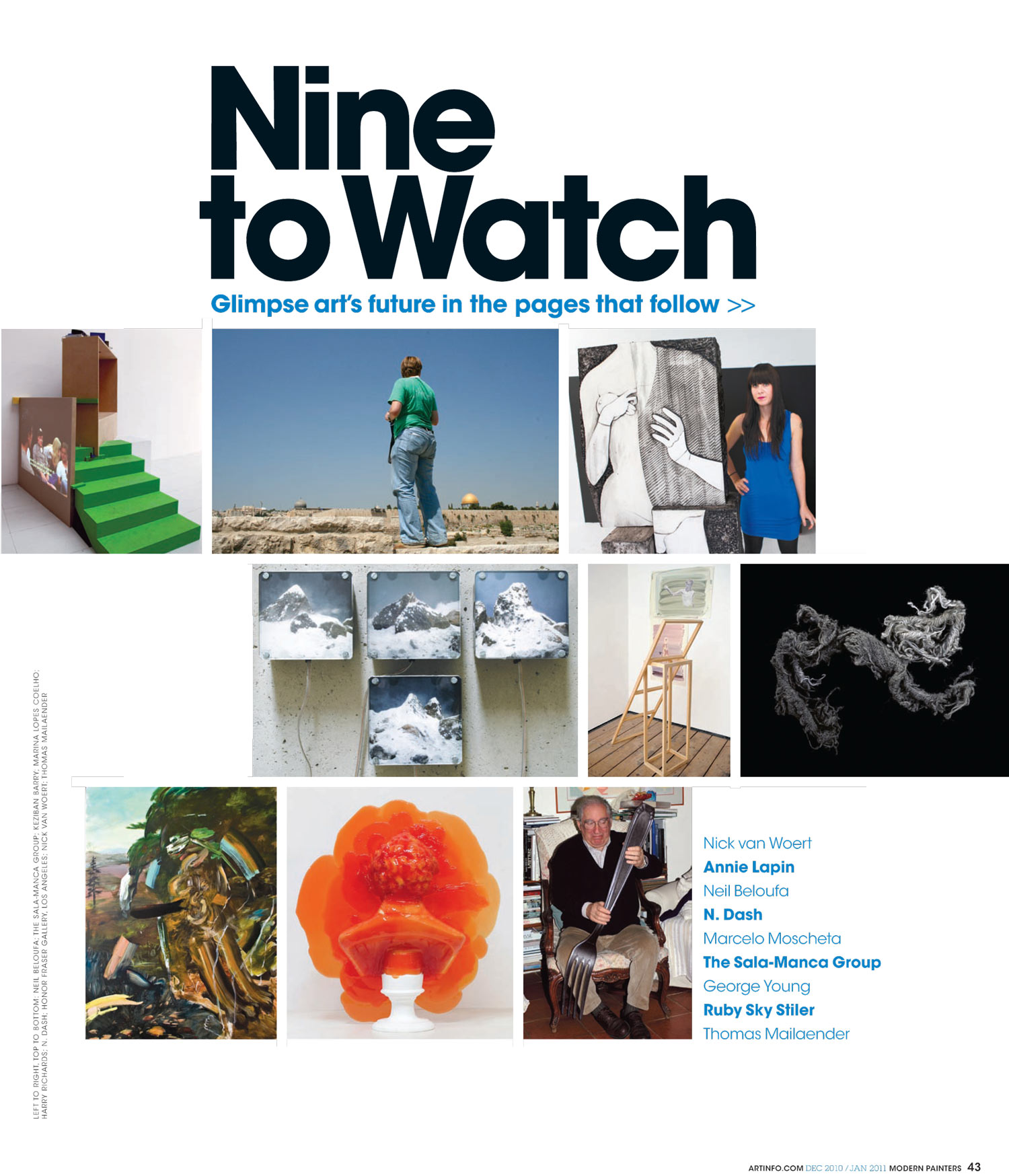
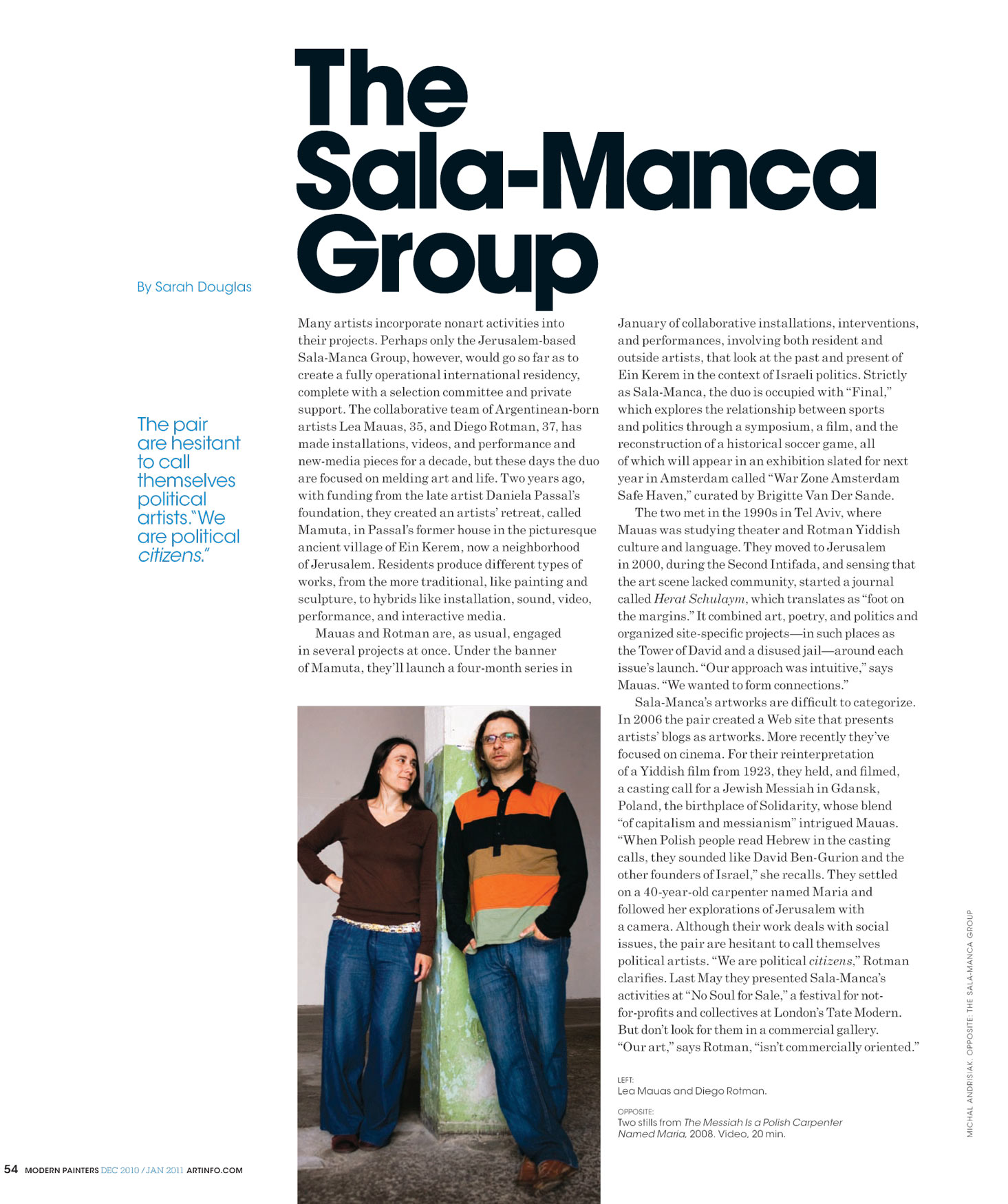
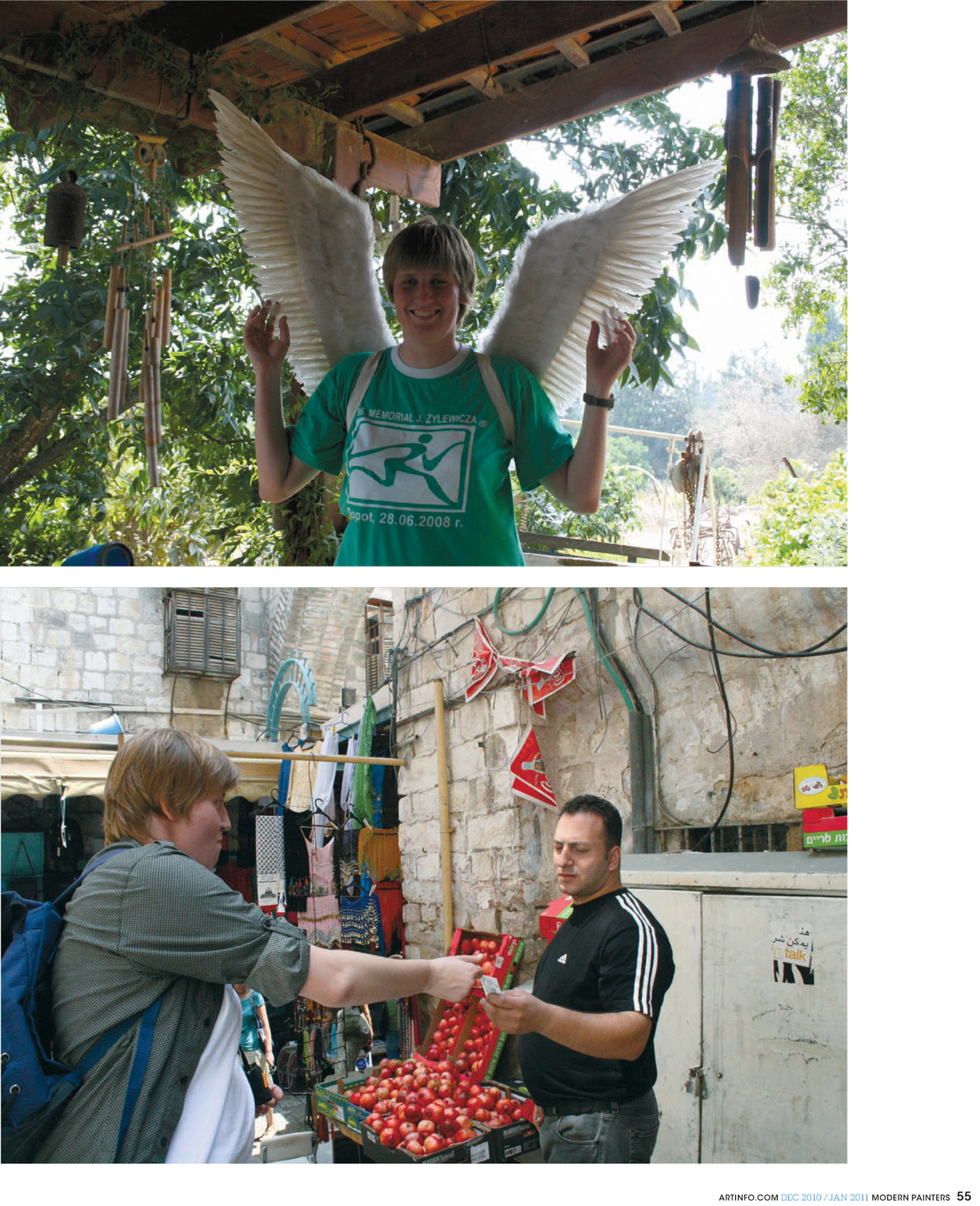
Click to enlarge
What’s Hidden Behind the Pastoral? is an art project in which more than thirty artists present installations, performances, tours, and shows dealing with the past, present, and future of Ein Karem. The project explores the history of the village from biblical times, through its epoch as a Palestinian village, and until its present day as a Jewish neighborhood of West Jerusalem and a primary object of desire for big real-state projects. These are the central themes that the artists deal with at the project. This series of actions examines the place of the pastoral in Israeli art in general and its implications on Ein Karem specifically. The event is also the formal opening to the public of the Mamuta at the Daniela Passal Art and Media Center, which has been operating since February 2009 in the house of the late artist Daniela Passal, thanks to her generosity. Mamuta is a joint project of the Jerusalem Foundation and the Sala-manca group.
Works and projects that will be held and presented at the event:
1 – The presentation of some twenty five actions, media installations, and performances by different artists
2 – Open Source Souvenir Shop Project (OSSS). At the Shop, the public will be able to create souvenirs of the event and of Ein Karem, with free access to some of the images of the artists’ works.
3 – Audio tours of Ein Karem will be offered, creating a new and multi-layered narrative of the village: the visitors are invited to go set out on a hike with a map and an MP3 of guided tours made up of different voices that present the history of Ein Karem from different points of view.
4 – Throughout the event and in real time, three groups—each comprised of a poet, a photographer, a theoretician, an editor, and a graphic designer—will head out on a safari with a personal guide, to collect and create materials. Each group will produce and design its own catalogue for the event. The catalogues will be printed on the site and the public will have the opportunity to choose between the different catalogues—different records of the same event
5 -Friday October 16, from 9:30 to 13:00: Symposium on the curation and creation of art in contested spaces, with the participation of Galit Eilat, Charles Esche and Danna Tagar.
6 – Saturday October 17, from 11:00 to 14:00: Bridge tournament between the local ladies’ team and guests of the event.
Background
The Center’s location demands in our view a treatment of the historical and ideological complexity of the loaded landscape: the landscape of the village of Ein Karem and the village of Ein Karem as landscape.
The central project that guides us at Mamuta, and which gives this lecture its title, is: “What’s Hidden Behind the Pastoral?”
One of Mamuta’s main challenges is its location and history and the need to observe and confront that very same spatial pastorality, which is essentially a window into understanding Israeli reality in the broadest sense. Through “What’s Hidden Behind the Pastoral?” we take a critical look at the geographic and historical space of Ein Karem; we deal with the representation of the landscape and the relationship of the landscape with notions of power and nation; and we explore the connection between art, media, and technology, and the Israeli landscape as an arena for events and critical artistic production in general and in the representation of Israeliness in particular.
According to jewish the tradition, Ein Karem is the ancient Beit HaKarem as recorded in the Bible (Jeremiah 6:1, Nehemia 3:14).According to the Christian tradition, Ein Karem is the birthplace of John the Baptist. In the Byzantine era, churches were built there that are connected to the name of John the Baptist and his family, and to this day Ein Karem is considered a holy place for Christianity and a site of pilgrimage.
In the thirteenth century, the village was conquered by the arabs forces of Omar al-Khatav ,. In the nineteenth century, the village, home to both Christians and Muslims, developed into a site of pilgrimage for Christians from around the world and also a site for the cultivation of olives and the production of olive oil.
In the 1948 war—which ended with Independence for Israel, and catastrophe, or Nakba, for the Palestinians—the village was conquered by Israeli army forces. Most of the residents of the village fled before the army came in, following attacks on neighboring villages . After the property was confiscated, the State began to settle the village with Jewish refugees and immigrants from various countries. A youth agricultural school was established there over the years , and in the 1980s Ein Karem became a central tourist spot in Jerusalem, bringing about a rise in real estate prices and an influx of wealthy residents.
Ein Karem is one of the few Arab villages that was not destroyed by the Israeli army during or after the 1948 war, and it amazingly preserves the pre-1948 architecture of the village.
The history of the village, the history of the representation of the landscape in Israeli art and a criticism on the dominant pastoral perspective in the area in which the Center is located are the central subjects of the long-term project that will occupy us and the center for the coming years,. This project will be comprised of a series of actions, events, exhibits, and performances dealing with the present, the past, and the future of Ein Karem. The project will take place, will be produced and presented at Mamuta and its environs through collaboration with different institutions and neighbors. It is a project in stages, with different stops in which its opening date is known (this October 15-17) but its completion date is unknown.
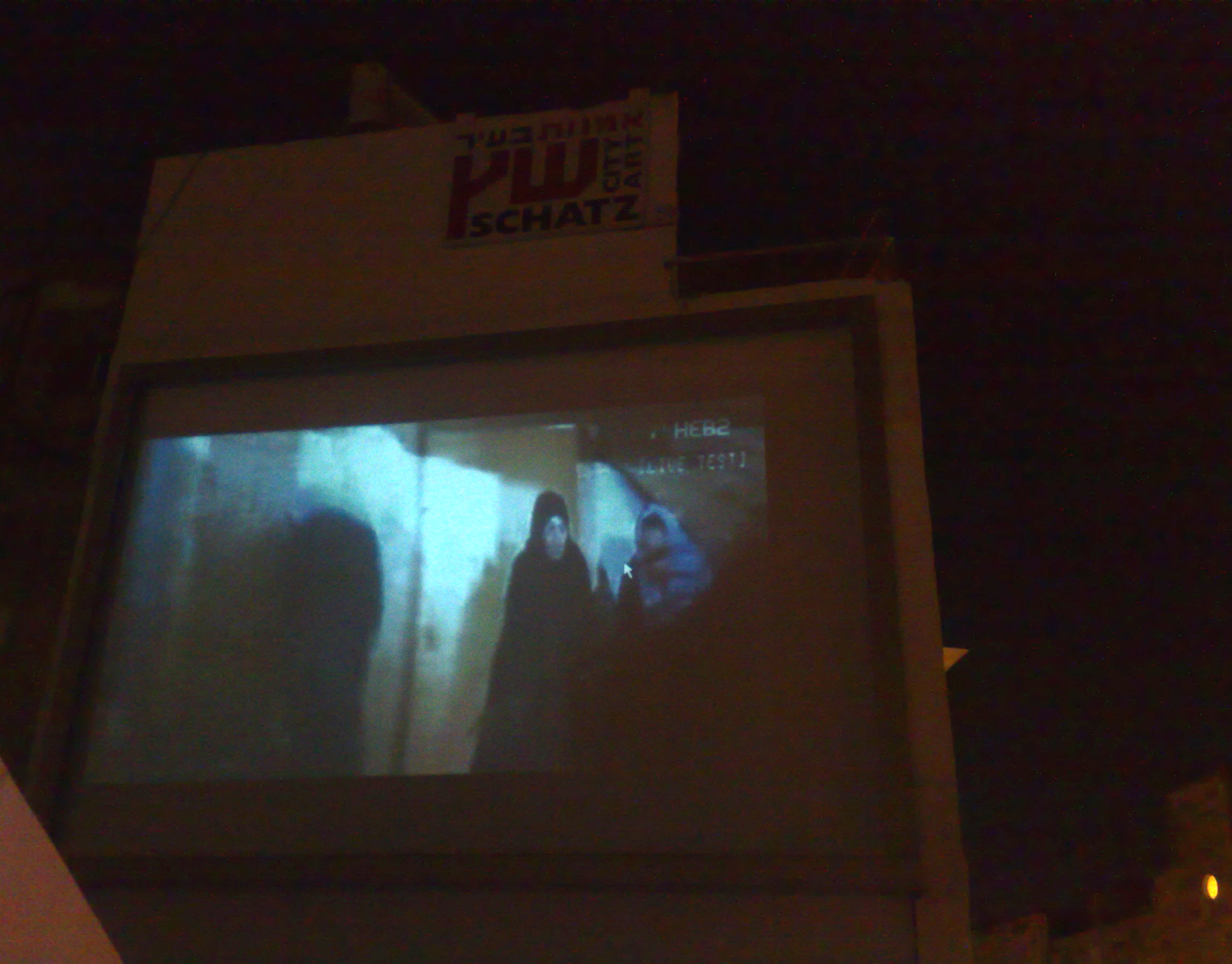
HEB2 at BEZALEL0 | Curators: Sala-manca | 2009 in the frame of Manofim
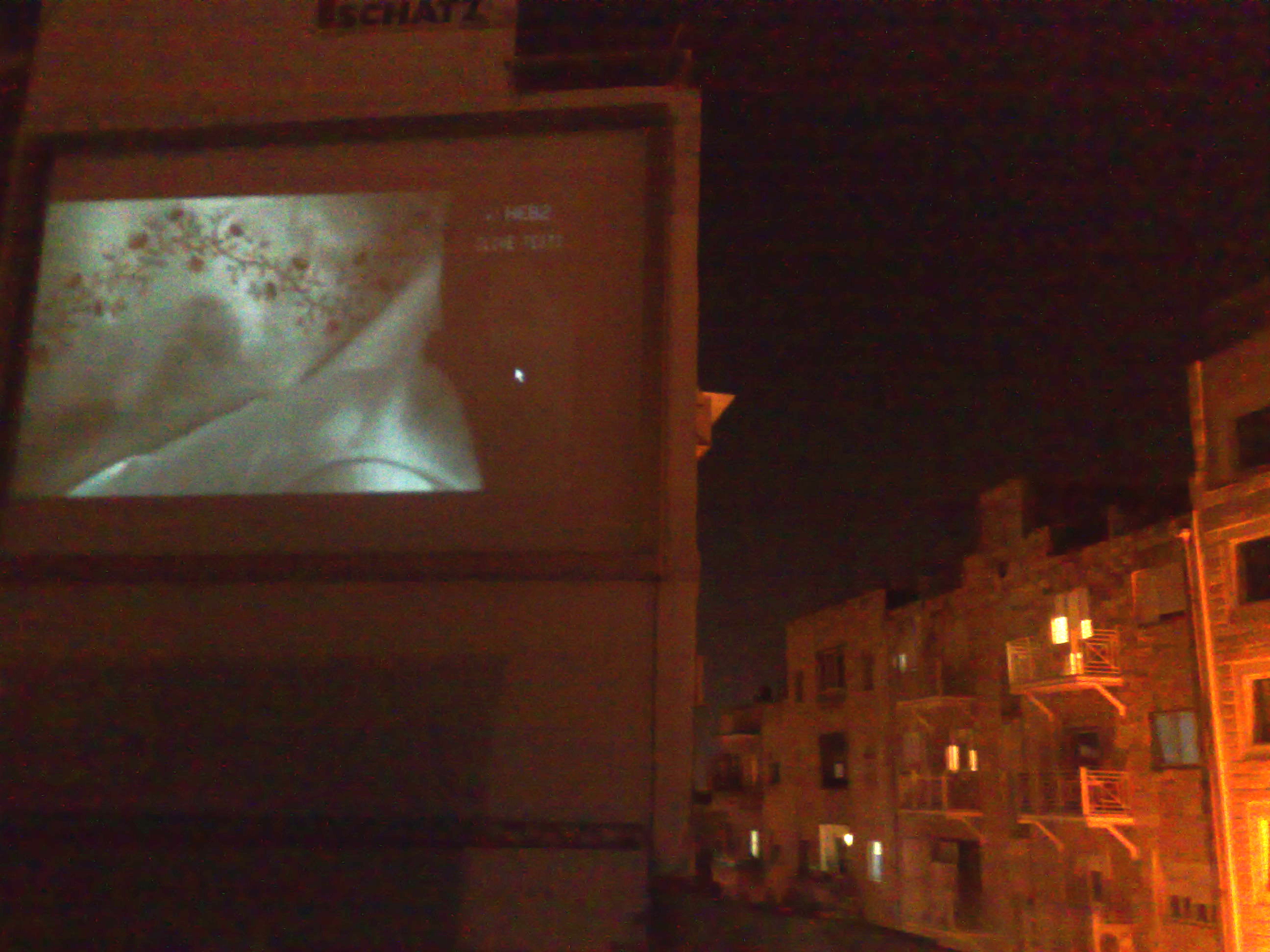
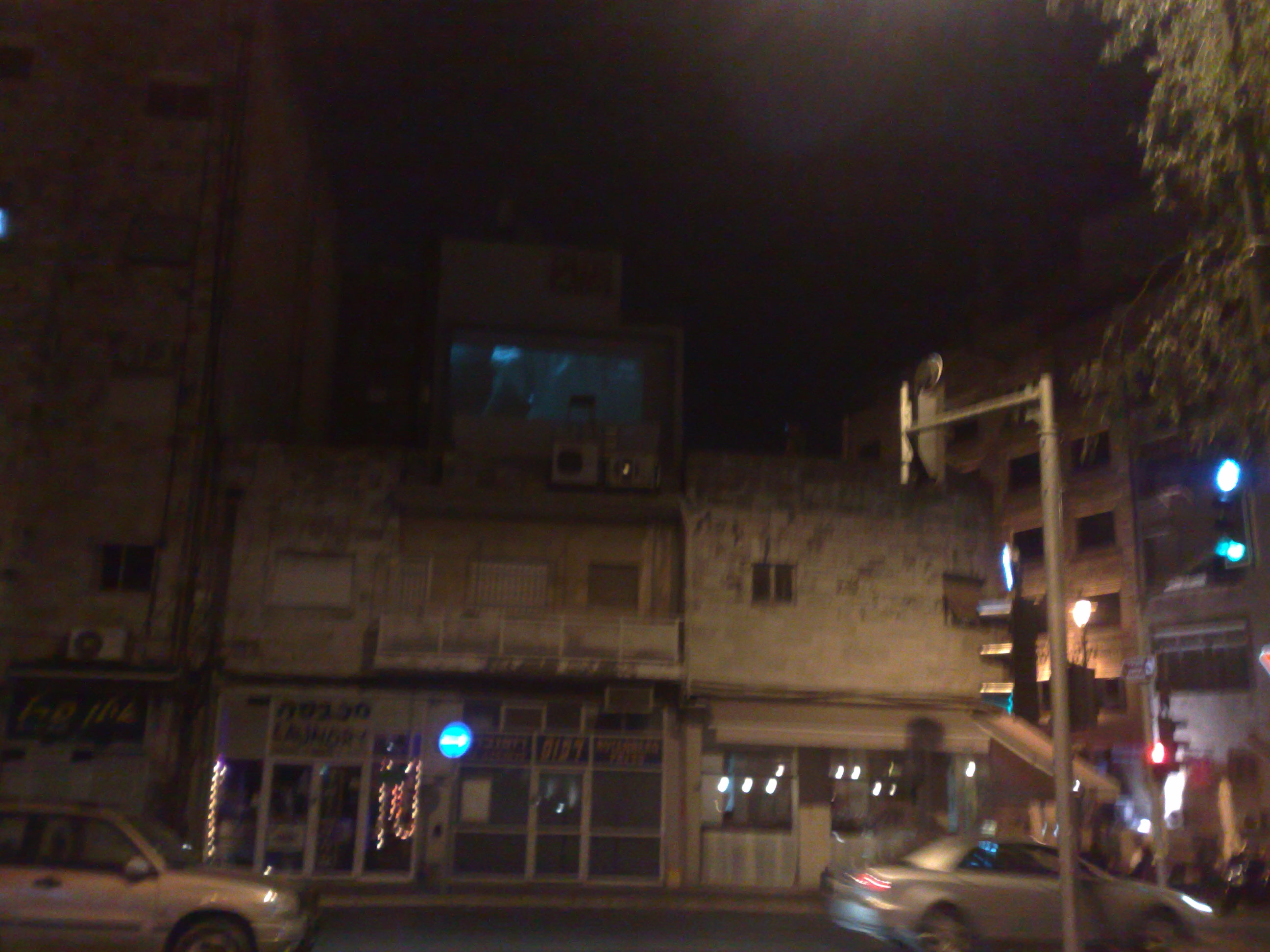
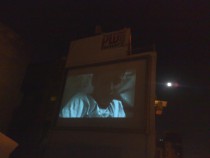
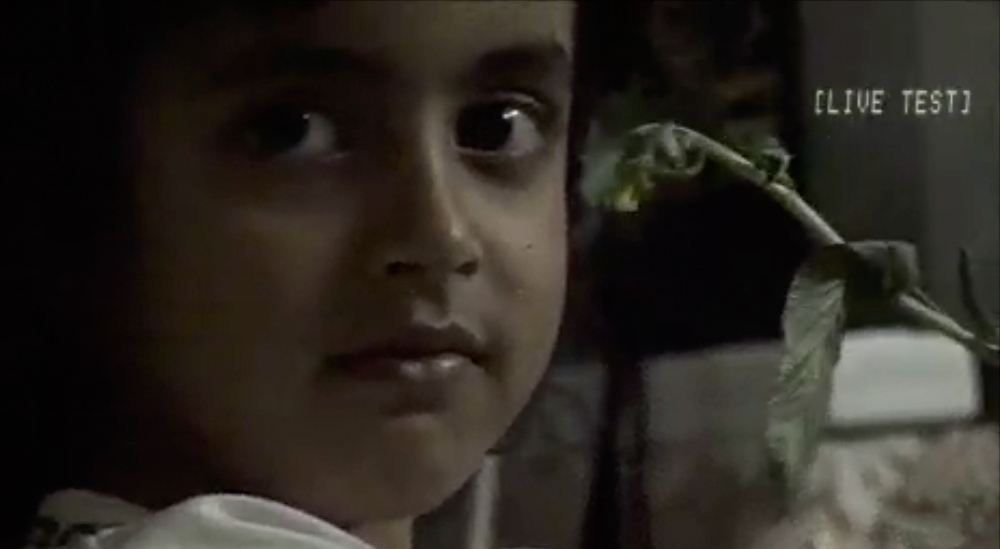
For four nights at the end of summer 2009, a residential building on the corner of Shmuel Hanagid Street and Bezalel Street, across from the historical building of the Bezalel Academy of Art, is transformed into a huge television set and a window into the heart of occupied Hebron. It is a joint project of Mamuta at the Daniel Passal Art & Media Center in Ein Kerem, and HEB2—an experimental documentary video project operating in Hebron.
HEB2 engages with the everyday life of the Palestinian residents of the Israeli-controlled area of the city known as H2. Today, Hebron is the only Palestinian city with Jewish settlements in the heart of its neighborhoods. In order to protect the 600 or so Israeli settlers who live there, the IDF imposes severe restrictions on the Palestinian residents of the area: restricting their movement on the main streets; closing the outdoor market and hundreds of other stores; and subjecting the residents to internal checkpoints, frequent house searches, and regular curfews. What was once a lively commercial center has become a “ghost town.” The Palestinian families that remain in H2 live a life under siege, confined to their houses, under constant military surveillance, and exposed to daily violence by settlers.
This daily reality of those who decided to stay is at the heart of the documentary project. The television station, which broadcasts over the internet from a house on the edge of the Jewish settlement of Tel Rumeida, involves its neighbors not only as documentary subjects but as documenters in their own right, giving them the tools to shoot and edit films about their own lives, from their point of view.
For four nights, four Hebron families host HEB2 to film in their homes following the Ramadan meal. In turn, the footage from Hebron is broadcast live via the internet to the heart of Jerusalem, inviting the West Jerusalem public to witness the lives of the residents of Hebron, to partake of family conversations and of the Ramadan meal, in which families customarily host other families in their private homes. But it is not only this live broadcast that is viewed by the guests. During the family meal, the families and their guests view archival footage on their television sets, material shot by them as participants in the HEB2 project. Thus the public screening on the building captures the private screening in the homes, creating a brief shared viewing experience for those in the houses and those on the street.
“Hospitality” is a central theme in the project. It began with “Manofim”—the opening of the Jerusalem art season—inviting Mamuta at the Daniela Passal Art and Media Center to contribute. We in turn extended the invitation to HEB2, and HEB2 invited the families, and so forth, until this ultimate invitation to the public, calling upon the residents of West Jerusalem to view life in Hebron from the perspective of the Palestinian residents.
The Polish-American artist Krzysztof Wodiczko employed large-scale outdoor projections on historical buildings in order give voice to the individual, to the voiceless. Here, it is a residential building located in West Jerusalem, at the heart of Israeli political discourse, that gives voice to the Palestinian residents of Hebron who are searching for an alternative way to convey their experience. The creators are also the object of filming as their immediate surroundings and daily lives are broadcast live. This tension between “live“ and “not-live”, another central theme of the project, is an attempt to give a platform to a more sensitive kind of documentation and observation, an alternative to that which is presented in the mainstream media and which is familiar to Israeli audiences.
The screening transforms television- and internet-viewing, normally an intimate and private experience, into a public viewing experience, an opportunity to get to know the lives of the residents of Hebron from the inside. The event does not aim to be an idyllic or utopian encounter, but rather to give public exposure to images from the lives of the neighbors as they are created by themselves.
As an intervention in the urban space, the projections transplant a slice of landscape and life from another place into the path of Jerusalemites wandering in the center of their city. These can catch a glimpse and become acquainted not only with the Palestinian families in Hebron, but with the unique and fascinating artistic and social endeavors taking place in H2 under the direction of Michael Zupraner and Issa Amaro. Urban zapping, as defined by Prof. Wakolinchuk.
As in the first screenings of the Lumière Brothers, we are looking forward to the screenings, not so much because of their technological innovation as because of the opportunity for a meeting in real time in an era when lies still rule.
Lea and Diego – Sala-Manca Group
Mamuta at the Daniela Passal Art and Media Center
Statement by the directors of HEB2.TV
This project is defined as “community television,” but in a way that is a misleading term. Local TV stations are meant for local consumption, while HEB2—despite the way in which it presents itself—is aimed at an external audience. The residents of H2 in Hebron are well aware of daily life in their area. But only rarely does this reality make its way into Israeli or international living rooms. The mainstream media, in general, does not succeed in describing what goes on in the Territories. The coverage is simplistic, superficial, and sporadic. Whether due to intentional policy or simply the limitations of the medium, the Occupation is not televised.
HEB2’s response is to try and realize television’s potential as a tool for public enlightenment. I define it an experimental project because I see in it a search for alternative ways of documenting realities like that of Hebron. How would television look if it dealt exclusively with the Occupation? And how would this reality be broadcast, if it were up to the occupied (and the occupier)? The difference, as I said, has to do with point of view and degree of proximity. The choice is to place the point of view of the viewer as close as possible to that of the citizen, of the local inhabitant, who is generally only the object of documentation—to bring the viewer into daily life in the thick of the conflict, instead of presenting him with broad political events.
The project is also, despite it all, a social experiment within the community that it documents. More than just a tool for raising consciousness, HEB2 grants its videographers a tangible tool for self-expression, both political and artistic. In many cases, the very presence of the camera deters soldiers and settlers from aggression towards the Palestinian residents. They also encourage cooperation within the community and strengthen solidarity between neighbors. Thus, HEB2 exposes television’s potential, not only for documentation but for protection, cooperation, and empowerment.
Michael Zupraner, HEB2
Press: Click
Sound stretched to the limit – Cacophony and multiculturalism come together in a joint Polish-Israeli work featured in Tel Aviv’s centennial celebrations, Haaretz, Ayelet Dekel, 11.3.2009
If You Listen, Ayelet Dekel, Midnigh East
There is no borderline, yet the demarcation between north and south Tel Aviv is clear. Concert halls, hummers and penthouses to the north, central bus station, markets and bicycles to the south. International Festivals don’t usually select venues in south Tel Aviv.
However, Contempo, the Tel Aviv International Festival of Contemporary Music and Video Art, ushered in the approaching centennial celebrations with events that extended throughout the city from a video art exhibition at the Tel Aviv Museum to a sound installation at Zimmer, a former air-conditioner factory turned studio on HaGdud HaIvri, a small street not far from the central bus station.
“If You Speak It, It’s No Legend”, a sound installation that took place at Zimmer from February 26 – 28th, was the result of a multi-lingual, international collaborative effort co-curated by Antoni Beksiak of the Turning Sounds Society in Warsaw and Lea Mauas and Diego Rotman of Sala-Manca in Jerusalem (co-organized by the Adam Mickiewicz Institute as part of the Polish Year in Israel). Zimmer does not announce itself loudly to the world. Its large front window is usually closed off with a metal rolling shutter. A small sign with the words “Zimmer Family” written in magic marker is taped to the wooden door, as if it were just another low-rent apartment.
On this rain-soaked Friday the window was open to the street and a large free-standing poster placed by the door announced the event. Entering a tiny kitchen, a step up to the left leads into an average size room with two mismatched rugs, a sofa, and chairs of all sorts arranged around the four walls. Books, tapes and video cassettes fill the bookshelves up to the top where a sophisticated system of six loudspeakers was strategically arranged for the installation.
Sitting in the dark winter warmth, I let myself listen. Rain, car wheels, footsteps and voices from the street merged with the sounds from the loudspeakers and did not feel like a disruption. A sound installation creates a relationship between time, sound and space. Everything that happens in the space becomes somehow part of the experience: taking coins out of a purse, whispered conversations, the closing of an umbrella. It requires a certain willingness to immerse oneself in anything that may happen.
The installation was created by sound artists XV Parowek, Wolfram, Eran Sachs and 17 Migs of Spring, each working separately; the different tracks combined by Beksiak to form a sequence in which short segments from each piece appear in rotating order. The compositions were based on recordings of foreign workers at the central bus station in Tel Aviv reading from a list of words in Hebrew, using the human voice in its different colors and timbres as “pure material for music” according to Beksiak. He explained that while his original inspiration had been the Biblical concept of “Shibboleth” (from Judges 12:5-6) –the revelation of identity through one’s manner of pronouncing words, he gave the composers complete freedom and the end result was very different from what he had imagined, “but that is where the fun begins,” he said.
 Beksiak originally had in mind a focus on the revival of the ancient Hebrew language by immigrants who arrived in Israel from all corners of the world, each bringing his or her native language to the way they expressed themselves in Hebrew. Sala-Manca’s Mauas and Rotman extended this idea to reflect the linguistic and social context of contemporary Israel and in particular Tel Aviv, where many foreign workers and refugees live and work. People for whom Hebrew is a necessity rather than an ideology, foreign workers “are not considered part of Israeli culture,” says Mauas.
The human voice exerts a compelling power. Research into language development in infants shows the importance of exposure to speech and the intensity of the infant’s response to the human voice. The boundaries between sounds in language, such as the difference between “b” and “p”, depend on very subtle changes in duration and frequency. Infants are born with the ability to sense these acoustic changes, even in languages they have never heard, yet this ability diminishes drastically in the first year of life. Dr. Patricia K. Kuhl, an expert on speech development at Washington University, claims that infants have the ability to analyze the statistical distribution of sounds that they hear in ambient language and by the end of their first year learn to reduce their response to sounds that do not belong to their native language. The distinctions between what does and does not belong are made very early in life, literally shaping our minds as neural connections are created.
Immigrants, foreign workers and refugees are linguistic outsiders, living within the context of a language that will always remain somewhat foreign. Linguistically and culturally, these outsiders have the potential to enhance and revitalize their surroundings as elements of their home cultures and languages are integrated over time, yet this potential is not always realized.
“All in all we are very detached,” said Albert Aviad, a musician and student of linguistics who together with Binya Reches made the recordings of the participants for the installation, “there is no melting pot – we don’t really encounter one another.” Mauas and Rotman attempted to engage the foreign workers whose voices were recorded as partners in the project, paying them for their time and choosing locations for both the recording and installation that would be as convenient and non-threatening as possible. Although the atmosphere during the recording sessions was relaxed and friendly, Mauas felt that the language barrier made real communication difficult.
Seeking to “introduce a voice from outside the canon”, Mauas and Rotman recorded 28 foreign workers reading words in Hebrew that were chosen from a Hebrew language textbook published in 1960. Rotman felt that the sound of these voices would “acquire a political dimension in the context of a contemporary music festival”. The words chosen were written in the flyleaf of the book by a previous owner, Dr. Edward Horowitz, the author of How the Hebrew Language Grew. The interviewers engaged the participants in conversations in an attempt to record as much Hebrew as possible. The sound artists were each given both sets of recordings to work with.
Konstantin Gervis and Natalia Gurfinkel, who create together as 17 Migs of Spring, worked only with the recorded voices, without adding other sound or instruments. As immigrants themselves and working in a very experimental form of music, Gervis says that for many years they had felt like “emissaries of a different culture from that which is here in Israel” but that today they feel very much a part of the local scene, adding, “who has changed, us or the country?” Gervis took phrases that he liked from the recordings to work with, but later noticed that some of the phrases were not in Hebrew, and therefore could not be used in the context of this project. “I use three languages interchangeably,” he explained, “and don’t really distinguish between them.”
Composer Bartek Kalinka, whose group name XV Parówek means “15 hot dogs” in Polish, played the accordion as a child, but otherwise does not have a formal background in music and is somewhat outside the mainstream. “Humor helps me keep a distance from myself,” he says in reference to the unusual name. Working with the phonetic qualities of the words, he also added some non-instrumental sounds and accordion. “I’m trying “to keep the composition very minimal, with a lot of silence and space.”
Eran Sachs, while also working with the phonetic elements, approached the project from a perspective of social-theoretical critique, making additional recordings in the neighborhood of Neve Sha’anan (surrounding the central bus station) and researching the history of the area. “There is something in the act of collecting,” he says, “that gives credence to the work…that connects the listener too…to a moment that existed…what interests me when I work with recorded materials is to preserve traces that will locate the experience of the listener in a specific realm.” His research on Neve Sha’anan, based in part on Sharon Rotbard’s White City, Black City (published in Hebrew, Babel 2005) led him to the conclusion that the neighborhood has always been characterized by ethnic diversity and has always been excluded from the main narrative in Tel Aviv’s development as a city. Established by a group of Jews, who had been driven out of Jaffa in 1921, who wished to create a self-sustaining, ethnically and socio-economically diverse community, the neighborhood never received the support of the establishment. Sachs said that the current concentration of foreign workers in the area creates “a cosmopolitan area…tensions between groups exist, but they are contained.”
Researching the phonology to learn about the acoustic characteristics of language, Sachs experimented with taking the same work spoken by different people in different accents and manipulating the sound to either bring the words closer together or increase the phonetic distance. In this sense, his work was closest to Beksiaks’s original concept. Working with a computer program that enables him to remove layers of sound from an utterance, leaving only a trace, Sachs sought to create a ghostly presence of sound in the composition, an allusive, elusive connection to a particular time and place.
When I returned to Zimmer on Saturday night, as the installation drew to a close, the room was full of people actively engaged in listening. Soon, food and drinks would be set out for a celebratory end to the weekend’s event. Closing remarks would be said and the murmurs of everyday conversations would fill the space. Yet in that space other voices were heard, and their presence remains.
A different version of this article was published in Haaretz.
Image credit: Dror Katz